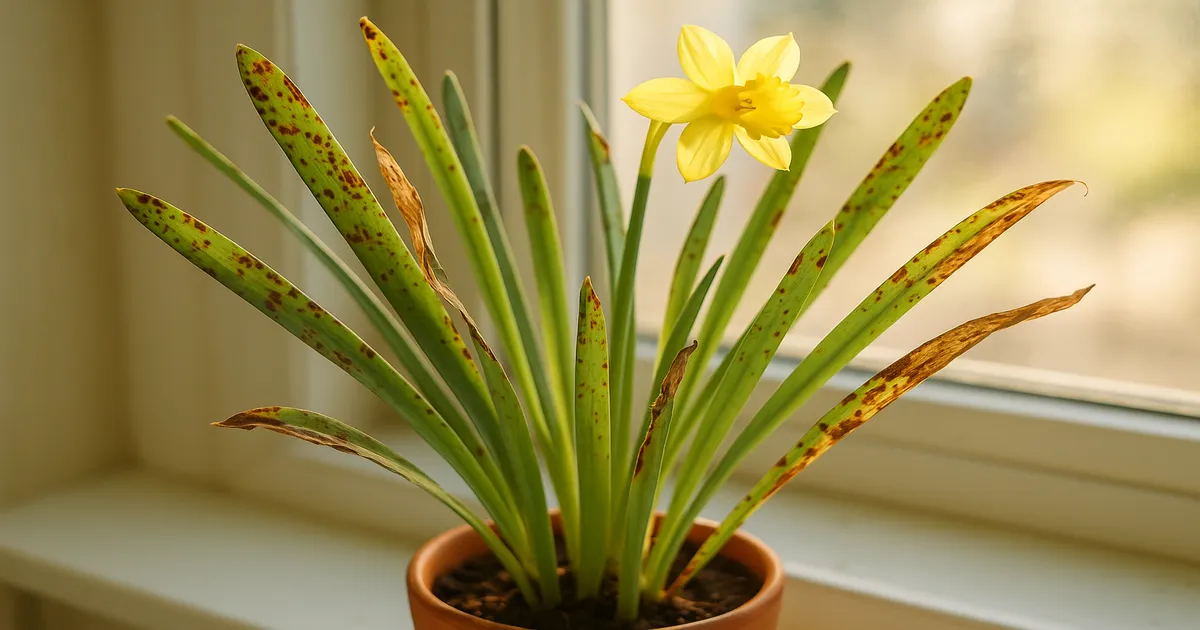
Quick Answer: Brown spots on daffodils are most commonly caused by fungal diseases like narcissus leaf scorch or Botrytis smoulder, but environmental stress (frost, sunscald, fertilizer burn), bacterial soft rot, bulb fly damage, and nutrient deficiencies can all produce similar symptoms. The location, texture, smell, and pattern of the spots are your fastest diagnostic tools — and most cases are treatable once you’ve identified the cause.
So you’ve spotted brown patches on your daffodils and you’re wondering what went wrong. You’re not alone — “what are these brown spots on daffodils?” is one of the most common spring gardening questions, and the answer isn’t always simple. Daffodils are tougher than most bulbs. The lycorine alkaloids in their tissue deter the majority of pests and pathogens. But “more resistant” doesn’t mean immune, and under the wrong conditions — a cold wet spring, waterlogged soil, or a late frost — even a healthy planting can develop brown spots fast.
The good news: once you know what you’re looking at, fixing it is usually straightforward.
What Are These Brown Spots on Daffodils? The Main Causes
There are nine main reasons daffodil leaves, stems, or flowers develop brown spots:
- Narcissus leaf scorch (Stagonospora curtisii) — fungal, starts at leaf tips
- Narcissus smoulder (Botrytis narcissicola) — fungal, gray fuzzy mold in cool wet weather
- Other fungal leaf spots (Ramularia, Didymellina) — circular spots with yellow halos
- Bacterial soft rot (Pectobacterium carotovorum) — mushy, foul-smelling base rot
- Frost damage — uniform browning across the entire bed after a cold snap
- Sunscald — bleached, papery patches on the sun-facing side of leaves
- Fertilizer burn — scorched tips shortly after feeding
- Nutrient deficiency — tip burn (potassium) or scattered spots (calcium)
- Narcissus bulb fly — base browning with a weak, stunted plant above ground
Use Spot Location as Your First Diagnostic Clue
Before you reach for any treatment, look at where the spots appear. Tip damage points toward leaf scorch, frost, or potassium deficiency. Base browning suggests bacterial rot or bulb fly. Spots on only one side of the leaf? That’s sunscald. Uniform browning across every plant simultaneously after a cold night? Almost certainly frost. Location narrows your diagnosis faster than any other single factor.
Identifying Brown Spots on Daffodils: A Visual Guide
Spots at Leaf Tips and Margins
Reddish-brown or chocolate-brown discoloration starting at the tip and working down the leaf is the classic sign of narcissus leaf scorch. Potassium deficiency and frost damage can look similar, so check whether the browning appeared gradually over several days (fungal or nutrient) or overnight after a cold event (frost).
Water-Soaked or Mushy Spots with Odour
Soft tissue that smells unpleasant points to bacterial soft rot, not a fungus. The foul odor is the definitive clue. Fungal spots are firm and dry by comparison.
Circular or Oval Spots with Yellow Halos
Geometrically defined spots with a darker brown border and a yellow halo suggest secondary fungal pathogens like Ramularia or Didymellina. These are more visually tidy than the irregular streaking of leaf scorch — think polka dots rather than brushstrokes.
Bleached, Papery Patches on One Side of the Leaf
Dry, tan-colored patches affecting only the sun-facing surface of the leaf are sunscald. The asymmetry is the giveaway — pathogens don’t pick sides.
Uniform Browning Across the Entire Planting
When every plant in the bed browns at the tips simultaneously, especially after a cold night, frost damage is almost always the cause. A fungal outbreak spreads progressively; frost hits everything at once.
Fungal Diseases: The Most Common Cause of Brown Spots
Narcissus Leaf Scorch (Stagonospora curtisii)
This is the single most frequent cause of brown spots on daffodils. The fungus overwinters in infected bulb scales and soil debris, which is why symptoms often appear as leaves first emerge — the infection was already present underground. Spores spread by rain splash and overhead irrigation, producing reddish-brown to chocolate-brown streaks running from the leaf tip downward.
Wet springs are the trigger. Once you see symptoms, the infection for that season is already underway, so focus on limiting spread rather than reversing damage.
Narcissus Smoulder (Botrytis narcissicola)
Unlike Botrytis cinerea, which attacks a wide range of plants, Botrytis narcissicola is host-specific to Narcissus — it won’t spread to your roses or tomatoes. It thrives in cool, humid conditions, with optimal sporulation at 59–68°F (15–20°C) and relative humidity above 90%. The diagnostic signature is a gray fuzzy layer of mold over water-soaked brown lesions on leaves and stems.
The fungus produces sclerotia — small, hardened survival structures — that persist in soil for multiple seasons. That’s why end-of-season sanitation matters so much.
Other Fungal Leaf Spot Pathogens (Ramularia, Didymellina)
These secondary pathogens colonize stressed or wounded tissue rather than attacking healthy plants outright. Leaf surfaces need to stay wet for at least four hours for spores to germinate, and both fungi are most active between 50–77°F (10–25°C). The resulting spots are more circular and defined than the streaky damage of leaf scorch.
Abiotic Causes: Weather and Environmental Stress
Frost Damage
When temperatures drop below 28°F (-2°C) after daffodil foliage has emerged, intracellular ice crystals rupture cell membranes. As the tissue thaws, it collapses into a water-soaked mess that quickly turns brown. Flower buds are more sensitive than mature leaves, so you may lose blooms even when foliage survives. Frost damage is not contagious — no treatment of the soil is needed.
Sunscald
Sunscald occurs when intense direct sun photo-oxidizes chloroplasts in the leaf’s epidermal cells. It’s most common in late spring when temperatures spike before foliage has fully hardened. Damage is always asymmetrical, affecting only the sun-facing side. Water droplets sitting on the waxy leaf surface can intensify the effect by acting as tiny lenses.
Fertilizer Burn
Over-application of synthetic fertilizer floods the soil with soluble salts, creating an osmotic imbalance that pulls water out of root cells — effectively causing drought stress even in moist soil. The result looks like tip burn and appears within days of feeding. If you can correlate the browning with a recent application, you’ve found your culprit.
Bacterial Rot and Pest Damage at the Leaf Base
Bacterial Soft Rot (Pectobacterium carotovorum)
This bacterium produces enzymes that dissolve plant cell walls, turning solid tissue into mush. It enters through wounds, insect feeding sites, or waterlogged roots, and is most active in warm, wet soil above 68°F (20°C). The clues are unmistakable: soft, collapsing tissue at the leaf base with a distinctly foul odor. No fungal disease smells like this. There’s no curative bactericide available to home gardeners, so prevention through good drainage is everything.
Narcissus Bulb Fly
The large narcissus bulb fly (Merodon equestris) lays eggs near the bulb neck in late spring. Larvae tunnel into the bulb, destroying internal tissue, and secondary bacterial and fungal infections follow — producing the brown discoloration you see at the leaf base. Affected plants look weak, stunted, and generally sorry for themselves.
If you suspect bulb fly, dig up one affected plant. A cream-colored larva up to 18mm long inside a hollowed, foul-smelling bulb confirms the diagnosis. Daffodils’ alkaloid content deters most pests, but it offers no protection against bulb flies.
Nutrient Deficiencies That Cause Brown Spotting
Potassium deficiency causes tip burn at leaf margins. Potassium regulates stomatal opening and cell turgor; when it’s short, leaf edges lose moisture faster than the plant can replace it. This is most common in sandy soils or where pH has drifted below 5.5 or above 7.5.
Calcium deficiency produces scattered, irregular brown spots on younger leaves — quite different from the tip-down progression of potassium deficiency. Calcium is immobile within the plant and can’t be redistributed from older tissue. Even when soil calcium is adequate, poor transpiration caused by high humidity or stagnant air limits uptake.
When soil pH drifts outside the 6.0–7.0 range, nutrients become chemically unavailable even if they’re physically present. A simple soil test is the only reliable way to confirm a nutrient problem. Nutrient symptoms also tend to be bilateral and symmetrical, appearing the same on both sides of the leaf — which helps separate them from the asymmetrical damage of sunscald or the irregular patterns of fungal disease.
How to Treat Brown Spots on Daffodils
Fungal Diseases
Remove all visibly infected foliage immediately. Bag it for municipal waste — not the compost heap. Apply a copper-based fungicide at 7–14 day intervals during wet weather; a ready-to-spray copper hydroxide product like Bonide Copper Fungicide works well for most home gardeners. For Botrytis smoulder specifically, a systemic fungicide containing thiophanate-methyl provides better curative action than contact sprays. Switch from overhead watering to drip irrigation or soaker hoses, and divide overcrowded clumps every 3–5 years to improve air circulation.
Bacterial Soft Rot
Remove affected plants along with the surrounding soil in a roughly 6-inch radius, and don’t replant Narcissus in that spot for 2–3 years. Then address the root cause: improve drainage by amending the bed with perlite at 20–30% by volume. There is no cure once a plant is infected.
Abiotic Stress
- Sunscald: Move container plants to bright indirect light during afternoon heat. For in-ground plants, a 30–40% shade cloth during heat waves above 80°F (27°C) helps. Never water foliage in the middle of a sunny day.
- Frost: Cover emerging foliage with horticultural fleece when temperatures below 28°F (-2°C) are forecast. After damage occurs, leave browned tissue in place until all frost risk has passed — cutting it back stimulates tender new growth that’s even more vulnerable.
- Fertilizer burn: Flush the soil deeply with water to leach excess salts, then withhold all fertilizer for 4–6 weeks. Transition to a slow-release organic fertilizer going forward.
Nutrient Deficiencies
Always start with a soil test before adding amendments — guessing can make things worse. For confirmed potassium deficiency, apply sulfate of potash (avoid muriate of potash, as the chloride can be phytotoxic at high rates). For calcium deficiency, gypsum (calcium sulfate) supplies calcium without altering pH. A slow-release bulb fertilizer with an NPK ratio around 5-10-10 applied at planting provides a solid baseline — Dr. Earth Bulb Food 4-10-6 is a reliable organic option.
Bulb Fly Infestation
Discard any bulb that’s soft, hollowed, or harboring larvae — do not compost it. For prevention, lay a fine mesh insect barrier (1mm or finer) over the bed from late spring through midsummer to stop adult flies from reaching the soil. Cultivating the soil surface in early summer can expose and destroy pupae. For serious infestations, a soil drench with beneficial nematodes (Steinernema feltiae) applied in late summer targets larvae before they cause further damage.
Preventing Brown Spots on Daffodils Year After Year
Good prevention comes down to four habits: drainage, sanitation, spacing, and smart watering.
Plant bulbs in well-draining soil amended with coarse sand or perlite. Never plant where water pools after rain — dig a 12-inch hole, fill it with water, and time how long it takes to drain; more than an hour is a red flag. Plant bulbs at 2–3 times their diameter in depth (typically 6–8 inches for standard daffodils). Too shallow increases frost risk and temperature stress.
Always water at the base, never overhead, and water in the morning so any incidental moisture evaporates before evening. Remove and dispose of all dead foliage at season’s end — don’t leave it on the soil surface where fungal sclerotia can overwinter. Disinfect cutting tools between beds with a 10% bleach solution or 70% isopropyl alcohol. Before storing or replanting bulbs, inspect each one individually: discard anything soft or discolored, and dust healthy bulbs with sulfur powder as a prophylactic.
With over 13,000 registered daffodil cultivars, disease resistance varies considerably. Cultivars bred from Narcissus poeticus and many modern large-cupped hybrids tend to show better tolerance to leaf scorch than older heirloom varieties. If you garden in a consistently wet spring region, ask your local extension service or a specialist bulb nursery for cultivar recommendations suited to high Botrytis pressure.
Frequently Asked Questions About Brown Spots on Daffodils
Can daffodils with brown spots still bloom next year?
Usually yes, if the cause is abiotic. Frost, sunscald, and fertilizer burn don’t affect the bulb’s stored energy, so next year’s bloom is typically unaffected as long as the remaining green foliage can photosynthesize until it yellows naturally. Fungal or bacterial disease that reaches the bulb, or bulb fly damage that hollows it out, can reduce vigor or prevent flowering altogether.
Is narcissus leaf scorch contagious to other plants in my garden?
Stagonospora curtisii is specific to plants in the Amaryllidaceae family, so it won’t spread to unrelated plants. It can spread to other daffodils, amaryllis, and related bulbs through rain splash or contaminated tools. Remove infected material promptly, disinfect your tools, and avoid overhead watering to limit spread within your planting.
Should I cut off brown-spotted daffodil leaves?
Remove leaves that are heavily infected with fungal disease to reduce spore spread. For frost-damaged or sunscalded leaves, leave them in place — even partially browned leaves are still photosynthesizing in the green portions, and that energy feeds the bulb. Never remove foliage until it has yellowed and begun to collapse on its own.
What is the gray fuzzy mold on my daffodil stems?
That’s almost certainly Botrytis narcissicola, the pathogen responsible for narcissus smoulder. The gray coating is the fungus actively sporulating on water-soaked brown lesions. Remove affected material immediately, improve air circulation, and apply a systemic fungicide containing thiophanate-methyl to slow further spread.
How do I tell the difference between frost damage and fungal disease on daffodils?
Timing and pattern are the key. Frost damage appears overnight across every plant in the bed simultaneously, always following a cold event. Fungal disease develops gradually over days or weeks, often starting on a few plants before spreading outward. If the browning appeared after a single cold night and affects the whole bed uniformly, frost is almost certainly the cause — no treatment needed beyond protecting new growth going forward.