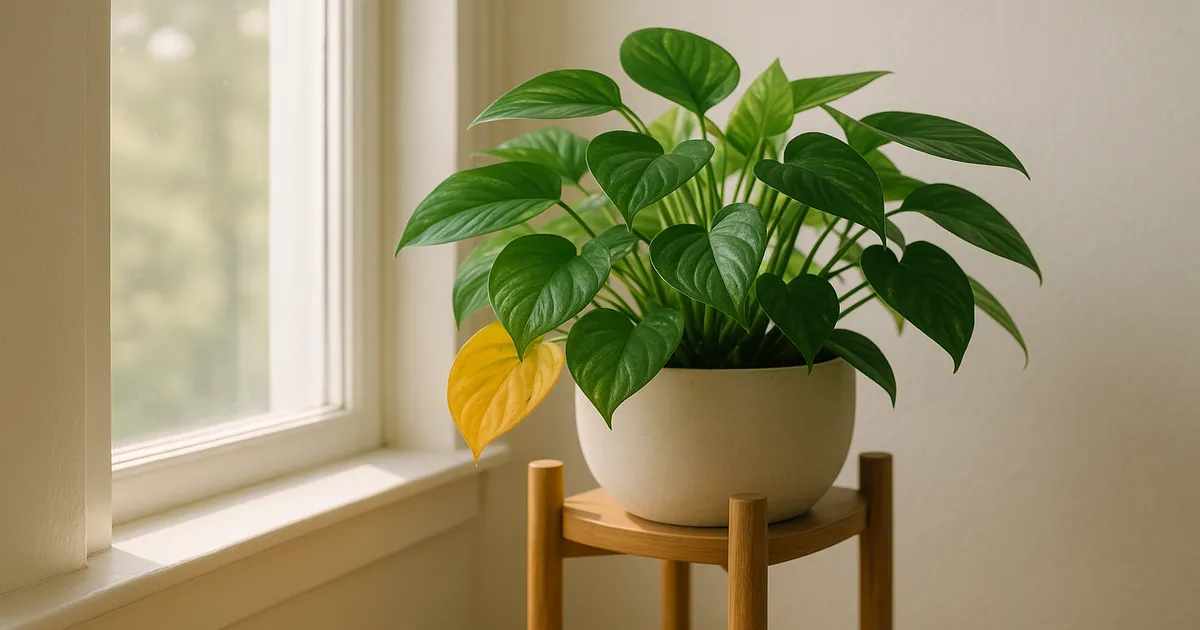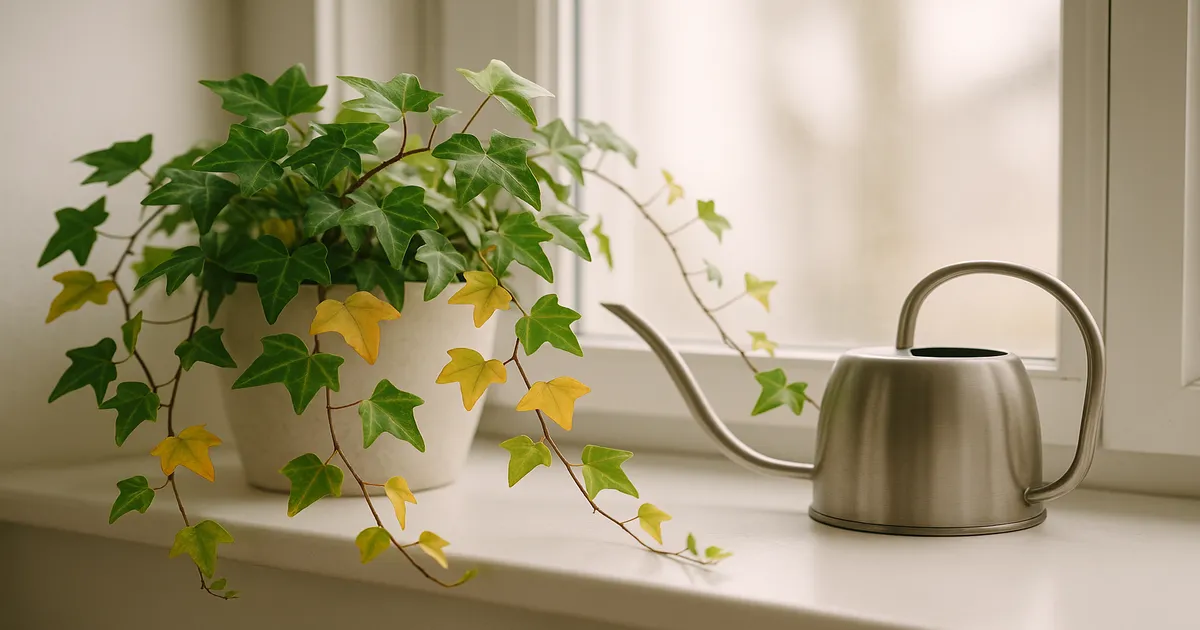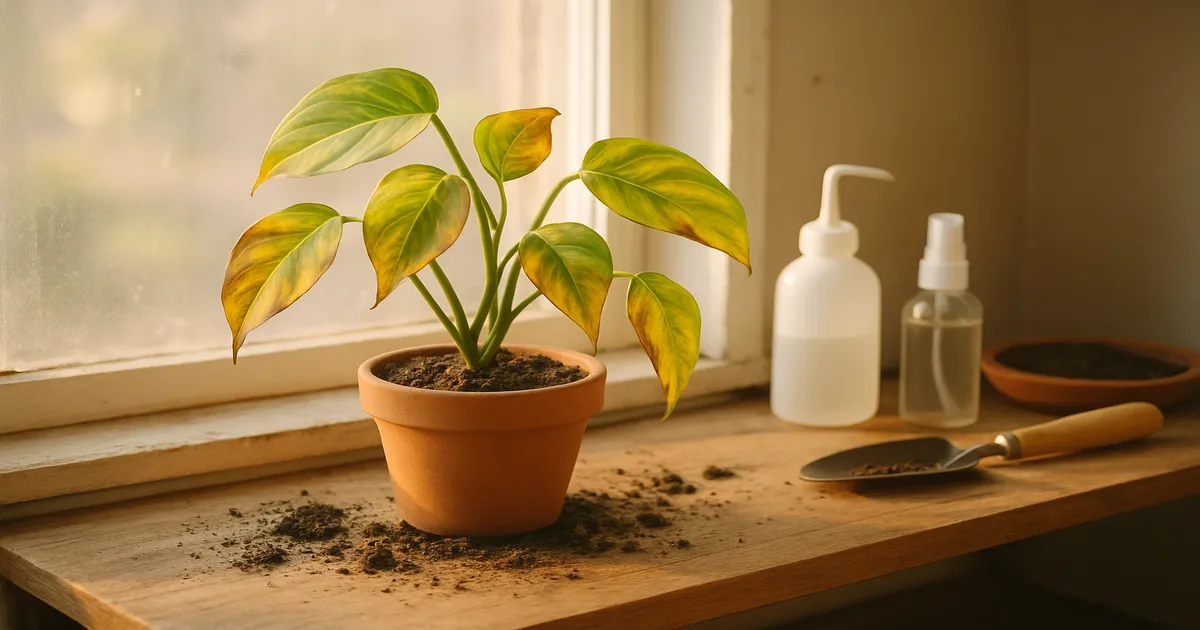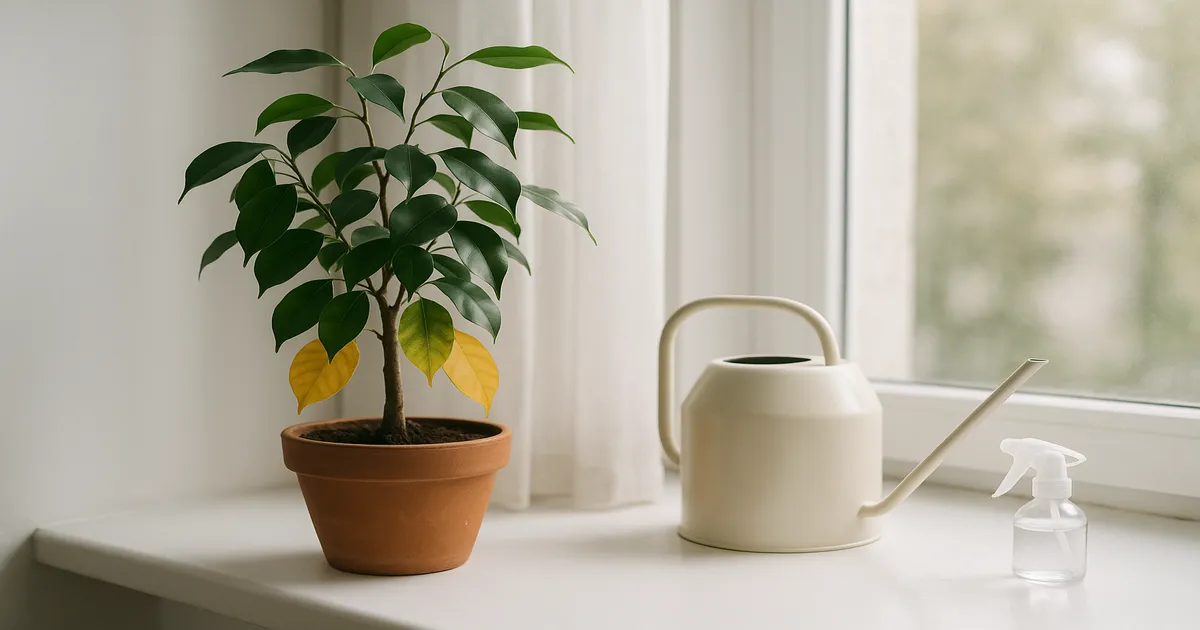
Quick Answer: Leaves turn yellow (a condition called chlorosis) when chlorophyll breaks down due to stress — most often overwatering, underwatering, low light, or nutrient deficiency. The pattern of yellowing is your best diagnostic clue: where the yellowing starts and how it spreads tells you which cause you’re dealing with. Fix the root cause and your plant can bounce back, but act quickly — prolonged stress compounds the damage.
If you’ve ever caught yourself wondering why are some of her leaves yellowing, you’re in good company — it’s the most common houseplant distress signal there is. The good news: yellowing leaves are a symptom, not a death sentence. Most causes are fixable once you know what you’re looking at.
Why Are Some of Her Leaves Yellowing? The Most Likely Culprits
- Overwatering / root rot — the #1 cause across all houseplants
- Underwatering or drought stress
- Low light — especially for lower, shaded leaves
- Nutrient deficiencies — nitrogen, iron, or magnesium most often
- Pests — spider mites, mealybugs, scale, thrips, or fungus gnats
- Root binding — compacted roots can’t absorb water or nutrients efficiently
- Temperature stress or cold drafts
- Low humidity — especially in winter or air-conditioned rooms
- Natural aging (senescence) — normal for the lowest 1–3 leaves
Use Leaf Pattern as Your First Diagnostic Clue
Before you change anything, look closely at which leaves are yellowing and how they’re yellowing. This single observation narrows your suspect list dramatically.
| Yellowing Pattern | Location on Plant | Most Likely Cause |
|---|---|---|
| Uniform yellow, whole leaf | Lower/older leaves | Overwatering, nitrogen deficiency, or low light |
| Interveinal (veins stay green) | New/upper leaves | Iron deficiency or high soil pH |
| Interveinal (veins stay green) | Old/lower leaves | Magnesium deficiency |
| Yellow with crispy brown edges | Any leaves | Underwatering, low humidity, or fertilizer burn |
| Yellow with soft, mushy stem | Lower leaves | Root rot (overwatering) |
| Pale yellow with stippling or webbing | Any leaves | Spider mites or other pests |
| Sudden yellowing near window or vent | Nearest leaves | Temperature/cold draft stress |
| Lowest 1–3 leaves only, slow progression | Lowest leaves | Normal senescence |
What Is Chlorosis and Why Does It Happen?
Chlorophyll — the pigment that makes leaves green — isn’t permanent. It needs a steady supply of nutrients, water, and light to stay stable. When any of those inputs drop off, chlorophyll degrades and the yellow carotenoid pigments underneath become visible. That’s chlorosis in plain terms: green goes away, yellow takes over.
Four main patterns each point somewhere different. Interveinal chlorosis (yellow tissue, green veins) signals a micronutrient problem. Marginal yellowing (yellow edges) suggests water stress or salt burn. Uniform whole-leaf yellowing points to nitrogen deficiency, overwatering, or light issues. Spotty or patchy yellowing is often pest damage or a fungal issue.
Normal Aging vs. a Real Problem
One or two lower leaves going yellow on a mature, otherwise healthy plant is completely normal. Plants continuously push new growth and shed old leaves, recycling nutrients like nitrogen and magnesium back into newer tissue. If fewer than 10% of total leaves are yellowing — and they’re all the oldest, lowest ones — you’re watching normal aging, not a crisis.
Multiple yellow leaves scattered across the plant, or yellowing that’s moving upward, is a systemic warning sign. That’s when it’s time to investigate.
Overwatering and Root Rot: The #1 Reason Leaves Turn Yellow
Why Wet Soil Can Still Starve Your Plant
Here’s the paradox that catches most plant owners off guard: a plant sitting in soggy soil can still die of thirst. Saturated soil pushes out all the oxygen in the root zone. Without oxygen, roots can’t respire — they die and begin to rot, often accelerated by Pythium or Fusarium fungi. Dead roots can’t transport water or nutrients upward, so leaves yellow even though the soil is soaking wet.
Signs of overwatering:
- Soil stays wet for more than 7–10 days after watering
- Lower, older leaves yellow first and feel soft, not crispy
- Stem base feels mushy or smells sour/sulfurous
- Soil has pulled from pot edges despite being wet
How to fix it:
- Remove the plant from its pot and inspect the roots. Healthy roots are white or tan and firm; rotten roots are black, brown, and mushy.
- Trim all rotten roots with sterilized scissors, cutting back to healthy tissue.
- Air-dry the root ball for 30–60 minutes before repotting.
- Repot into fresh, well-draining mix — aim for 20–40% perlite or pumice by volume. A quality amended mix like Fox Farm Ocean Forest works well straight out of the bag.
- Make sure drainage holes are present and unblocked. Never let your plant sit in standing water for more than 30 minutes.
- Going forward, water only when the top 1–2 inches of soil are dry. A soil moisture meter removes the guesswork entirely.
Terracotta pots are genuinely helpful here — their porous walls let soil dry more evenly, making accidental overwatering much less likely.
Underwatering, Drought Stress, and Low Humidity
Signs Your Plant Is Too Thirsty
When water is scarce, plants close their stomata to conserve moisture, halting photosynthesis. They also pull nutrients out of older leaves to feed new growth — a process called nutrient remobilization. The result: older leaves yellow and feel papery or crispy. That texture is the key distinction from overwatering, where yellowed leaves tend to feel soft.
Other signs include bone-dry soil pulling away from the pot edges and wilting before yellowing appears.
Fix: Water thoroughly until it drains freely from the bottom. For severely dry, hydrophobic soil that repels water, try bottom-watering — set the pot in a tray of water for 20–30 minutes and let the soil absorb moisture from below. A small amount of plain dish soap in your watering can also helps water penetrate compacted, hydrophobic soil.
Low Humidity: The Hidden Culprit
Tropical houseplants evolved in 60–90% relative humidity. Most homes sit at 20–40%, dropping even lower in winter when heating runs constantly. The result is a transpiration deficit: leaves lose water faster than roots can supply it, and margins dry out and yellow first.
Look for yellow leaves with crispy brown edges — dry and brittle, not mushy. Spider mites often appear alongside this symptom because they thrive in dry air.
The most effective humidity fixes are grouping plants together, placing pots on pebble trays filled with water, or running a small humidifier nearby. Aim for 50–60% relative humidity for most tropicals; Calatheas prefer 60–80%.
Light and Nutrients: Two Overlooked Causes of Yellow Leaves
Too Little Light
In low light, plants can’t synthesize enough chlorophyll to maintain all their foliage, so they sacrifice the lower, shaded leaves first — they’re the least productive. New growth that does appear will be small, pale, and stretched (etiolated).
- Most tropical houseplants: bright indirect light (1,500–3,000 foot-candles) is optimal; they’ll survive in medium light (500–1,500 foot-candles) but may slowly decline
- Peace Lily: tolerates low light (50–150 foot-candles) but thrives in medium
- Monstera: needs bright indirect light (1,500–3,000 foot-candles) for healthy, fenestrated growth
Move your plant to within 3–5 feet of a bright window. If natural light isn’t an option, a full-spectrum LED grow light run at 4,000–6,500K for 12–16 hours a day will do the job.
Nitrogen, Iron, and Magnesium Deficiencies
Nutrient deficiencies are more common than most plant owners realize, especially in plants that haven’t been fed in months.
- Nitrogen: Uniform yellowing of older, lower leaves. Nitrogen is mobile in the plant — it migrates from old leaves to new growth when supplies run short. Fix with a balanced liquid fertilizer at half strength. (Jack’s Classic All Purpose 20-20-20)
- Magnesium: Interveinal chlorosis on older leaves (veins stay green, tissue between them turns yellow). Magnesium is the central atom of the chlorophyll molecule, so a shortage shows up fast. Fix: dissolve 1 teaspoon of Epsom salt per gallon of water and apply as a monthly soil drench.
- Iron: Interveinal chlorosis on new leaves. Iron is immobile in the plant, so newer growth shows symptoms first. Soil pH above 7.0 is often the real culprit — iron becomes chemically unavailable even when it’s physically present. Lower pH to 5.5–6.5 with an acidic potting mix, then apply chelated iron fertilizer for the fastest correction.
Fertilizer Salt Burn
Excess fertilizer salts build up over time and create osmotic stress — essentially pulling water out of root cells. Symptoms look like drought stress: yellow or brown leaf tips and margins, often with a white crusty deposit on the soil surface. Flush the soil thoroughly with plain water every 2–3 months, and always fertilize at half the recommended label strength.
Pests, Root Binding, and Temperature Stress
Common Pests That Cause Yellow Leaves
Sap-sucking insects pierce plant cells and extract phloem sap, causing stippling, chlorotic patches, and generalized yellowing. Always check leaf undersides with a magnifying glass — that’s where most pests hide.
| Pest | What to Look For | Fix |
|---|---|---|
| Spider mites | Fine webbing, tiny dots, bronzing | Neem oil or insecticidal soap; raise humidity |
| Fungus gnats | Larvae in soil; mimics overwatering | Let soil dry; beneficial nematodes; yellow sticky traps |
| Mealybugs | White cottony masses on stems/leaves | Isopropyl alcohol swabs; neem oil spray |
| Scale | Brown bumps on stems; sticky honeydew | Isopropyl alcohol; horticultural oil |
| Thrips | Silver streaks; stippling | Spinosad spray; remove badly infested leaves |
Repeat treatments every 5–7 days for at least 3–4 weeks to break the egg cycle. One application rarely finishes the job.
Root Binding
When roots fill the entire pot, they compress each other and reduce uptake efficiency. The soil-to-root ratio drops so low that the mix dries out within a day or two of watering, creating constant drought stress. Signs include roots spiraling out of drainage holes, circling the soil surface, or the pot itself bulging slightly.
Gently slide the plant out. If you see a solid mass of roots with almost no visible soil, it’s time to repot. Choose a new pot just 1–2 inches larger in diameter — going too big invites overwatering problems. Repot in spring if possible, when the plant has the energy to recover quickly.
Cold Drafts and Temperature Shock
Tropical houseplants hate temperature swings. Cold air from an AC vent, a drafty window, or a sudden cold snap causes chilling injury — cell membranes stiffen, enzyme function breaks down, and leaves yellow rapidly, sometimes developing water-soaked or translucent patches. Keep plants in the 60–85°F (15–29°C) range and away from cold drafts.
How to Diagnose Yellow Leaves in 5 Steps
Work through these in order before changing anything. Treating the wrong cause can make things worse.
- Identify the pattern and location. Lower/older vs. upper/newer? Uniform, interveinal, marginal, or spotty? Use the table at the top to match your pattern to a likely cause.
- Check soil moisture and root health. Stick your finger 1–2 inches into the soil. Soggy for over a week? Suspect overwatering. Bone dry and pulling from the edges? Suspect drought. If moisture seems fine, inspect the roots for rot or severe binding.
- Assess light levels. Are the yellowing leaves the lowest, most shaded ones? Is new growth small, pale, or stretching toward the light? Most tropicals need to be within 3–6 feet of a bright window to thrive.
- Inspect for pests. Take the plant to good light and flip the leaves over. Look for webbing, tiny moving dots, cottony fluff, brown bumps, or sticky residue. Early infestations are easy to miss and easy to misread as a watering problem.
- Review your care history. When did you last fertilize, and at what strength? Has the plant been near a heating or AC vent? Did the yellowing start after you moved it, repotted it, or changed the season? A single event often triggers yellowing that then persists.
Prevention: Keeping Leaves Lush and Green
Water by soil moisture, not by schedule. The same plant may need watering twice a week in summer and once every two weeks in winter. Always water thoroughly until it drains from the bottom, then empty saucers after 30 minutes.
Quick species guide:
- Pothos & Monstera: Let the top 1–2 inches of soil dry before watering
- Peace Lily: Water when the top inch is dry; it wilts dramatically when thirsty — a useful built-in alarm
- Fiddle-Leaf Fig: Water when the top 2 inches are dry; it hates inconsistency more than drought
- Snake Plant: Let soil dry 50–75% of the way down before watering; overwatering is almost the only way to kill one
- Calathea: Keep the top inch consistently moist but never soggy; use filtered or distilled water to avoid tip burn from fluoride
Fertilize monthly during the growing season (spring through early fall) at half the recommended strength. Skip fertilizing entirely in winter when growth slows. Repot every 1–2 years in spring, moving up just one pot size at a time.
Frequently Asked Questions
Should I remove yellow leaves from my plant? Yes — once a leaf has turned fully yellow, it won’t recover. Removing it redirects the plant’s energy to healthy growth and reduces the risk of fungal issues. Use clean scissors and cut close to the stem.
Can yellow leaves turn green again? Partially yellowed leaves can sometimes recover if you catch the problem early and fix the cause quickly. A leaf that is more than 50% yellow is unlikely to fully green up and is best removed.
Why are some of her leaves yellowing even though I just repotted? Repotting is a stress event. Roots get disturbed, the soil moisture profile changes, and the plant may drop a few leaves while it adjusts. This is normal as long as it stops within 2–3 weeks and new growth continues. If yellowing accelerates, check that the new pot isn’t too large and that the mix drains well.
How often should I fertilize to prevent nutrient deficiencies? For most houseplants, a balanced liquid fertilizer at half strength once a month during the growing season (March–September) is sufficient. Don’t fertilize in winter — the plant isn’t actively growing and excess salts will build up.
Could tap water be causing my plant’s leaves to yellow? Yes, in some cases. Tap water high in fluoride or chlorine can cause tip burn and marginal yellowing, especially in spider plants, peace lilies, and Calatheas. Let tap water sit uncovered overnight to off-gas chlorine, or switch to filtered or rainwater.