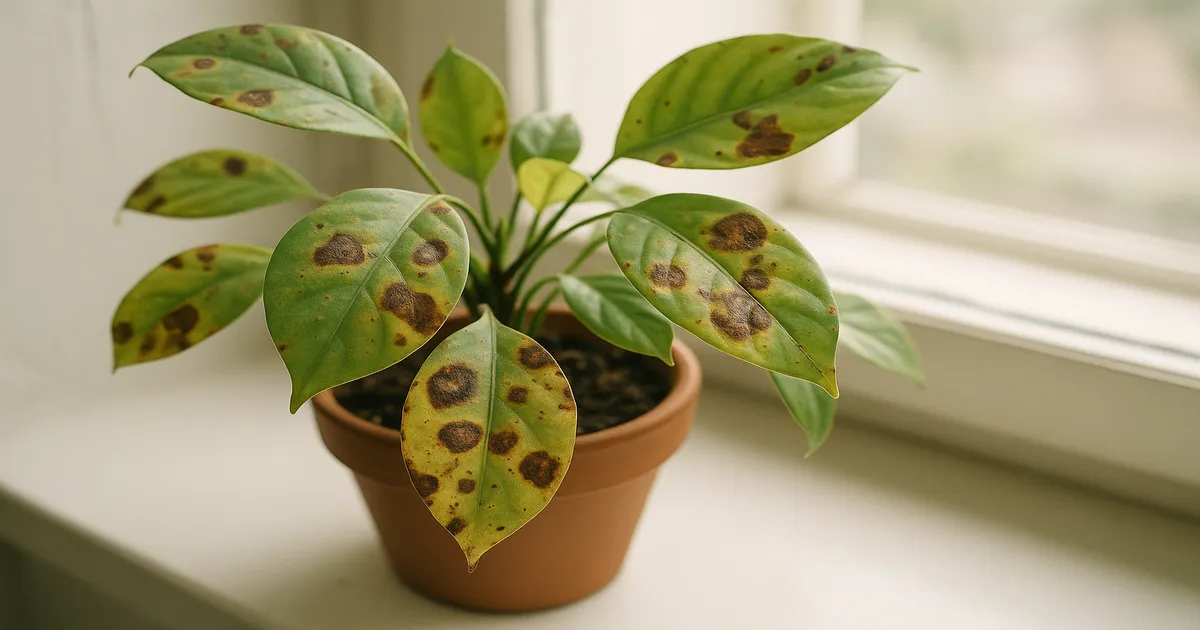
Quick Answer: Brown spots on houseplant leaves signal underlying stress — not a disease in themselves. The cause could be overwatering, low humidity, fungal infection, pest damage, or several other things. Learning to read the spot’s location, texture, and spread pattern is the fastest way to diagnose the problem and fix it.
If you’ve ever stared at your plant and thought what are these brown spots? — you’re not alone. It’s one of the most common houseplant questions out there, and the frustrating truth is that brown spots can mean a dozen different things. The good news: each cause leaves behind its own visual clues. Once you know what to look for, diagnosis gets much easier.
What Are These Brown Spots? The 10 Most Common Causes
Brown spots are your plant’s way of signaling that something is off. The underlying causes fall into three broad categories: environmental stress, disease, and pests.
- Overwatering / root rot — mushy dark spots, often with a yellow halo
- Underwatering / drought — crispy tan tips and edges
- Low humidity — dry, papery brown margins on thin-leaved plants
- Sunburn — bleached or pale tan patches on the upper leaf surface
- Fungal disease — circular spots, concentric rings, or fuzzy lesions
- Bacterial infection — angular, water-soaked spots that spread fast
- Pest damage — stippled bronze dots, silvery streaks, or sooty patches
- Fertilizer burn / salt toxicity — crispy tips after feeding, white crust on soil
- Cold damage — sudden dark brown patches on the side facing a cold source
- Chemical damage — irregular bleached patches from sprays or hard water
How to Use Spot Pattern and Texture as Diagnostic Clues
Where the spot appears (tip, edge, center, underside), what it feels like (crispy vs. mushy), what color it is, whether it has a yellow halo, and how quickly it spreads all point toward specific causes. The sections below walk through each clue in detail.
How to Diagnose Brown Spots on Houseplant Leaves
Spot Location: Tips, Edges, Centers, and Undersides
Location is your first and most powerful clue.
- Leaf tips and margins → drought stress, low humidity, fertilizer salt buildup, or fluoride toxicity
- Leaf centers or interior → fungal or bacterial infection, or cold damage
- Upper leaf surface only → sunburn (the exposed side takes the hit)
- Undersides of leaves → check for pests — spider mites, scale, and thrips all prefer the underside
Spot Texture and Color: Crispy vs. Mushy vs. Water-Soaked
Touch the spot. This one step rules out half the possible causes.
- Crispy and papery → drought, low humidity, sunburn, or fertilizer burn
- Soft and mushy → overwatering, root rot, or bacterial infection
- Water-soaked and translucent → bacterial infection (early stage) or cold damage
- Bleached, silvery, or pale tan → sunburn or thrips damage
- Dark brown to black → rot, bacterial infection, or cold injury
- Stippled bronze or fine dots → spider mite feeding
Spread Rate and Pattern: Yellow Halos and Concentric Rings
How fast a spot grows tells you a lot about what’s driving it.
- Rapid spread (new spots appearing daily) → bacterial infection; act immediately
- Slow or static → environmental stress; the damage is done, not actively spreading
- Yellow halo around the spot → overwatering, bacterial leaf spot, or some fungal diseases
- Concentric rings (target-board pattern) → Alternaria fungal infection
- Fuzzy gray-brown coating → Botrytis (gray mold)
Which Houseplants Are Most Vulnerable?
| Plant | Primary Vulnerabilities |
|---|---|
| Tropical aroids (Monstera, Philodendron, Pothos) | Overwatering, root rot, low humidity |
| Ficus (F. lyrata, F. elastica) | Sunburn, bacterial leaf spot, cold drafts |
| Calathea / Goeppertia | Fluoride toxicity, low humidity, inconsistent watering |
| Succulents & cacti | Overwatering rot, sunburn |
| Orchids (Phalaenopsis) | Bacterial soft rot, cold water spotting |
| Dracaena | Fluoride/salt tip burn |
| Peace lily (Spathiphyllum) | Underwatering, low humidity, fertilizer salts |
| Ferns (Nephrolepis, Asplenium) | Low humidity (need 50–80%) |
Environmental Causes of Brown Spots — and How to Fix Them
Overwatering and Root Rot
Waterlogged soil creates oxygen-depleted conditions that invite water mold pathogens — primarily Phytophthora and Pythium — to attack the roots. Once roots are compromised, they can’t transport water, so the plant experiences a paradox: sitting in water but dying of thirst.
What it looks like: Mushy, dark brown to black spots, often starting at the leaf center or the base of the plant. A yellow halo around the spot is common. The soil smells sour or musty.
How to fix it:
- Unpot the plant and inspect the roots — healthy roots are firm and white or tan; rotted roots are brown or black and mushy
- Trim all rotted roots with sterile scissors, cutting back to healthy tissue
- Dust cut ends with powdered cinnamon or sulfur as a natural antifungal
- Repot into a well-draining mix — for aroids, aim for 40–50% perlite by volume
- Always use a pot with drainage holes
- Going forward, insert your finger 1–2 inches into the soil and water only when it feels dry at that depth. A soil moisture meter removes the guesswork entirely
Underwatering and Drought Stress
When leaf cells lose their internal water pressure, they collapse and die. Browning starts at the tips and margins first because those are the furthest points from the plant’s vascular supply.
What it looks like: Dry, papery, tan or light brown areas with a sharp defined border. No yellow halo. The tissue crumbles when you rub it. Multiple leaves show symptoms at once.
Watch out for hydrophobic soil: if your potting mix has dried out completely, water can run straight through without being absorbed. The fix is to submerge the entire pot in a basin of water for 20–30 minutes so the root ball fully rehydrates.
Low Humidity and Dry Indoor Air
Most popular houseplants evolved in tropical environments with 60–90% relative humidity. Average indoor air sits at 30–50%, and in winter with heating running, it can drop to 20–30%. That gap causes marginal and tip cells to desiccate faster than roots can replenish water.
The key distinction from underwatering: the soil is moist, but browning continues anyway.
Target humidity by plant group:
- Tropical aroids: 60–80%
- Ferns and Calathea: 50–80%
- General tropical houseplants: 40–60% minimum
- Succulents and cacti: 10–40%
A humidifier paired with a hygrometer is the most reliable fix . Grouping plants together and using a pebble tray (pot sitting above — not in — water on a pebble-filled tray) adds a modest 5–10% boost to local humidity. Skip misting as a primary strategy — it raises humidity for only minutes and can promote fungal disease if leaves stay wet.
Sunburn and Photodamage
Intense or direct light overwhelms the plant’s photoprotective systems, generating reactive oxygen species that destroy chlorophyll and cell membranes. This is most common when a plant is moved suddenly from a shady spot to a bright one.
What it looks like: Bleached, pale tan, or silvery-white patches on the upper leaf surface only. The shape is irregular, the texture dry and papery, there’s no yellow halo — and crucially, it does not spread.
Move the plant to bright indirect light (1,500–3,000 foot-candles) and acclimate it gradually when increasing light levels — add 1–2 hours of exposure per day over 2–3 weeks. Sheer curtains over south- or west-facing windows work well. Burned tissue will not recover, so remove severely damaged leaves.
Cold Drafts and Temperature Stress
Most tropical houseplants suffer chilling injury below 50–55°F (10–13°C). Cold disrupts cell membrane function, causing rapid cell death — often appearing suddenly after an open window in winter or placement near an air conditioning vent.
What it looks like: Dark brown to black, water-soaked patches localized to the side of the plant facing the cold source. Unlike overwatering, there’s a clear triggering event. Move the plant away from cold drafts and keep leaves from touching cold window glass in winter.
Fertilizer Burn and Salt Toxicity
Excess fertilizer salts create hyperosmotic conditions in the soil, drawing water out of root cells through osmosis. The same effect can build up from minerals in tap water over time.
What it looks like: Crispy brown tips and margins (similar to drought), often with a white crusty deposit on the soil surface or pot edges. Symptoms typically worsen in the days after fertilizing.
Flush the soil every 2–3 months by running water through it slowly for several minutes to leach excess salts. Target a soil electrical conductivity (EC) of 1.5–2.5 mS/cm — above 3.5 mS/cm causes visible burn. Plants especially sensitive to fluoride include Dracaena, Calathea, spider plants, and peace lilies. If your tap water is fluoride-treated, switch to filtered or rainwater for these species.
Disease-Related Brown Spots: Fungal and Bacterial Infections
Common Fungal Diseases
Fungal pathogens each leave a characteristic signature:
- Cercospora leaf spot: Small, circular brown spots with yellow halos; common in Ficus, Dracaena, and Dieffenbachia
- Alternaria leaf spot: Dark brown to black spots with concentric rings — the classic “target board” look; common in Monstera, Begonia, and Pothos
- Botrytis cinerea (gray mold): Fuzzy gray-brown lesions, usually starting at wound sites; thrives in cool (below 60°F/15°C), humid, poorly ventilated conditions
- Anthracnose (Colletotrichum spp.): Water-soaked spots that turn tan-brown with dark borders; common in Ficus, palms, and Schefflera
Fungal spores spread via water splash, air movement, and contaminated tools — which is why overhead watering and crowded shelves are such common triggers.
Bacterial Leaf Spot
Bacterial infections — Pseudomonas, Xanthomonas, and Erwinia are the main culprits — enter through stomata, wounds, or damaged tissue. They secrete enzymes that break down cell walls, causing rapid tissue collapse. Erwinia soft rot deserves special mention: it produces a distinctly foul odor as it liquefies plant tissue and can destroy a plant within days in warm, wet conditions.
Fungal vs. Bacterial Spots: Key Differences
| Feature | Fungal | Bacterial |
|---|---|---|
| Initial appearance | Dry, defined spots | Water-soaked, translucent |
| Shape | Circular or with rings | Angular, bounded by leaf veins |
| Surface texture | May have fuzzy or powdery coating | Greasy or slimy |
| Odor | Rarely | Sometimes (especially Erwinia) |
| Spread rate | Moderate | Rapid |
| Yellow halo | Sometimes | Common |
Treatment for Fungal and Bacterial Infections
- Remove and bin (don’t compost) all affected leaves immediately
- Sterilize your tools with 70% isopropyl alcohol between every cut
- Improve air circulation — space plants further apart and run a small fan on low
- Stop overhead watering — water at soil level only
- Apply a copper-based fungicide/bactericide as a foliar spray, repeating every 7–10 days for 3–4 applications
- Sulfur-based fungicides work well against fungal disease but avoid applying when temperatures exceed 90°F (32°C)
- Biological fungicides containing Bacillus subtilis or Trichoderma harzianum are effective preventatives with low toxicity — a good option if you want to avoid harsher chemicals
Pest-Caused Brown Spots on Houseplants
Spider Mites
Spider mites pierce individual leaf cells to extract their contents, leaving a stippled bronze or dusty brown pattern across the leaf surface. Look for fine silky webbing between leaves and stems — that’s the tell. They thrive when indoor humidity drops below 40%, so dry winter air is peak spider mite season.
Thrips
Thrips use rasping mouthparts to scrape leaf tissue, leaving silvery-bronze streaks and brown patches. New growth often comes in distorted or scarred. Check for tiny black specks on leaves — that’s their frass (excrement), and it’s a reliable confirmation.
Scale Insects and Mealybugs
Scale and mealybugs don’t directly create brown spots. Instead, they weaken the plant through sap depletion, causing yellowing that progresses to browning. They also excrete sticky honeydew, which attracts sooty mold — a black, powdery fungal coating that further blocks photosynthesis.
Fungus Gnat Larvae
Adult fungus gnats are mostly a nuisance, but their larvae feed on roots in the top few inches of soil. The resulting root damage mimics overwatering symptoms: brown spots, wilting, and general decline despite appropriate watering.
How to Confirm and Treat a Pest Infestation
Use a magnifying glass and check leaf undersides, stem joints, and the soil surface. Once confirmed:
- Spider mites: Increase humidity, spray plants with water to dislodge mites, apply neem oil or insecticidal soap every 5–7 days for 3–4 rounds
- Thrips: Yellow sticky traps to monitor, neem oil or spinosad-based spray
- Scale / mealybugs: Dab with 70% isopropyl alcohol on a cotton swab, follow with neem oil or insecticidal soap
- Fungus gnats: Let the top 2 inches of soil dry out completely between waterings; use yellow sticky traps; apply Bacillus thuringiensis var. israelensis (Bti) as a soil drench to kill larvae
How to Treat Brown Spots and Stop Them Spreading
Can Brown Spots Be Reversed?
Here’s the honest answer: dead brown tissue will not turn green again. Once cells are dead, they’re gone. What you can do is stop the spread, protect healthy tissue, and let the plant grow out of it. Shifting your focus from fixing existing spots to preventing new ones is actually the more useful mindset.
When to Remove Damaged Leaves vs. Leave Them On
Remove the leaf if:
- More than 50% of the leaf is brown or dead
- The leaf shows signs of active disease (fungal sporulation, bacterial ooze)
- It’s creating an entry point for further infection
Leave it on if:
- The damage is minor (less than 20% of the leaf), stable, and not spreading
- The leaf is still photosynthesising and contributing to the plant’s energy budget
- Removing it would stress the plant further (e.g., it’s one of only a few leaves)
Choosing the Right Soil Mix
| Plant Type | Recommended Mix |
|---|---|
| Tropical aroids | Potting soil + 40–50% perlite + orchid bark |
| Succulents / cacti | Dedicated cactus mix + coarse sand or pumice |
| Ferns | Moisture-retentive mix with coco coir; avoid letting it dry out |
| Orchids | Pure orchid bark or bark + perlite blend |
| General tropicals | Quality potting mix + 20–30% perlite |
Frequently Asked Questions
Why do my houseplant leaves get brown spots even when I water correctly? Watering is just one variable. Brown spots can still develop from low humidity, fluoride in tap water, cold drafts, pests, or disease — even when your watering schedule is perfect. Work through the location and texture clues above to narrow down the real cause.
Are brown spots contagious between plants? Environmental causes (overwatering, sunburn, low humidity) are not contagious. Fungal and bacterial diseases can spread via water splash, contaminated tools, or shared air — so isolate any plant showing signs of infection until you’ve confirmed the cause.
Should I cut off leaves with brown spots? Only if more than 50% of the leaf is affected, the damage is actively spreading, or the leaf shows signs of disease. Minor, stable spots on an otherwise healthy leaf are fine to leave — the leaf is still contributing to photosynthesis.
Can I use tap water on all my houseplants? For most plants, tap water is fine. However, species sensitive to fluoride and chlorine — including Dracaena, Calathea, spider plants, and peace lilies — do better with filtered water, rainwater, or tap water left to sit overnight so chlorine can off-gas. Fluoride cannot be removed by sitting, so filtered or rainwater is the better choice for these plants.
How quickly should brown spots respond to treatment? Existing brown tissue will not recover regardless of treatment. What you’re watching for is whether new spots stop appearing. Environmental fixes (humidity, watering) typically show results within 1–2 weeks. Fungal and bacterial treatments require 3–4 spray applications over 3–4 weeks before you can assess whether the infection is under control.