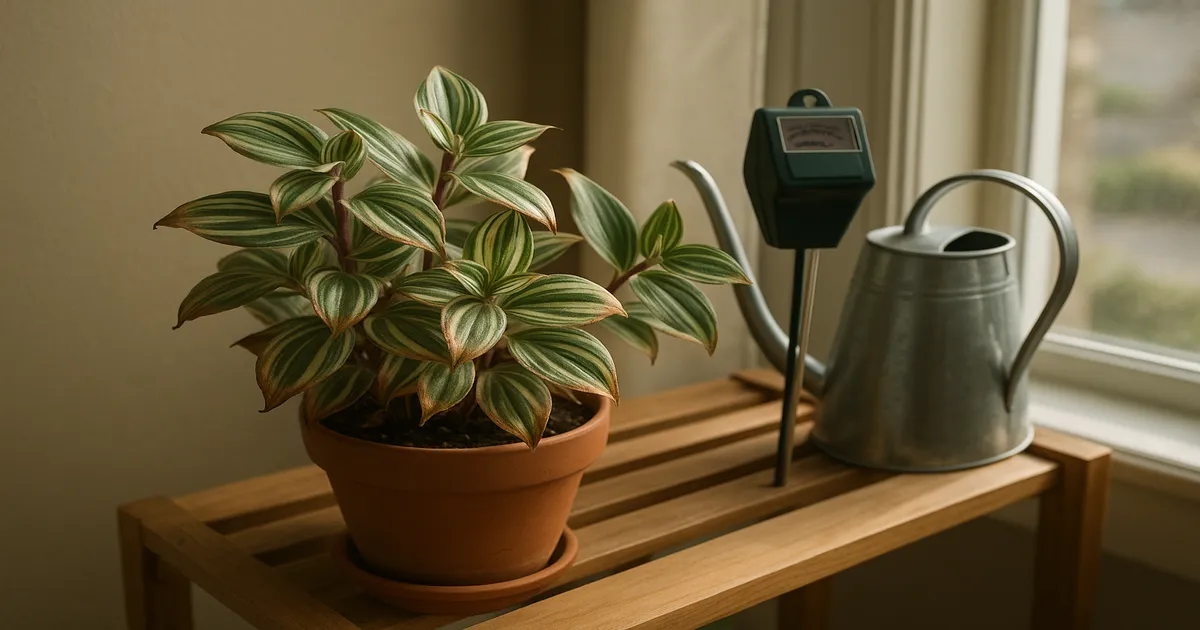
Quick Answer: Brown leaves on a Wandering Jew (Tradescantia spp.) are almost always caused by one of these culprits: underwatering, low humidity, overwatering/root rot, direct sun, fertilizer burn, cold drafts, or pests. Tradescantia has a thin leaf epidermis that reacts quickly to environmental stress, so problems show up fast — but most are straightforward to fix once you identify the pattern. Read on to match your specific symptom to its cause and get it sorted.
If you’ve been asking yourself why does my Wandering Jew have brown leaves, the good news is that the browning itself is diagnostic. The pattern, texture, and location of the damage will tell you almost exactly what’s wrong. A crispy brown tip is a completely different problem from a soft, mushy brown patch — and treating them the same way will make things worse.
How to Diagnose Brown Leaves on Wandering Jew
Before you do anything, look closely at the browning. Is it crispy or mushy? Is it at the tips and edges, or in the middle of the leaf? Is it spreading to new growth, or only on old leaves at the base?
| Browning Pattern | Likely Cause |
|---|---|
| Crispy brown tips and edges | Underwatering, low humidity, or fertilizer burn |
| Soft, mushy, yellow-to-brown | Overwatering / root rot |
| Sudden tan or bleached patches on upper surface | Sunscald |
| Irregular spots, speckling, or streaks | Pests or fungal/bacterial disease |
| Only the oldest, lowest leaves browning | Natural senescence |
Use this table as your starting point, then read the relevant section below.
Crispy tips and edges (dry browning): The leaf tips or margins turn brown and feel papery — not wet, not soft. This points to underwatering, low humidity, or salt buildup from over-fertilizing.
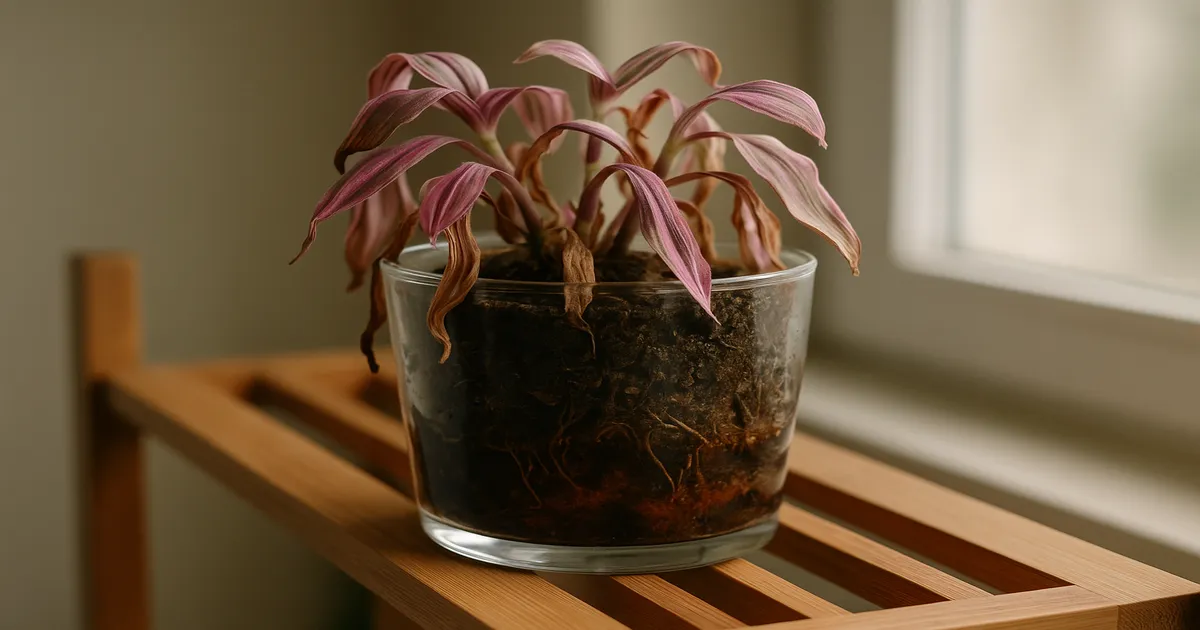
Soft, mushy, yellow-to-brown discoloration: If the browning feels wet or slimy and the leaves yellowed before they browned, overwatering and root rot are almost certainly the cause. This kind of damage often starts at the base of stems and works upward.
Sudden brown patches on the upper leaf surface: Patches that appear over just a few days on the side of the plant facing the window are classic sunscald. The surrounding tissue may look bleached or washed out before it turns brown.
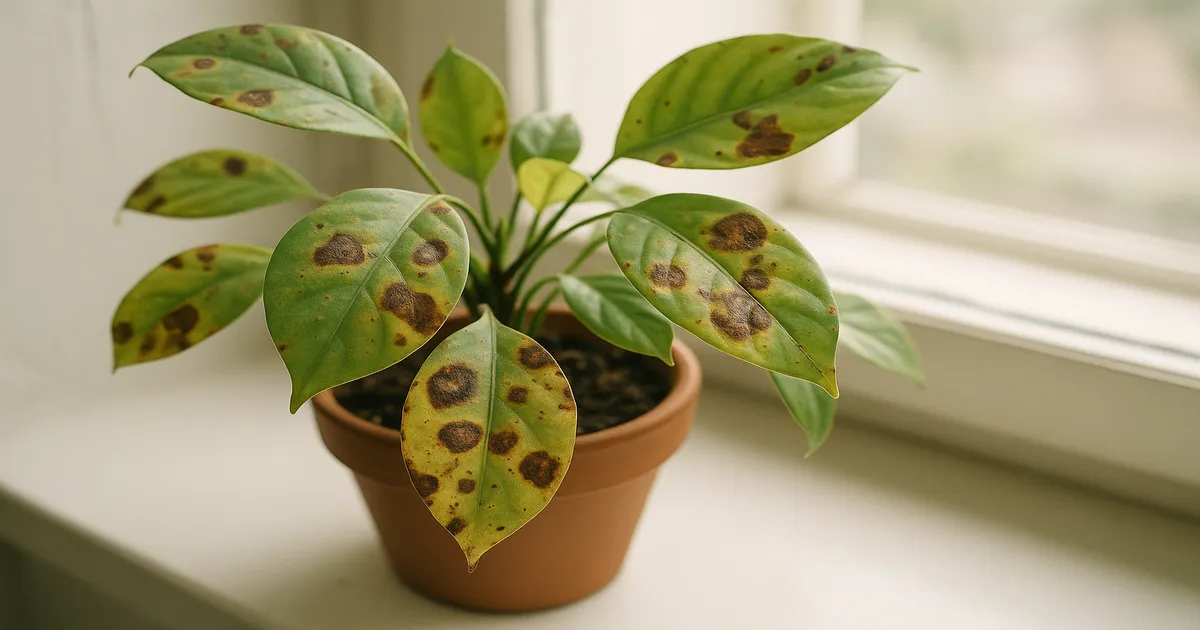
Irregular, spotty, or streaked browning: Random speckling, streaks, or spots with yellow halos suggest pests or disease. Spider mites leave a bronze stippled look; fungal infections tend to produce spots with defined edges and sometimes a yellow ring.
Browning only on the oldest, lowest leaves: If the newest growth at the stem tips looks healthy, relax. Older leaves naturally die back as the plant redirects energy to new growth — this is normal and nothing to fix.
The 6 Most Common Causes — and How to Fix Them
1. Underwatering and Drought Stress
When soil dries out completely, leaf cells lose turgor pressure. The margins and tips — the farthest points from the plant’s vascular system — desiccate first, producing that familiar crispy brown edge. Stems may go limp before the leaves even show damage.
Look for: dry, papery brown tips; soil pulling away from the pot edges; leaves curling inward. Tradescantia sillamontana (White Velvet) handles drought best of the common species, but even it will brown if left too dry for too long.
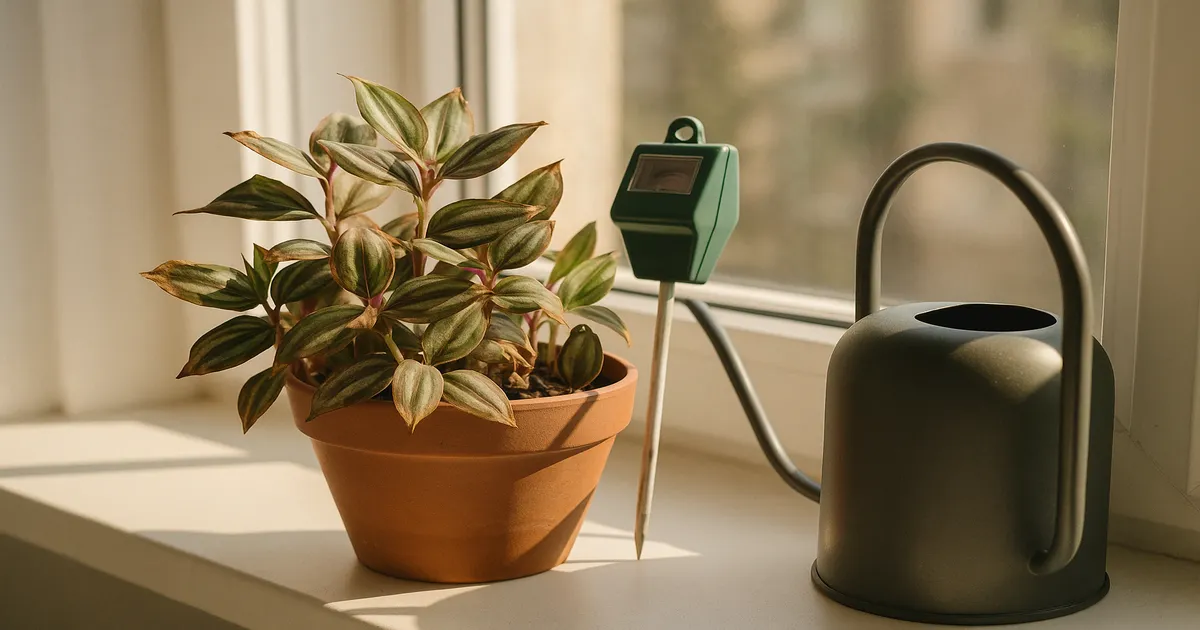
Fix it: Water thoroughly until water drains freely from the drainage holes, then let the pot drain completely before returning it to its saucer. Going forward, press a finger 1–2 inches into the soil — water when the top inch is dry but the second inch still has slight moisture. A soil moisture meter takes the guesswork out of this; aim for a reading of 4–6 on a standard 1–10 scale.
For soil, a blend of 60% peat or coco coir, 30% perlite, and 10% compost gives you the moisture retention Tradescantia wants without waterlogging. Avoid cactus mixes — they drain too fast. Terracotta pots dry out faster than glazed ceramic or plastic, so factor that into your watering frequency.
2. Overwatering and Root Rot
Chronically soggy soil cuts off oxygen to the roots and invites pathogens like Pythium and Fusarium that rot root tissue. Once the roots go, the plant can’t move water even though the soil is wet — so you get browning that looks like drought but isn’t.
Look for: soft, mushy browning that starts yellow; a sour or sulfurous smell from the soil; roots that look brown, slimy, or hollow when you unpot the plant.
Fix it: Remove the plant from its pot and inspect the roots. Trim all brown, mushy, or hollow roots with sterilized scissors, then dust the cut surfaces with powdered cinnamon as a natural antifungal. Repot into fresh, sterile potting mix — never reuse contaminated soil — in a pot with drainage holes that’s only 1–2 inches larger than the root ball. A soil drench with a biological fungicide containing Trichoderma spp. or Bacillus subtilis can help prevent pathogen regrowth. (Trifecta Crop Control) Then adjust your watering: let the top 1–2 inches dry out between waterings, and water even less in fall and winter.
3. Low Humidity and Dry Indoor Air
Tradescantia evolved in humid tropical understories where relative humidity sits around 60–80%. Most homes run at 30–50% RH, and near heating vents in winter it can drop below 20%. When the air is too dry, the plant loses moisture through its leaves faster than the roots can replace it, causing thin, papery browning along the leaf margins. This tends to be worse in winter, and new growth can be affected just as much as older leaves — which helps distinguish it from natural senescence.
Fix it: The most effective solution is a cool-mist ultrasonic humidifier placed within 3–5 feet of the plant, targeting 50–60% RH. Grouping plants together raises local humidity through collective transpiration, and a pebble tray with water beneath the pot adds a modest boost — just make sure the pot bottom isn’t sitting in the water. Skip misting: the humidity boost lasts only minutes, and wet foliage promotes fungal disease.
4. Direct Sun and Sunscald
Most Tradescantia species want bright indirect light (1,500–3,000 foot-candles). Push them into intense direct sun above 5,000–6,000 foot-candles and the photosynthetic machinery gets overwhelmed, generating reactive oxygen species that destroy cell membranes. The result is bleached, tan, or brown patches that appear suddenly on the sun-facing side of the plant.
Tradescantia pallida (Purple Heart) is the exception — it tolerates and even prefers more direct sun than its cousins. For T. zebrina, watch for the silver stripes fading or turning white as an early warning sign before full browning sets in.
Fix it: Move the plant to bright indirect light — typically 2–5 feet from an east- or north-facing window, or set back from a south- or west-facing window with a sheer curtain to diffuse afternoon sun. If you’re moving a plant from low light to higher light, acclimate it gradually over 2–3 weeks to avoid shock in the other direction.
5. Fertilizer Burn and Salt Accumulation
Over-fertilizing — or using hard tap water over time — causes soluble salts to build up in the soil. Those salts pull water out of root cells through osmosis, essentially causing chemical drought. The result looks almost identical to underwatering: brown, crispy tips and edges.
The clue it’s salt burn: white crusty deposits on the soil surface or pot rim, browning that worsens right after fertilizing, and symptoms that persist even when you’re watering consistently.
Fix it: Take the plant to a sink and water slowly and thoroughly with room-temperature distilled or rainwater for 3–5 minutes, letting it drain completely. Repeat two or three times to leach accumulated salts. Going forward, use a balanced liquid fertilizer at half the label-recommended dose, every 2–4 weeks in spring and summer only — and stop entirely in fall and winter. If your tap water tests above 200 ppm TDS, switch to filtered or collected rainwater.
6. Cold Temperatures and Cold Drafts
Most Tradescantia species prefer 60–85°F (15–29°C). Below 50°F (10°C), cell membranes lose integrity and tissue collapses, turning brown or black. Cold drafts from single-pane windows in winter are a sneaky culprit — the damage shows up on leaves closest to the glass and can look water-soaked before it turns brown.
Tradescantia fluminensis is the most cold-tolerant of the common species; T. zebrina is the most sensitive.
Fix it: Move the plant away from cold windows, exterior walls, and drafty doorways. On freezing nights, a piece of cardboard between the plant and cold glass makes a real difference. Remove cold-damaged leaves cleanly to prevent secondary fungal infection, and hold off on fertilizing until you see active new growth returning.
Pests and Diseases That Cause Brown Leaves on Wandering Jew
Spider mites thrive in hot, dry indoor conditions. They pierce individual leaf cells and drain the contents, leaving a stippled, bronze, or speckled browning across the leaf surface. Check the undersides of leaves for fine webbing — that’s the giveaway. Isolate the plant, rinse leaves thoroughly under a strong stream of water, then follow up with insecticidal soap (2 tsp per quart of water) or neem oil applied to all leaf surfaces including undersides. Repeat every 5–7 days for 3–4 cycles. Raising humidity also helps, since mites hate moisture.
Mealybugs cluster at stem nodes as waxy white masses and inject saliva that disrupts vascular tissue, causing yellowing and browning near feeding sites. Dab individual bugs with a cotton swab dipped in 70% isopropyl alcohol, then follow with a neem oil spray.
Thrips leave silvery-brown streaks across leaves and can transmit viral diseases. Apply a spinosad-based insecticide or insecticidal soap weekly for four weeks.
Fungus gnats are mostly a nuisance as adults, but their larvae feed on roots and can indirectly cause browning by reducing the plant’s ability to take up water. Let the soil dry more between waterings and apply a biological larvicide containing Bacillus thuringiensis israelensis (Bti) as a soil drench.
Fungal and bacterial diseases look different from environmental browning: you’ll see spots with yellow halos or water-soaked margins rather than uniform edge browning. Botrytis cinerea (gray mold) produces visible gray fuzzy sporulation in high-humidity, low-airflow conditions. Bacterial leaf spots (Pseudomonas, Xanthomonas) spread progressively and have sharply defined lesion borders. For either, cut away all visibly diseased tissue with sterilized tools, increase airflow with a small fan on a low setting, and switch to watering at soil level to keep foliage dry.
Quick-Reference Care Guide to Prevent Brown Leaves
| Care Factor | Target Range |
|---|---|
| Watering frequency | Every 5–7 days (spring/summer); every 10–14 days (fall/winter) |
| Soil moisture | Moist but not soggy; top inch dry before watering |
| Light | Bright indirect, 1,500–3,000 foot-candles |
| Humidity | 50–70% RH |
| Temperature | 60–85°F (15–29°C); never below 50°F |
| Fertilizer | Half-strength balanced liquid, every 2–4 weeks in spring/summer only |
A stable environment matters more than perfect numbers. It’s the sudden swings — a cold snap, a move to a sunnier window, a missed watering — that cause the most damage.
Is It Normal for Wandering Jew Leaves to Turn Brown?
Some browning is completely normal. Leaves have a finite lifespan, and as the plant grows it sheds older foliage at the base of stems through a process called programmed cell death. If the browning is limited to the oldest, lowest leaves and the stem tips are pushing out healthy new growth, there’s nothing wrong. Trim the dead leaves and move on.
Worry when: browning spreads to new growth, stems feel mushy at the base, there’s widespread leaf drop, or you spot visible pests or webbing. Those are signs of a systemic problem — root rot, severe pest infestation, or prolonged environmental stress — that needs active intervention rather than patience.
Frequently Asked Questions: Why Does My Wandering Jew Have Brown Leaves?
Should I cut off brown leaves on my Wandering Jew?
Yes. Brown leaves won’t recover, and removing them keeps the plant tidy and redirects energy to healthy new growth. Use clean scissors and cut each leaf off at its base where it meets the stem.
Why are the tips of my Tradescantia turning brown even though I water it regularly?
Regular watering doesn’t rule out the problem. If you’re using tap water with high mineral content, salts can build up in the soil and burn the root tips, mimicking drought stress. Low humidity is another frequent culprit that persists regardless of watering habits. Check for white crusty deposits on the soil surface and consider flushing the soil with distilled water.
Can brown leaves on a Wandering Jew turn green again?
No. Once leaf tissue dies and turns brown, that damage is permanent. The goal of fixing the underlying problem is to stop further browning and encourage healthy new leaves — which Tradescantia does quickly once conditions improve.
Why does my Wandering Jew have brown edges but the center of the leaf looks healthy?
Uniform browning along the leaf margins while the center stays green is the classic signature of low humidity or fertilizer salt burn — both of which affect the outermost leaf tissue first. If you notice white crust on the soil or pot rim, flush the soil with distilled water. If the air in your home is dry (especially in winter), add a humidifier or group your plants together to raise the ambient humidity.
How do I know if my Wandering Jew has root rot or just needs water?
Pull the plant out of its pot and check the roots. Healthy roots are white or light tan and firm. Rotted roots are brown, gray, or black, feel mushy or slimy, and may smell sour. If the roots look fine, drought is the more likely culprit.