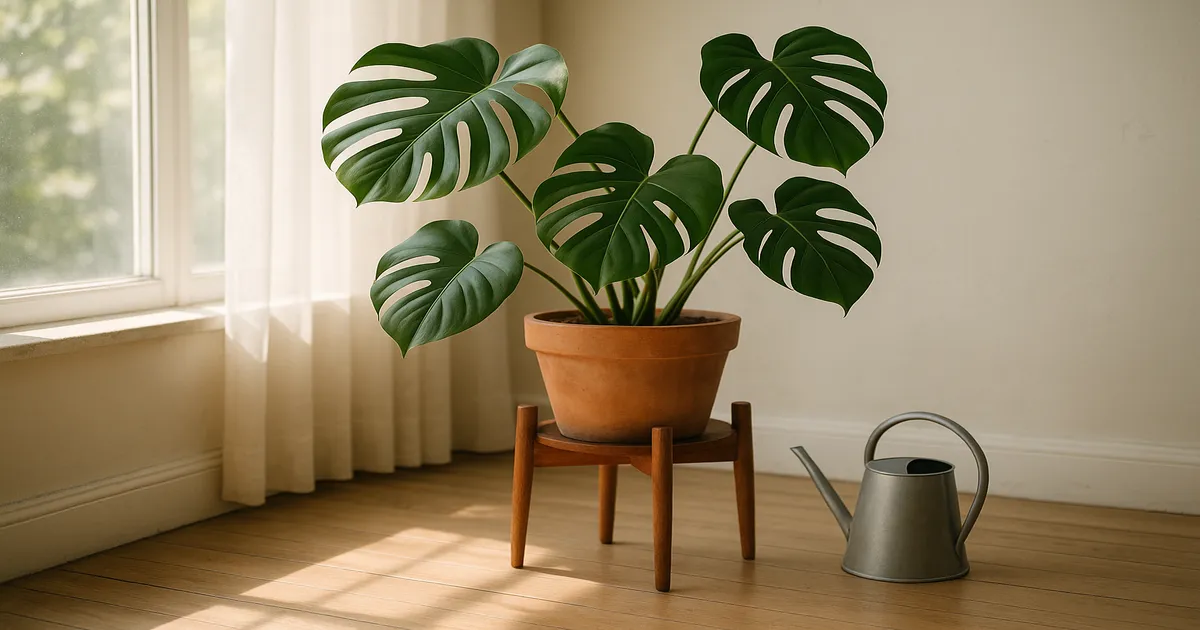
Quick Answer: Most Monsteras need watering every 7–14 days in spring and summer, and every 14–21+ days in fall and winter. Soil moisture — not the calendar — is your real guide. Push your finger 2 inches into the soil; if it’s dry at that depth, it’s time to water.
Figuring out how often a Monstera should be watered is one of the most common questions new owners ask — and one of the most misunderstood. The honest answer is that there’s no magic number. Frequency depends on your light levels, pot material, soil mix, season, and the humidity in your home. This guide walks through every variable so you can dial in the right schedule for your plant, not a generic average.
How Often Should a Monstera Be Watered: A Quick Reference
General Watering Frequency at a Glance
| Season | Typical Frequency |
|---|---|
| Spring & Summer | Every 7–14 days |
| Fall & Winter | Every 14–21+ days |
These ranges assume average indoor conditions: bright indirect light, a well-draining aroid mix, a moderately sized pot, and humidity around 50%. Treat them as a starting point, not a rule.
Why There Is No Single Universal Schedule
Monstera is a hemiepiphyte — it starts life on the forest floor, then climbs host trees, eventually losing its ground roots. That growth habit shapes how its roots work. They’re built for wet-dry cycles: soak up moisture, then dry out and breathe before the next rain. Roots need oxygen just as much as water, which is why constantly moist soil is far more dangerous than letting the plant dry out briefly.
7 Factors That Determine How Often to Water a Monstera
1. Light Levels and Transpiration Rate
Photosynthesis drives transpiration — the process by which water moves through the plant and evaporates from leaf pores. In bright indirect light (1,500–3,000 foot-candles), stomata are active and the plant depletes soil moisture quickly. In low light (under 200 foot-candles), metabolism slows and soil can stay damp for weeks.
- Bright indirect light: Water every 7–10 days
- Medium light: Water every 10–14 days
- Low light: Water every 14–21 days
Variegated cultivars like Thai Constellation and Albo Variegata have less chlorophyll, so they photosynthesize — and transpire — more slowly than all-green plants. Water them slightly less often than a standard Monstera deliciosa under the same conditions.
2. Season and Temperature
Warmer temperatures and longer days accelerate both transpiration and soil evaporation, so summer plants dry out faster. In winter, light intensity drops and growth pauses — the plant uses almost no water. Watering on a summer schedule through December and January is one of the most reliable ways to cause root rot.
Set a reminder in October–November to cut back your frequency, and another in March–April to ramp it back up.
3. Pot Material
Unglazed terracotta is porous — moisture evaporates through the pot walls, accounting for 20–40% more water loss compared to plastic or glazed ceramic. That passive evaporation actually works in your favor by completing the wet-dry cycle faster.
- Terracotta: Water every 7–10 days in the growing season — a good choice for overwatering-prone growers
- Plastic or glazed ceramic: Water every 10–14 days — better for low-humidity rooms where you want to slow evaporation
- Self-watering pots: Use with caution; they often keep soil too consistently moist for a hemiepiphyte
4. Pot Size and Root-to-Soil Ratio
An oversized pot holds far more moisture than the root system can absorb, creating stagnant wet zones that suffocate roots. A root-bound plant, by contrast, has almost no soil buffer and can dry out in 2–3 days. When repotting, go up only 1–2 inches in diameter — no more.
5. Soil Composition
Standard potting mixes can hold 60–80% of their volume in water — far too much for a Monstera. A chunky aroid mix drains in seconds and dries to “slightly damp” within a week. Dense, peat-heavy soil means you water less often, but the roots are under chronic stress. The right mix from the start solves this problem entirely (see the recipe in the root rot section below).
6. Ambient Humidity
In dry indoor air below 40% relative humidity — common in heated or air-conditioned homes — the vapor pressure deficit is high, stomata open wide, and the plant loses water faster. In humid conditions (60–80% RH), transpiration slows. A hygrometer will tell you exactly where you stand; a reliable option is the ThermoPro TP50 Digital Hygrometer. Monstera’s sweet spot is 50–70% RH.
7. Water Quality
High-TDS tap water — anything above 200–300 ppm — can create osmotic stress at the root zone, making it hard for roots to absorb moisture even when the soil is wet. This is called physiological drought. Fluoride accumulation also causes brown leaf tips over time. Filtered water or rainwater with TDS below 150 ppm is ideal. Letting tap water sit uncovered for 24 hours reduces chlorine but won’t remove chloramine or fluoride.
How to Tell When Your Monstera Needs Water
These methods always override a calendar schedule.
Finger or knuckle test: Push your finger straight down 2 inches into the soil. For Monstera deliciosa, water when the top 2 inches are dry. For Monstera adansonii, which is more drought-sensitive, water when the top 1 inch is dry. If the soil still feels cool and damp, wait a day or two and check again.
Wooden chopstick method: Insert a clean chopstick or bamboo skewer all the way to the bottom of the pot and leave it for 60 seconds. Wet soil clings to the wood; dry soil leaves it clean. This is especially useful for deep pots where your finger can’t reach the lower root zone.
Soil moisture meter: A moisture meter gives you a numerical reading on a 1–10 scale — water your Monstera when the reading drops to 3–4. The XLUX Soil Moisture Meter is a budget-friendly option that works well for this. Note that cheap resistive meters can read inaccurately in very dry or compacted soil, so treat readings as a guide rather than gospel.
Pot weight method: Lift the pot right after a thorough watering and note how heavy it feels. Check every few days — when it feels noticeably lighter, it’s time to water. Once you’ve done this a handful of times, it becomes second nature.
Overwatering vs. Underwatering: Symptoms and Diagnosis
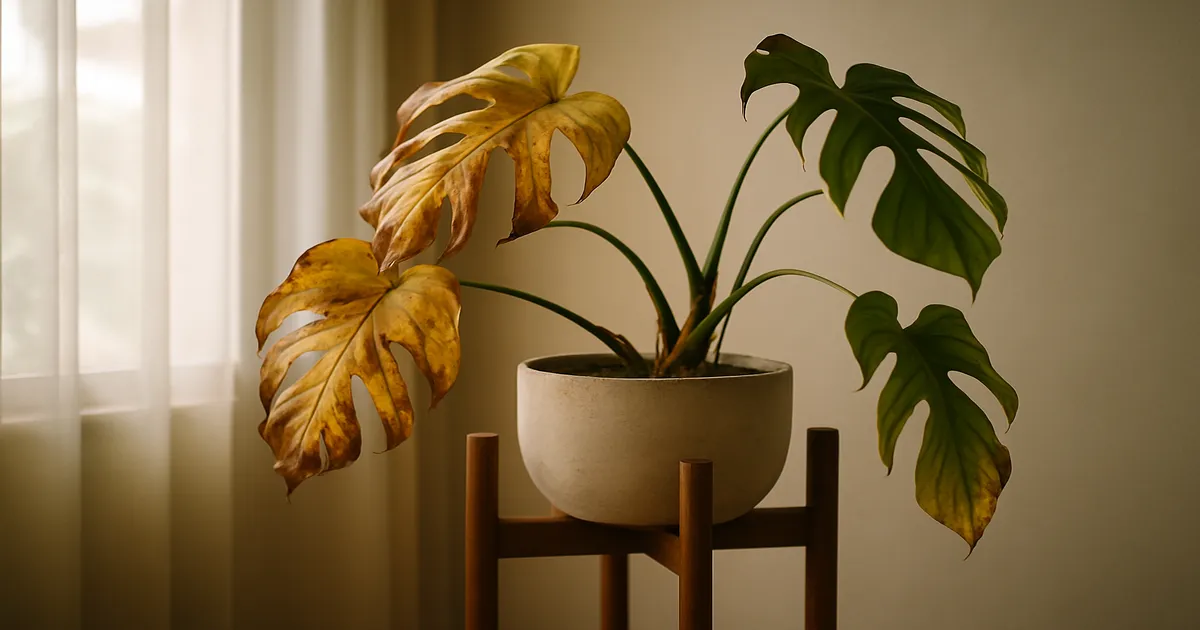
Both problems can cause yellowing leaves and wilting, which is why visual diagnosis alone is unreliable. Always check the soil first.
Signs of overwatering:
- Soil is wet or damp when you check it
- Lower, older leaves yellowing first
- Soft or mushy stems near the soil line
- Roots are brown, black, or mushy with a foul smell
- Fungus gnats hovering around the soil surface
Signs of underwatering:
- Soil is bone dry all the way through
- Leaf edges are crispy and brown
- Leaves curl inward or droop but feel dry, not soft
- Pot feels very light when lifted
Here’s the tricky part: when root rot (Pythium, Phytophthora, or Fusarium species) destroys the root system, the plant can’t absorb water even if the soil is wet — so it shows drought symptoms despite sitting in damp soil. If your Monstera looks wilted and the soil is wet, root rot is almost certainly the culprit.
How to Fix Overwatering and Rescue a Monstera with Root Rot
Step-by-Step Root Rot Treatment
- Remove the plant from its pot and gently shake off the soil.
- Inspect the roots — healthy roots are white to tan and firm; rotted roots are brown or black, mushy, and often smell foul.
- Sterilize scissors or pruning shears with 70% isopropyl alcohol.
- Cut away all rotted tissue back to healthy, firm root material.
- Dust cut surfaces with powdered cinnamon or a sulfur-based fungicide powder as a natural antifungal.
- Let the roots air-dry for 30–60 minutes before repotting.
The Right Soil Mix After Repotting
Use a well-draining aroid mix. Here’s a reliable recipe by volume:
- 40% high-quality potting mix (peat or coir-based) — Fox Farm Ocean Forest works well here
- 20% perlite (3–6 mm particle size)
- 20% orchid bark (pine bark preferred)
- 10% horticultural charcoal
- 10% worm castings
This mix drains freely in under a minute while retaining just enough moisture for healthy root development.
After repotting, water sparingly for the first 2–3 weeks — just enough to keep the soil from completely drying out. Hold off on fertilizer until you see new growth; the plant needs to focus its energy on rebuilding roots first.
To prevent recurrence, apply a soil drench containing Bacillus subtilis or Trichoderma species. These beneficial microorganisms suppress the pathogenic fungi that cause root rot and are safe to use alongside regular watering.
Best Watering Techniques
Top watering: Water slowly and evenly across the entire soil surface until water flows freely from the drainage holes. After 30 minutes, discard any water sitting in the saucer — roots should never sit in standing water.
Bottom watering: Place the pot in a tray of room-temperature water for 20–30 minutes. The soil draws moisture upward through capillary action, encouraging roots to grow downward and ensuring even saturation. Drain fully afterward. This method works especially well for terracotta pots or any time you want to make sure the entire root ball gets wet.
Water temperature: Always use room-temperature water — 65–75°F (18–24°C). Cold water below 55°F (13°C) can cause temporary wilting, particularly in winter.
Fungus gnats: Almost always a sign that soil is staying too wet for too long. Drench the soil with a Bacillus thuringiensis var. israelensis (Bti) product to kill larvae without harming the plant. Yellow sticky traps catch flying adults. A hydrogen peroxide drench (1 part 3% H₂O₂ to 4 parts water) kills larvae on contact and adds a burst of oxygen to the root zone. Long-term, letting the soil dry properly between waterings eliminates most infestations on its own.
Seasonal Watering Schedule
Spring and summer: As days lengthen in March and April, your Monstera will start pushing new leaves. Check soil every 5–7 days and water when the top 2 inches are dry. By peak summer, most plants in bright indirect light will need water every 7–10 days.
Fall and winter: Starting in October or November, actively pull back. Light intensity drops even near the same window, and the plant’s metabolism slows significantly. You’ll likely find the soil stays moist for 14–21 days or longer. Watering less frequently during this period isn’t neglect — it’s correct care.
Repotting: Repot every 1–2 years in spring, going up only 1–2 inches in pot diameter each time. Look for roots circling the bottom or emerging from drainage holes as signs it’s time. Spring repotting gives the plant the entire growing season to establish before winter slows things down again. Drainage holes are non-negotiable — never use a pot without them as a primary container.
Frequently Asked Questions
How do I know if my Monstera needs water?
The finger test is the most reliable method: push your finger 2 inches into the soil. If it’s dry at that depth, water the plant. You can also lift the pot — a noticeably light pot is a good sign the soil has dried out. Never water on a fixed schedule without checking first.
Can I water my Monstera once a week?
Once a week works well for many Monsteras during spring and summer, especially in bright indirect light with terracotta pots and a well-draining mix. In winter, low light, or plastic pots, once a week is almost certainly too often and risks root rot. Always check the soil before watering, regardless of what day it is.
What does an overwatered Monstera look like?
Yellowing on lower leaves first, soft or mushy stems near the soil line, and soil that stays wet days after watering are the main signs. Fungus gnats hovering around the pot are another strong indicator. In advanced cases, the roots will be brown, mushy, and foul-smelling when you unpot the plant.
Should I mist my Monstera instead of watering it?
No — misting doesn’t deliver enough moisture to the roots to matter. It can temporarily raise humidity around the foliage, but a humidifier or pebble tray is far more effective for that purpose. Water your Monstera properly at the root zone and address humidity separately if needed.
How does pot size affect watering frequency?
A larger pot holds more soil and more moisture, so it stays wet longer and you water less often. But excess soil volume also creates zones of stagnant moisture where roots aren’t present, which promotes root rot. A pot only 1–2 inches larger than the root ball strikes the right balance and keeps the wet-dry cycle on a healthy timeline.