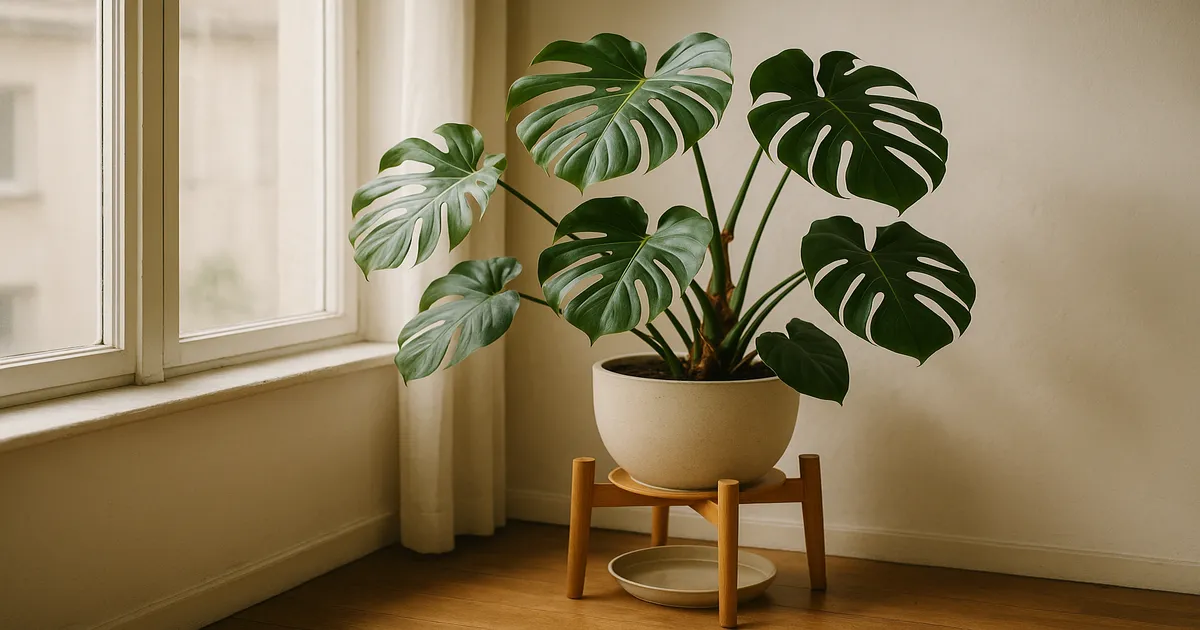
Quick Answer: No — leaving standing water in a saucer under your Monstera is not a safe way to cut down on watering. Monstera roots evolved for wet-dry cycles and need oxygen to stay healthy. Constant moisture creates ideal conditions for root rot, fungus gnats, and salt damage. There are much better ways to reduce how often you water without putting your plant at risk.
If you’ve ever asked “can I leave water under my Monstera for it to soak up to cut down on watering?” — you’re not alone. It sounds like a perfectly logical shortcut. The problem is that Monstera aren’t built for it. Unlike some houseplants that genuinely thrive with their roots near a water reservoir, Monstera need their soil to dry out between waterings. Standing water in a saucer works directly against that.
The good news: there are legitimate ways to reduce how often you water. This article covers why the saucer trick backfires, what to do instead, and how to rescue a plant that’s already showing signs of overwatering damage.
Why You Can’t Leave Water Under Your Monstera
Monstera Need Wet-Dry Cycles, Not Constant Moisture
Monstera deliciosa grows natively in the tropical rainforests of southern Mexico and Central America — but “tropical” doesn’t mean “perpetually wet.” Rainforest soils are porous, rich in organic matter, and drain rapidly after rainfall. Monstera experience distinct wet and dry seasons. Their roots are adapted to deep, episodic saturation followed by a drying period, not continuous waterlogging.
Leaving water in a saucer recreates swamp conditions, not rainforest floor conditions. It’s a subtle but critical difference.
How Monstera Roots Work — And Why Oxygen Matters
Monstera are hemiepiphytes. They start life rooted in soil but climb trees as they mature, developing aerial roots along the way. Their soil roots are fleshy and semi-succulent, capable of storing some moisture, but they depend on oxygen exchange to function. Healthy roots respire aerobically, converting sugars into energy.
When the root zone stays waterlogged, oxygen is displaced from soil pore spaces. Roots then switch to anaerobic fermentation, producing ethanol and acetaldehyde — compounds that are directly toxic to root cells. This can kill roots even without any pathogen involved.
A Wet Saucer Is Not the Same as Sub-Irrigation
Self-watering pots with a proper wicking chamber are a form of sub-irrigation, and when designed correctly, they can work for some plants. The key feature is an air gap between the water reservoir and the soil. The soil wicks moisture upward only as needed, and roots never sit directly in water.
A standard saucer with standing water is not the same thing. There’s no air gap, no controlled wicking, and most standard potting mixes lack the fine-particle structure needed to draw water upward efficiently. The bottom of the pot gets waterlogged while the upper root zone may stay dry — the worst of both worlds.
What Happens When You Leave Water in the Saucer
Root Rot Sets In Fast
The pathogens most responsible for root rot in Monstera — Phytophthora spp. and Pythium spp. — are water molds that produce motile zoospores. These spores are literally swimmers, and standing water gives them a direct route into your plant’s root system. Soil temperatures between 59–77°F (15–25°C) combined with constant moisture are optimal for these pathogens. Once established, root rot can destroy 80–100% of the root system within two to four weeks.
The rule: Empty saucers within 30–60 minutes of watering. This single habit prevents the majority of overwatering problems.
Oxygen Starvation Damages Roots Even Without Pathogens
Even in a sterile environment, waterlogged soil suffocates roots. Anaerobic conditions produce hydrogen sulfide and organic acids — byproducts that are directly toxic to root tissue. If your Monstera smells faintly sulfurous when you unpot it, oxygen starvation has already been at work.
Salt and Mineral Build-Up
As water evaporates from a saucer, dissolved minerals and fertilizer salts concentrate and wick upward through the soil. Over time, this raises salt levels beyond what Monstera roots can tolerate. The symptom — brown, crispy leaf tips — is often mistaken for underwatering, which leads owners to add more water and compound the problem.
Fungus Gnats Move In Quickly
Consistently moist soil is the primary breeding ground for fungus gnats (Bradysia spp.). Females lay up to 300 eggs in damp soil, and larvae feed on root hairs and fine feeder roots. At 75°F (24°C), the egg-to-adult cycle takes about 17 days — fast enough that a single wet-saucer situation can produce a full infestation within weeks.
Can I Leave Water Under My Monstera If I Use a Self-Watering Pot?
This is the one scenario where the answer shifts. A properly designed self-watering pot can genuinely reduce how often you water, because the air gap between the reservoir and the soil prevents direct contact. Fill the reservoir, not the top of the pot, and let the wicking do the work.
The catch: if the soil sits directly in the water with no air gap, you’re back to the same problem as a wet saucer. Check the design before you buy. Monstera also tend to do best in self-watering pots once they’re well-established — young plants with small root systems may not wick efficiently enough to keep the upper soil from staying too wet.
How to Actually Cut Down on Watering Without Harming Your Monstera
Use a Moisture Meter or the Finger Test
A probe-style moisture meter removes the guesswork. Water your Monstera when the reading drops to 3–4 out of 10. No meter? Push your finger 2 inches (5 cm) into the soil. If it feels dry at that depth, it’s time to water. If it still feels cool and damp, wait a few more days.
Water Thoroughly but Less Frequently
When you do water, water deeply. Pour slowly until water flows freely from the drainage holes, then discard the runoff within 30–60 minutes. Deep, infrequent watering encourages roots to grow downward and flushes accumulated salts. Frequent shallow watering does neither.
Choose the Right Pot
Terracotta pots are genuinely excellent for Monstera, especially for anyone who tends to overwater. Their porous walls allow oxygen exchange and help soil dry more evenly. Plastic pots retain moisture longer — not inherently bad, but they leave less margin for error. Whatever pot you use, it must have at least one drainage hole.
Pot size matters too. Go no more than 2 inches larger in diameter than the root ball. Oversized pots hold excess soil that roots can’t reach, and that wet soil stays wet far too long.
Use a Well-Draining Soil Mix
Standard all-purpose potting mixes often hold too much moisture for Monstera. A better blend:
- 40% high-quality potting mix (Fox Farm Ocean Forest)
- 30% perlite or pumice
- 20% orchid bark or chunky coco chips
- 10% worm castings
Target a soil pH of 5.5–7.0. Avoid mixes where vermiculite is the primary amendment — it retains more water than perlite and compounds overwatering risk.
Adjust for the Season
Watering on a fixed schedule ignores the fact that a Monstera in a bright, warm room in July uses water much faster than the same plant in a dim corner in January. Check soil moisture every 5–7 days and let the plant tell you when it’s thirsty.
- Summer: Every 7–10 days is common, but always check first.
- Winter: Every 14–21+ days is typical. Overwatering risk is highest in winter because low light, cooler temperatures, and slower growth all reduce how quickly the plant uses water.
Get Humidity Right Without Overwatering
Monstera prefer humidity of 60–80%, but that should come from the air, not the soil. A small humidifier near your plant is the most effective method. A pebble tray works as a supplement — fill it with pebbles, add water to just below the top of the pebbles, and set the pot on top so it sits above the waterline. The pot never contacts the water directly. Track ambient humidity with a digital hygrometer so you’re not guessing.
Adequate light also matters. A Monstera in low light uses water very slowly, which dramatically increases overwatering risk. Aim for bright indirect light — near an east-facing window, or 3–5 feet from a south- or west-facing window.
How to Fix Root Rot If It Has Already Set In
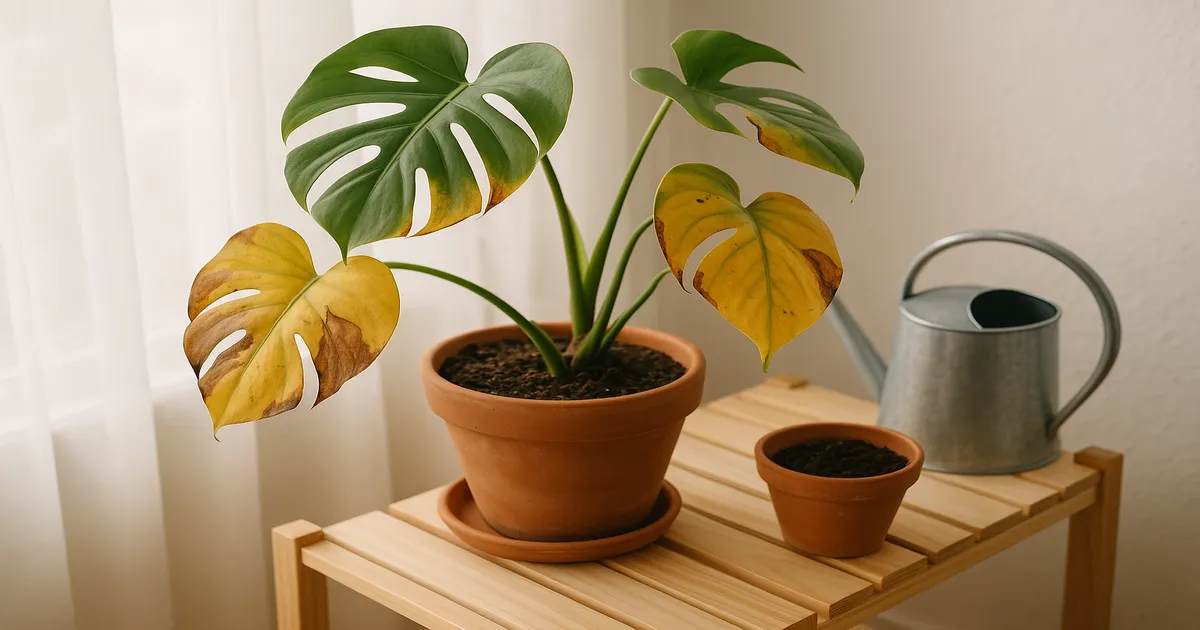
Signs Your Monstera Has Root Rot
- Yellowing leaves that don’t improve after watering
- Mushy or darkened stems at the base
- A sulfurous or rotten smell from the soil
- Dark, mushy roots when you unpot the plant (healthy roots are white to tan and firm)
Step-by-Step Treatment
- Remove the plant from its pot and gently shake off as much soil as possible.
- Rinse roots under lukewarm water to expose all root tissue.
- Using sterilized pruning shears (wiped with isopropyl alcohol between cuts), trim all rotted tissue back to healthy white root.
- Dust cut ends with powdered cinnamon (a natural antifungal) or a sulfur-based fungicide powder.
- Let roots air dry for 30–60 minutes before repotting.
- Repot into fresh, sterile soil in a clean pot — don’t reuse old soil or an unsterilized pot.
- Water lightly and place in bright indirect light. Hold off on fertilizer for 4–6 weeks.
Frequently Asked Questions
Can I leave water under my Monstera if I use pebbles in the saucer?
No — pebbles in a saucer are for humidity, not irrigation. They raise the pot above the waterline so the roots don’t contact standing water. This is a great humidity method, but it doesn’t replace watering and it doesn’t make standing water safe for the roots.
How long can a Monstera go without water?
A healthy Monstera in a well-draining mix can typically go 2–3 weeks without water in normal indoor conditions, and longer in winter when growth slows. The actual timeframe depends on pot size, soil mix, light levels, and temperature. A small plant in terracotta in a bright room dries out much faster than a large plant in plastic in a dim corner.
Why are my Monstera leaves turning yellow after I water it?
Yellowing after watering usually signals overwatering or root damage. If the soil has been consistently moist and multiple leaves are yellowing, check the roots for rot. Yellow leaves combined with soggy soil and a musty smell are a strong indicator that the root zone has been waterlogged.
Which houseplants can safely sit in water in a saucer?
Plants that genuinely tolerate or prefer consistently moist roots include peace lilies (Spathiphyllum spp.), umbrella palms (Cyperus alternifolius), and some ferns. African violets (Saintpaulia spp.) are commonly bottom-watered, though they use a controlled wicking method rather than open standing water. Monstera, pothos, philodendrons, and most other aroids are not on this list — they all need their soil to dry out between waterings.
Can Monstera grow in water or LECA instead of soil?
Yes — Monstera can be grown hydroponically in water or in an inert medium like LECA (lightweight expanded clay aggregate). These are legitimate methods, but they require a full transition: roots grown in soil need to be rinsed and conditioned before moving to water or LECA. Hydroponic Monstera also need liquid nutrients added to the water, since there’s no soil to provide minerals.