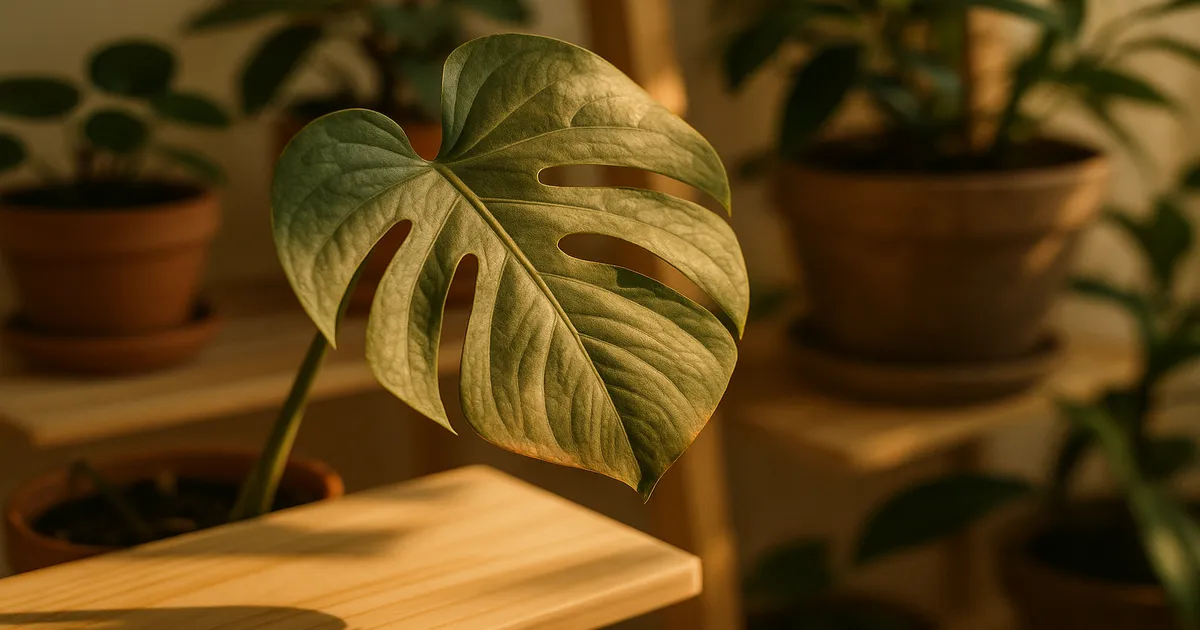
Quick Answer: Brown spots on the underside of a single Monstera leaf are most commonly caused by early-stage fungal leaf spot, spider mites, scale insects, or localised environmental stress — not a systemic disease. The underside shows symptoms first because it hosts the most stomata and stays moister than the top surface. One affected leaf is a reassuring sign: you’ve caught something early, and it’s very treatable.
If you’re asking “does my Monstera have a fungal infection?” because of suspicious browning on the underside of one leaf, take a breath. This is one of the most common concerns Monstera owners raise, and a single affected leaf almost never signals a plant-wide crisis. That said, you do need to identify the cause correctly — because fungal infections, spider mites, scale insects, and environmental stress all look surprisingly similar at first glance, and each needs a different treatment.
Why Does My Monstera Have Brown Spots on the Leaf Underside?
Why the Underside Shows Symptoms First
Monstera leaves are structured differently on each surface. The top side is waxy, smooth, and relatively sealed — built for photosynthesis. The underside is where most stomata and hydathodes are concentrated. These pores are essential for gas exchange, but they’re also entry points for fungal spores and pests. Because the underside faces away from light and airflow, it stays damp longer — exactly the conditions pathogens prefer.
Why One Leaf Is a Reassuring Sign
Systemic infections — root rot, vascular wilt — almost always appear on multiple leaves at once, often with upper-surface symptoms too. When browning is limited to the underside of a single leaf, you’re almost certainly dealing with something localised: an early pest colony, a small fungal lesion, or stress concentrated on that one leaf. Catching it at this stage means your treatment options are wide open.
How to Diagnose the Brown Spots: A Step-by-Step Visual Guide
Grab your phone camera or a 10x magnifying glass and inspect the affected leaf in good light before reaching for any treatment.
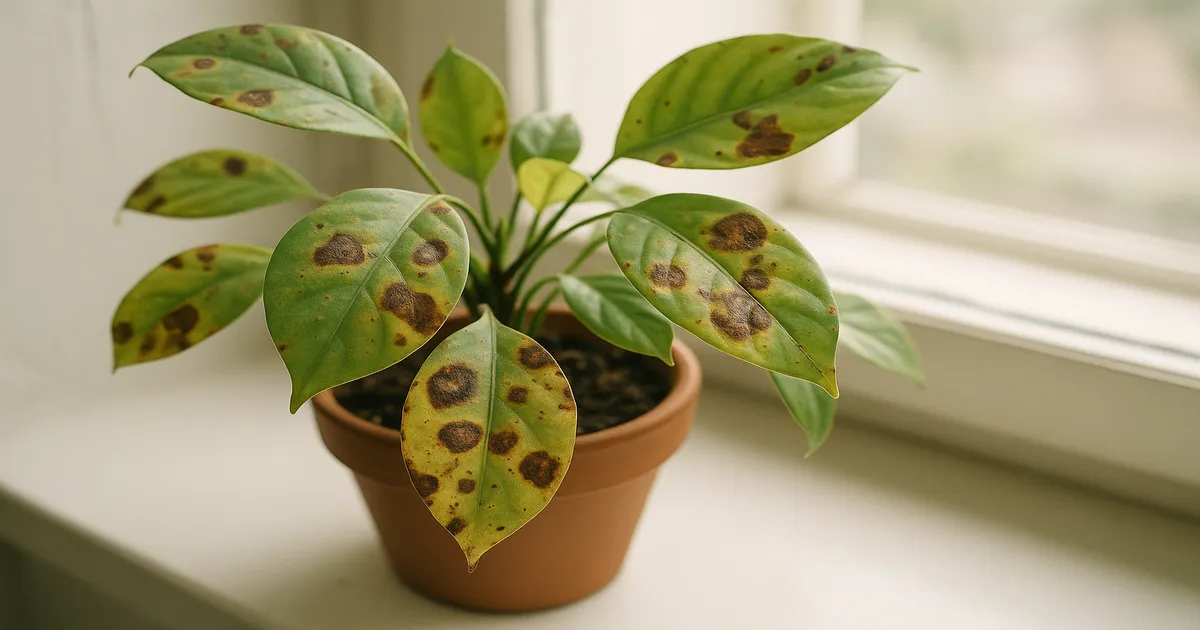
Fungal leaf spot typically starts as small, water-soaked or greasy-looking patches that darken to tan or brown as they mature. Look for relatively well-defined margins — sometimes a darker border or faint yellow halo — and tiny spore masses (black dots or powdery deposits) under magnification.
Spider mite damage feels completely different. Instead of smooth brown patches, you’ll find a stippled, sandpaper-like texture — hundreds of tiny pale dots where individual cells have been pierced. Run your finger across the underside; if it feels rough and grainy, mites are likely. In heavier infestations, fine silk webbing appears where the leaf meets the stem.
Scale insects look like tiny oval bumps — usually 2–4 mm — clustered along the midrib and veins. They don’t move once settled, so they’re easy to mistake for part of the leaf. Soft scale species produce sticky honeydew, which then grows a black powdery coating called sooty mold. That black residue is often what people notice first and mistake for a fungal infection. The key test: try to wipe it off with a damp cloth. Sooty mold smears away; true fungal lesions are within the leaf tissue and won’t wipe clean.
Thrips rasp open epidermal cells rather than piercing them cleanly, leaving silvery-bronze streaks or patches that eventually turn brown. Look for tiny dark specks of frass (insect droppings) scattered across the underside — one of the most reliable thrips indicators. The insects themselves are slender, 1–2 mm long, and range from pale yellow (nymphs) to tan or black (adults).
Bacterial leaf spot tends to be angular rather than round, because the infection spreads until it hits a leaf vein and stops. Spots look water-soaked and greasy, expand quickly — sometimes visibly within 48 hours — and in advanced cases may carry a faint unpleasant odour. There are no visible spore structures under magnification.
Physical damage and edema follow their own patterns. Mechanical damage produces irregular brown areas with no defined spread over time, unless a secondary fungal colonisation sets in. Edema appears as corky, blister-like bumps — not flat brown patches — caused by excess water pressure in the cells when roots absorb faster than leaves can transpire. Environmental browning from low humidity is dry and papery, usually starting at leaf edges, and lacks any water-soaked appearance.
Quick diagnostic checklist:
| Symptom | Most Likely Cause |
|---|---|
| Defined brown spots, possible spore dots | Fungal leaf spot |
| Stippled texture + webbing | Spider mites |
| Oval bumps along veins + black residue | Scale + sooty mold |
| Silvery streaks + dark frass specks | Thrips |
| Angular, greasy, fast-spreading lesions | Bacterial leaf spot |
| Corky blisters, no spreading | Edema (overwatering) |
| Dry, papery edges, no defined border | Low humidity / scorch |
Does My Monstera Have a Fungal Infection? The Most Likely Culprits
Anthracnose (Colletotrichum spp.)
Anthracnose is the most common true fungal infection on Monstera. It produces water-soaked lesions that expand and turn tan to brown with a darker border. Spores spread via water splash, which is why overhead watering and misting are risk factors. It thrives when humidity is high and airflow is poor.
Cercospora Leaf Spot
Cercospora causes small, circular brown spots often ringed with a yellow halo. It’s particularly active when humidity exceeds 80% with stagnant air. Infections tend to stay contained if airflow improves, but they multiply quickly if ignored.
Botrytis (Gray Mold)
Botrytis cinerea is most active in cooler, very humid conditions — around 60–77°F (15–25°C) with humidity above 85%. It produces fuzzy gray-brown lesions that look almost dusty. It’s more common in winter when homes are cold and poorly ventilated, or when plants are crowded together.
Phytophthora and Pythium: Water Molds Often Mistaken for Fungi
These two are technically oomycetes — water molds — not true fungi, and that distinction matters because standard fungicides won’t stop them. Both cause rapidly expanding, dark, water-soaked patches and are almost always linked to overwatering or waterlogged soil. Phytophthora in particular can move fast; fix drainage immediately if you suspect it.
How Fungal Spores Infect Monstera Leaves
Spores land on the leaf surface and need as little as 4–12 hours of continuous leaf wetness to germinate. They penetrate through stomata or tiny wounds, then colonise the intercellular spaces, releasing enzymes that break down cell walls — producing the visible browning. Because the underside has more stomata and stays wet longer, it’s the primary infection site. Variegated cultivars like Thai Constellation and Albo are notably more susceptible: the white and cream sectors lack chlorophyll, making that tissue physiologically weaker and easier for pathogens to breach.
How to Treat a Monstera Fungal Infection
Step 1: Isolate and Remove the Affected Leaf
Move the Monstera away from your other plants immediately to prevent spore spread. If more than 30–40% of the affected leaf is damaged, remove it entirely. Use sterilised scissors or pruning shears — a pair like the Fiskars Micro-Tip Pruning Snips works well for precision cuts — wiping the blades with 70% isopropyl alcohol before and after. Bag the leaf and bin it; don’t compost it.
Step 2: Improve Airflow and Reduce Leaf Wetness
Reposition the plant where it gets gentle air movement — a small fan on its lowest setting nearby works well. Avoid cold drafts from windows or AC vents. Switch to watering at the base rather than overhead, and if you mist, do it only in the morning so leaves dry completely before nightfall.
Step 3: Choose the Right Fungicide
Copper-based fungicides (copper octanoate or copper hydroxide) are broad-spectrum and effective against Colletotrichum, Cercospora, and Alternaria. Bonide Copper Fungicide is a reliable option . Spray both leaf surfaces and repeat every 7–10 days for 3–4 applications.
Neem oil contains azadirachtin and other compounds with genuine antifungal activity alongside its insecticidal effects. Garden Safe Neem Oil Extract Concentrate is a good cold-pressed option. Mix 1–2 teaspoons per quart of water with a few drops of insecticidal soap as an emulsifier, and apply in the evening to avoid photosensitivity burn.
Biological fungicides based on Bacillus subtilis — such as Serenade Garden CEASE Biofungicide — are safe to use indoors around people and pets. They work best as a preventive or at the very first sign of infection; apply as a foliar spray every 7 days.
For Phytophthora and Pythium, standard fungicides won’t help. You need a phosphonate-based systemic treatment or a product containing mefenoxam. More importantly, fix the drainage first — repot into fresh, well-draining mix if the current soil is staying soggy.
Treating Pests Causing Brown Spots on Monstera Leaf Undersides
Spider mites: Start by blasting the undersides of all leaves with a strong stream of water at the sink or shower — this physically dislodges mites and eggs immediately. Then raise ambient humidity to 60–70% using a humidifier; mite populations struggle to reproduce above 60% humidity. Follow up with insecticidal soap at a 2% solution sprayed thoroughly on the undersides every 5–7 days for 3–4 cycles. For severe infestations, escalate to a miticide containing spinosad or abamectin, rotating between the two to prevent resistance.
Scale insects: Manual removal is your most effective first step. Dip a soft toothbrush or cotton swab in 70% isopropyl alcohol and physically scrub the scales off the leaf undersides and stems. Follow with a horticultural oil spray — Bonide All Seasons Horticultural Oil is a solid choice — every 10–14 days to suffocate any remaining insects. Once scale is gone, sooty mold won’t recur; speed up its removal by wiping leaves with a damp cloth and a drop of mild dish soap.
Thrips: Spinosad-based foliar spray is the most effective treatment — apply to both leaf surfaces every 7 days for 3–4 cycles. Insecticidal soap handles nymphs on contact. For larger collections where thrips keep returning, introducing Amblyseius cucumeris predatory mites provides ongoing biological control without repeated chemical applications.
How to Prevent Fungal Problems and Browning Long-Term
Keep humidity between 60–80% and temperatures between 65–85°F (18–29°C). Gentle, consistent air circulation is as important as humidity — it dries leaf surfaces quickly after watering and disrupts the still, moist microenvironments that fungal spores need to germinate.
Water at the base of the plant rather than overhead. Allow the top 1–2 inches of soil to dry out between waterings, and never let the pot sit in standing water for more than 30 minutes. Flush the soil with plain water every 2–3 months to clear fertilizer salt buildup, and use a balanced liquid fertilizer at half the label-recommended strength once a month during spring and summer only.
Quarantine every new plant for 2–4 weeks before placing it near your existing collection. Inspect leaf undersides thoroughly before the quarantine ends. Make a habit of checking your Monstera’s leaf undersides once a week — you’re looking for stippling, bumps, webbing, frass, or any discolouration. Wipe leaves with a damp microfiber cloth monthly to remove dust, which is prime spider mite habitat. Variegated cultivars warrant extra attention since their weaker tissue is more vulnerable to both pests and pathogens.
Frequently Asked Questions
Can a fungal infection on one Monstera leaf spread to the whole plant?
Yes, but it’s unlikely to do so quickly if you act promptly. Fungal spores spread via water splash and air movement, so other leaves are at risk if you continue overhead watering or misting. Remove the affected leaf, improve airflow, and apply a fungicide. Catching it on a single leaf gives you a significant head start.
How do I tell the difference between spider mites and fungal spots on a Monstera?
Spider mite damage produces a stippled, grainy texture across the underside — thousands of tiny pale dots — often with fine webbing in heavier infestations. Fungal spots are smoother, more defined patches with clearer margins, sometimes with a yellow halo. Use a 10x magnifying glass or phone camera macro mode: if you see tiny moving dots or silk threads, it’s mites, not fungi.
Should I cut off a Monstera leaf with brown spots on the underside?
It depends on the extent of the damage. If more than 30–40% of the leaf is affected, removal is the cleanest option — it eliminates a source of spores or pests and redirects the plant’s energy. If the spots are small and caught early, treat the leaf in place and monitor it. Always use sterilised scissors and dispose of the removed leaf in the bin, not the compost.
Does neem oil treat both fungal infections and pests on Monstera?
Yes. Neem oil has genuine antifungal properties alongside its insecticidal effects, making it one of the most versatile treatments available. It’s effective against leaf spot fungi, spider mites, scale crawlers, and thrips nymphs. Use cold-pressed, 100% neem oil mixed with insecticidal soap as an emulsifier, and apply in the evening to avoid leaf burn.
What’s the difference between edema and a fungal infection on Monstera?
Edema produces corky, blister-like bumps on the underside — not flat brown patches. It’s caused by the plant absorbing water faster than it can transpire, usually when light is low and the soil stays wet. It doesn’t spread or worsen once watering is corrected. Fungal lesions, by contrast, are flat, may have defined margins or spore structures, and will continue to expand if untreated.