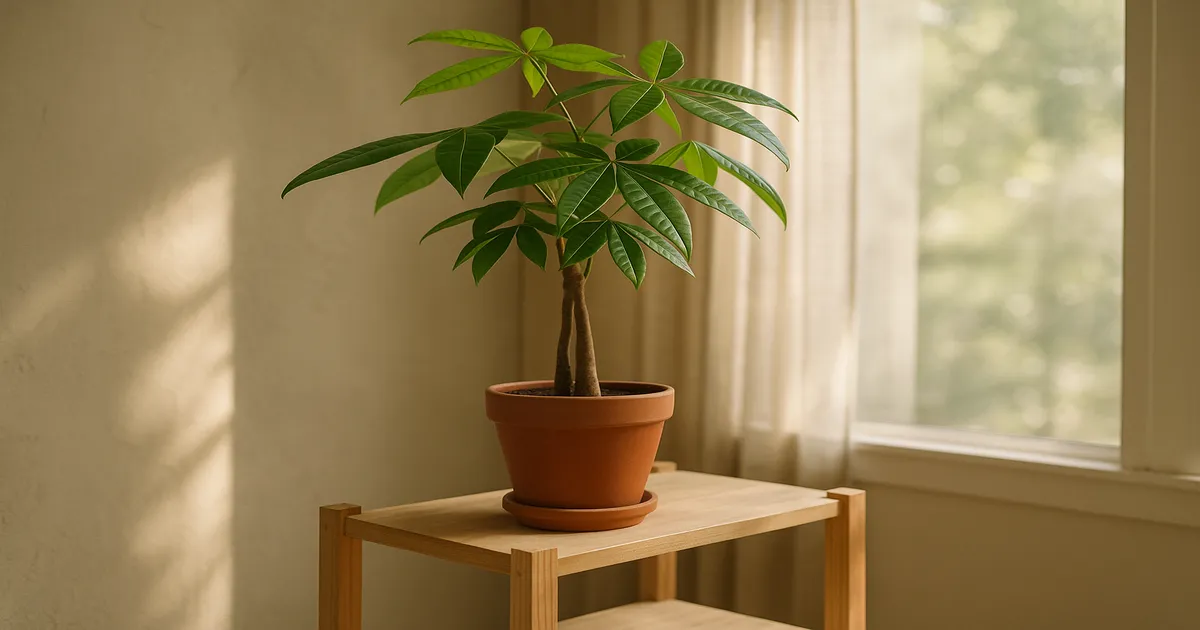
Quick Answer: Bare lower branches on a money tree are almost always caused by apical dominance, low light, or environmental stress — not disease. The fix is strategic tip pruning combined with correcting the underlying cause. Pruning alone without improving light, watering, or humidity will only produce temporary results.
If you’re trying to figure out how to go about pruning a money tree with no leaves on the bottom of the branches, here’s the good news: you’re dealing with one of the most common money tree problems, and it’s almost always fixable. The bare stems look alarming, but they usually mean the plant is redirecting energy upward — not dying. Understanding why the lower branches went bare is what separates a lasting fix from a temporary one.
Why Money Trees Lose Leaves on the Lower Branches
Apical Dominance: The Most Common Cause
Pachira aquatica produces a growth hormone called auxin at its tip meristems. This hormone flows downward and suppresses bud development lower on the stem — a natural phenomenon called apical dominance. The taller the plant grows, the more auxin accumulates along the lower stem, and the more aggressively lower leaves are deprioritized. Braided specimens make this worse because multiple competing stems all push growth upward at once.
Low Light and Self-Shading
As the upper canopy fills in, it casts shade on the lower stems. When light at the base drops below roughly 50–75 foot-candles, those leaves can no longer photosynthesize efficiently enough to justify their metabolic cost. The plant responds with programmed leaf senescence — stripping nutrients from those leaves before dropping them. Overall low light (below 200 foot-candles) accelerates this across the whole plant.
Overwatering and Root Rot
Despite originating in tropical wetlands, container-grown money trees are highly susceptible to root rot from Pythium, Phytophthora, and Fusarium species when drainage is poor. Damaged roots can’t supply water and nutrients efficiently, so the plant sheds lower leaves to reduce transpiration demand. Yellowing that starts at the bottom combined with soil that stays wet for more than 10 days points strongly to overwatering.
Underwatering and Drought Stress
Chronic underwatering causes turgor pressure loss in leaf cells. The plant closes its stomata and drops leaves — oldest and lowest first, since those are furthest from the root system’s primary water pressure zone. Inconsistent watering (long dry spells followed by heavy soaking) can mimic drought stress even when you do water occasionally.
Low Humidity, Temperature Stress, and Cold Drafts
Money trees evolved in environments with 60–90% relative humidity. Most homes sit at 30–50%, dropping further in winter. When humidity stress sets in, the plant reduces its total leaf surface area by shedding older, lower foliage first. Temperatures below 50°F (10°C) trigger ethylene production, which accelerates leaf drop — and lower leaves, being closest to cold floors and drafty windows, are usually the first to go.
Nutrient Deficiency
Nitrogen is a mobile nutrient. When supplies run low, the plant cannibalizes older lower leaves to feed new growth at the tips, causing progressive yellowing from the bottom up. Magnesium deficiency shows a similar pattern but with interveinal chlorosis — leaf veins stay green while the tissue between them yellows. Container soil is typically depleted within 3–6 months without supplemental feeding.
Pests and Root-Bound Stress
Spider mites, mealybugs, and scale insects concentrate on vascular tissue and lower stem axils, causing direct cell damage and triggering leaf drop. Spider mites in particular thrive when humidity drops below 40%. Root-bound plants face a separate but equally damaging issue: when the root system becomes too crowded, nutrient and water uptake suffers regardless of how well you water, and the plant responds exactly as it does to drought.
How to Diagnose the Problem Before You Prune
The pattern and appearance of leaf loss tells you a lot before you touch a pair of shears.
- Clean leaf drop with healthy, lush upper growth → apical dominance or light issue
- Yellowing lower leaves, soggy soil, mushy stems → overwatering or root rot
- Crispy brown leaf edges, dry soil, curling leaves → underwatering or low humidity
- Yellow leaves with green veins → magnesium deficiency
- Pale, washed-out upper leaves plus lower drop → nitrogen deficiency
- Sticky residue, webbing, or white cottony clusters on stems → pests
Check soil moisture first. Push your finger 2 inches into the soil. If it’s still wet more than a week after watering, drainage is the problem. A soil moisture meter gives you a more objective read — you’re aiming for a reading of 3–4 on a 1–10 scale before rewatering. If you suspect root rot, unpot the plant and inspect: healthy roots are firm and white to tan; rotted roots are brown, black, or mushy and may smell.
Check light levels next. A free light meter app on your phone gives a rough foot-candle reading. Money trees need bright indirect light (1,500–3,000 foot-candles) to thrive. Hold your phone at the lower stem level and compare it to the reading near the canopy. A dramatic difference confirms self-shading.
Inspect for pests last. Use a magnifying glass to check leaf undersides and stem joints. Spider mites leave fine webbing and tiny dots; mealybugs leave white fluff; scale looks like small brown bumps stuck to stems. If the plant looks clean but has interveinal yellowing on lower leaves, review your fertilization history before assuming pests.
How to Prune a Money Tree with No Leaves on the Bottom of the Branches
Tools and Sterilization
You’ll need sharp bypass pruners and 70% isopropyl alcohol. Wipe blades thoroughly before you start and between cuts — this prevents transmitting fungal or bacterial pathogens between stems, which matters especially on braided specimens where multiple plants share close quarters.
Best Time to Prune
Spring and early summer are ideal. The plant is entering its active growth phase and has the energy reserves to respond to pruning by activating new buds rather than going into stress. Avoid heavy pruning in fall and winter when recovery is slow.
Step-by-Step Pruning to Stimulate Lower Bud Growth
- Identify the tallest, most dominant branch tips — these are your primary auxin sources and the first targets.
- Locate a node (a slight bump or leaf scar) a few inches below each tip.
- Cut just above the node at a 45-degree angle so water runs off rather than pooling on the cut surface.
- Work from the top down, removing the most dominant tips first and reassessing as you go.
- Step back frequently — it’s easy to over-prune once you start.
- Apply a diluted balanced fertilizer (half-strength 10-10-10 or 20-20-20) 1–2 weeks after pruning to support bud activation.
Removing the apical tips reduces auxin concentration along the stem, which can activate dormant lower buds within 4–8 weeks. Don’t expect overnight results.
Never remove more than 20–25% of total foliage in a single session. Taking too much at once causes shock and sets recovery back significantly. If the plant needs heavy reshaping, spread it across two sessions a few months apart.
Special Considerations for Braided Money Trees
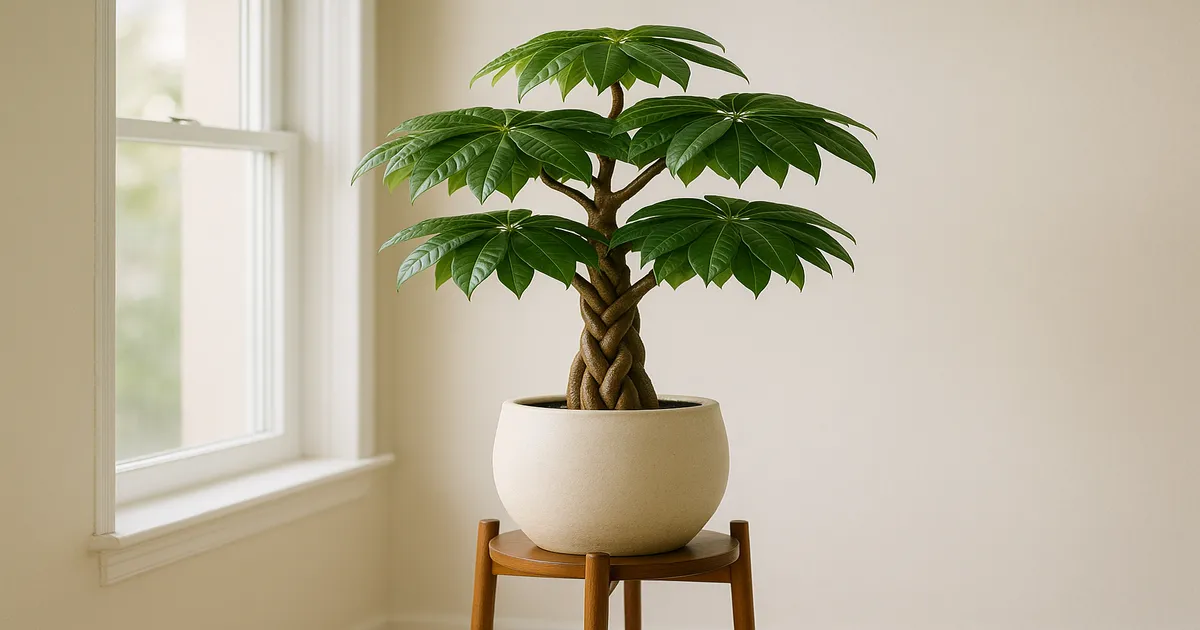
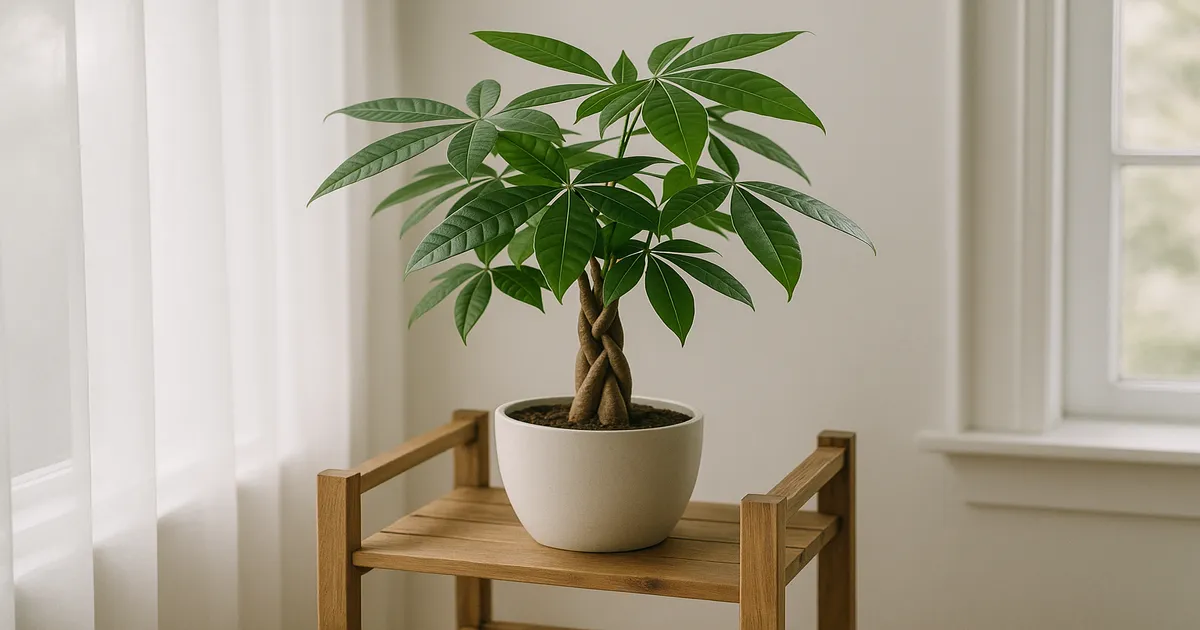
On a braided specimen, prune the tallest, most dominant stem first rather than all stems at once. One dominant stem tends to suppress the others — reducing it gives the less dominant stems a chance to push new growth before you make further cuts. This staged approach produces more even results across the braid.
Fixing the Underlying Causes So Bare Stems Don’t Return
Light
Move the plant to within 3–5 feet of an east- or south-facing window. If natural light is limited, a full-spectrum LED grow light running 12–14 hours per day at 12–18 inches above the canopy will compensate. Rotate the plant 90 degrees every 1–2 weeks so lower branches get their share of light, and trim the upper canopy lightly to let more light filter down to bare stems.
Watering
Base every watering decision on soil moisture, not the calendar. Water deeply when the top 1–2 inches of soil are dry, letting water drain freely from the bottom. If the soil has become hydrophobic and water runs straight through, bottom-water by setting the pot in a tray of water for 30–60 minutes. In summer this typically means watering every 7–10 days; in winter, every 14–21 days — but always let the soil make the call.
Root Rot
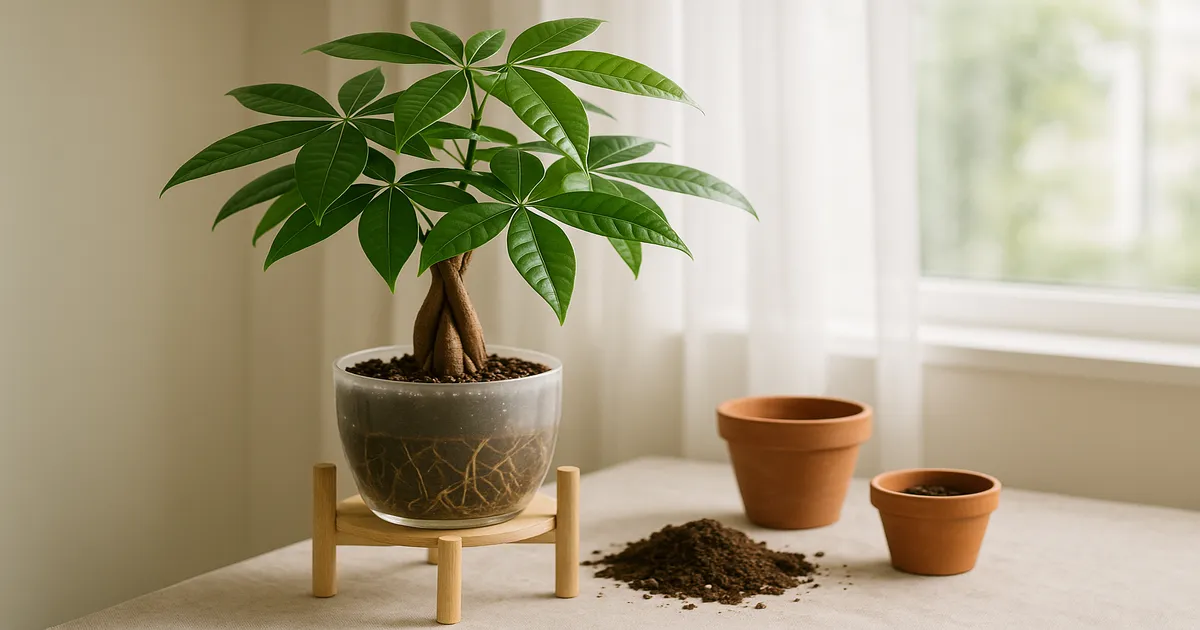
Remove the plant from its pot and trim all brown, mushy roots with sterilized scissors. Dust cut ends with powdered cinnamon or horticultural sulfur as a natural antifungal. Repot into a fresh mix of 60% quality potting soil, 20% perlite, and 20% coarse orchid bark in a pot with drainage holes. For severe rot, drench the root zone with a 1:4 dilution of 3% hydrogen peroxide and water to oxygenate the soil and suppress anaerobic pathogens.
Humidity and Temperature
A cool-mist humidifier targeting 50–70% relative humidity is the most reliable solution. Grouping the money tree with other houseplants creates a slightly more humid microclimate through collective transpiration. A pebble tray under the pot helps too — just make sure the pot base isn’t sitting directly in the water. Skip misting; it raises humidity for only minutes and can encourage fungal leaf spot. Keep the plant away from HVAC vents, drafty windows, and exterior doors.
Fertilizing
Feed with half-strength balanced fertilizer (10-10-10 or 20-20-20 NPK) every 4–6 weeks from March through September. For magnesium deficiency specifically, apply a foliar spray of Epsom salt solution (1 teaspoon per gallon of water) monthly — magnesium sulfate absorbs quickly through leaf tissue. Flush the soil with plain water every 2–3 months to prevent fertilizer salt buildup, which can itself trigger lower leaf drop.
Pests and Root-Bound Conditions
Treat spider mites and mealybugs with insecticidal soap or neem oil (2 teaspoons per quart of water with a drop of dish soap) every 5–7 days for 3–4 cycles. Remove scale manually with a cotton swab dipped in isopropyl alcohol, then follow up with neem. For fungus gnats, let the soil dry more aggressively and apply a Bacillus thuringiensis israelensis (Bti) soil drench. If the plant is root-bound, repot in spring into a container 1–2 inches larger in diameter, gently loosening circling roots before placing in fresh soil.
Will Bare Lower Branches Grow Leaves Back?
Stems that are bare but still have visible dormant bud tissue — small bumps or scars along the stem — can absolutely reactivate after tip pruning. The auxin suppression lifts, conditions improve, and new growth emerges from those dormant sites within 4–8 weeks. Very old, fully lignified stems that have been bare for years and show no bud tissue are a different story; those may not re-leaf regardless of what you do.
If a stem has been completely bare and woody for a long time with no visible bud sites, you have a few options: accept the bare lower trunk as a structural design element (it can look quite elegant), use the exposed stems to display trailing plants, or propagate healthy cuttings from the upper growth to start a fresh, fuller plant. Consistent long-term care improvements matter far more than any single pruning session.
Preventing Bare Lower Branches: Ongoing Care
Light maintenance pruning once or twice a year — spring and early summer — keeps apical dominance from getting out of hand before bare stems become extensive. A little off the top, done consistently, is far easier to manage than a dramatic rescue pruning every few years.
Quick reference for ongoing care:
- Light: Bright indirect light (1,500–3,000 foot-candles), 3–5 feet from an east- or south-facing window; rotate 90 degrees every 1–2 weeks
- Watering: Soil-moisture-based; deep and thorough each time; room-temperature filtered or distilled water when possible
- Humidity: 50–70% relative humidity year-round, monitored with a digital hygrometer
- Fertilizing: Half-strength balanced fertilizer every 4–6 weeks, March through September; flush soil every 2–3 months
- Repotting: Every 2–3 years into a container 1–2 inches larger with fresh well-draining soil
- Pest prevention: Monthly wipe-downs with diluted neem oil; quarantine new plants for 2–4 weeks before placing near your money tree
Wipe leaves monthly with a damp soft cloth as well — dust buildup can reduce photosynthetic efficiency noticeably, quietly stressing the plant over time.
Frequently Asked Questions
Why does my money tree have leaves only at the top and bare stems at the bottom?
This is almost always a combination of apical dominance and low light. The plant’s growing tips produce auxin, which suppresses lower bud development, while the dense upper canopy shades out lower leaves until they drop. It’s a natural growth pattern that accelerates when light levels are low or the plant hasn’t been pruned in a while.
Can I cut back the bare branches on my money tree to encourage new leaf growth?
Yes. Pruning the dominant tips reduces auxin production and can activate dormant buds along bare stems within 4–8 weeks. Cut just above a node at a 45-degree angle and remove no more than 20–25% of total foliage at once. Pruning works best when you also improve light and watering conditions at the same time.
How do I know if bare lower branches are caused by overwatering or lack of light?
Check the soil and the pattern of leaf loss. Overwatering typically shows soggy soil that stays wet for more than a week, soft yellowing leaves, and sometimes a mushy stem base. Low light usually produces a clean leaf drop with healthy green upper growth and normal soil moisture. A moisture meter and a light meter app can remove the guesswork quickly.
Will new leaves grow back on bare money tree stems after pruning?
They can, if dormant bud tissue is still present along the stem. After tip pruning reduces auxin levels, dormant buds may reactivate within 4–8 weeks given adequate light, humidity, and nutrients. Very old, fully lignified bare stems with no visible bud sites are unlikely to re-leaf and may need to be accepted as permanent structural features.
How often should I prune a braided money tree to keep it from going bare at the base?
Light maintenance pruning once or twice a year in spring and early summer is usually enough to stay ahead of apical dominance. On braided specimens, focus first on the tallest, most dominant stem rather than trimming all stems at once. Consistent annual pruning is far more effective than waiting until the bare stems are extensive and then attempting a dramatic rescue cut.