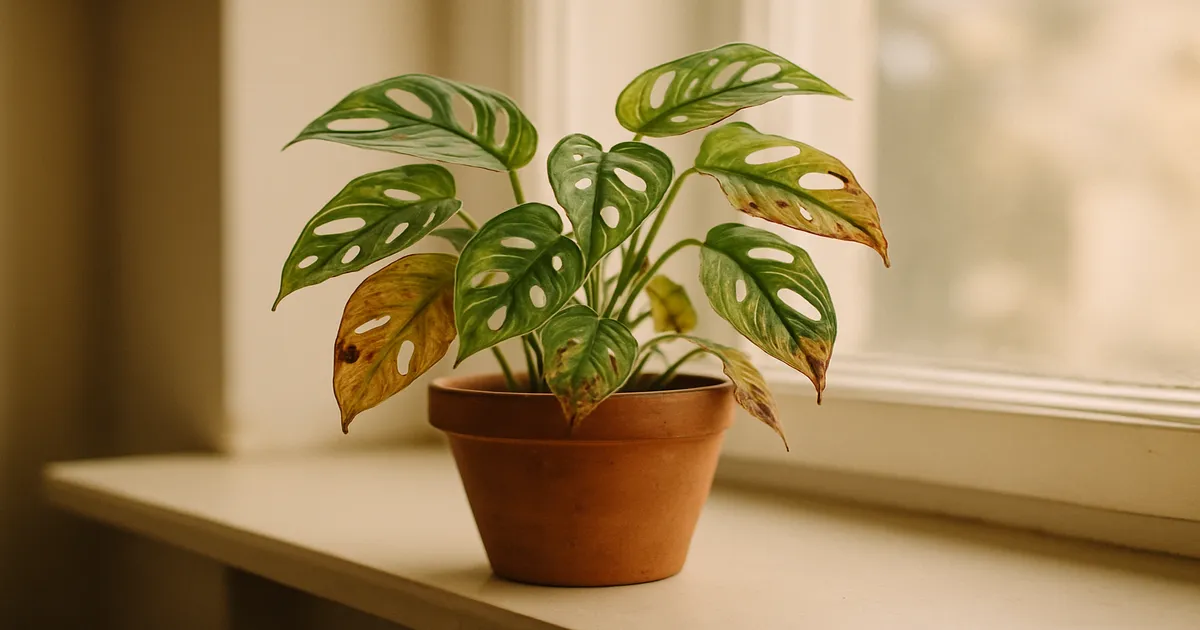
Quick Answer: The most common reason a Monkey Mask Monstera (Monstera adansonii) is dying is overwatering and root rot — its epiphytic roots aren’t built for constantly wet soil. Too little light, low humidity, pest infestations, and nutrient imbalances are the other usual suspects. Identify the specific symptom first, then follow the targeted fix below.
Why Is My Monkey Mask Monstera Dying? The 9 Most Common Causes
If your Monkey Mask Monstera is dying, the problem almost always traces back to one of nine causes. M. adansonii evolved as a hemiepiphyte — clinging to tree trunks in tropical rainforests — so its roots need air as much as moisture. Waterlogged soil suffocates them fast.
| # | Cause | Key Symptom |
|---|---|---|
| 1 | Overwatering / root rot | Yellow leaves, mushy stems, foul smell |
| 2 | Underwatering | Crispy brown edges, inward-curling leaves |
| 3 | Too little or too much light | Leggy etiolation or bleached sunscald patches |
| 4 | Low humidity or temperature stress | Brown leaf tips, cold-damaged black patches |
| 5 | Nutrient deficiency | Patterned yellowing matched to specific nutrients |
| 6 | Overfertilization / salt burn | Brown tips, white crust on soil surface |
| 7 | Pest infestation | Stippling, webbing, sticky residue, distorted growth |
| 8 | Root-bound or compacted soil | Stunted growth, rapid soil drying, roots escaping drainage holes |
| 9 | Fungal or bacterial disease | Water-soaked lesions, white mycelium at soil line |
How to Read Your Plant’s Distress Signals
Location matters. Yellowing that starts on older, lower leaves usually points to nitrogen deficiency or overwatering. Yellowing on new growth with green veins suggests iron or manganese lockout. Crispy edges are different from mushy browning — one signals drought or low humidity, the other rot. Use these distinctions to zero in before you do anything else.
Overwatering & Root Rot: The Number One Killer
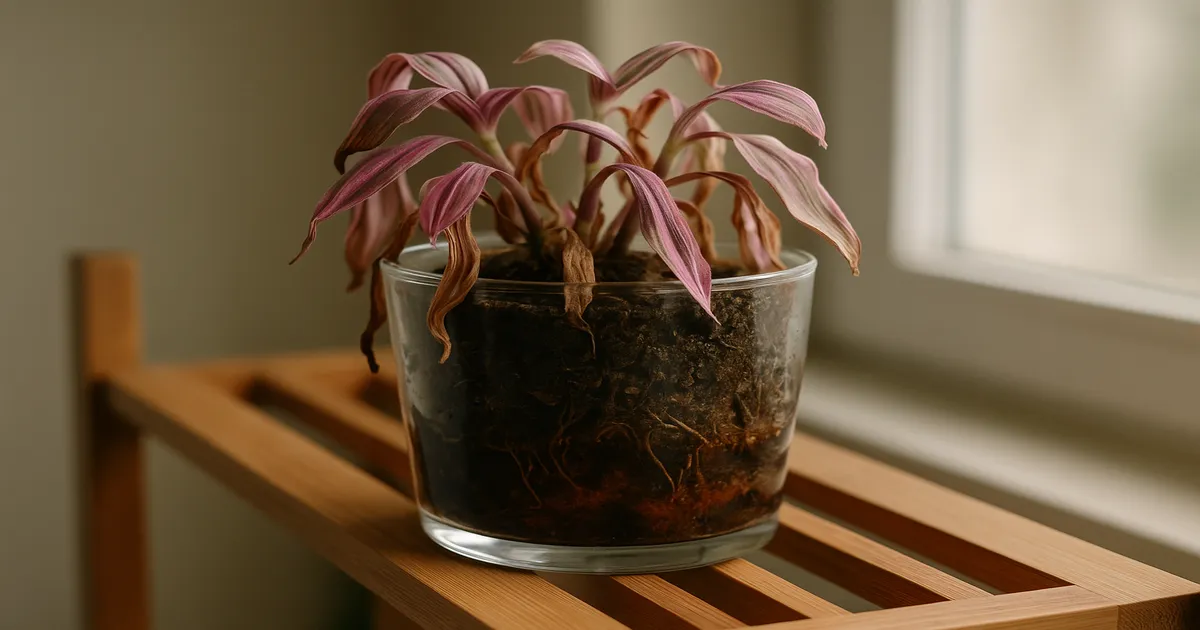
M. adansonii’s roots evolved to grip tree bark and absorb water from brief rain events — not to sit in saturated potting mix. Sustained moisture creates anaerobic conditions that invite Pythium, Phytophthora, and Fusarium, the fungal pathogens behind root rot.
How to Identify Root Rot
Watch for this cluster of symptoms:
- Yellowing lower leaves that feel soft rather than crispy
- Wilting despite wet soil — a red flag, since healthy roots should be absorbing that moisture
- Mushy, brown or black stems at the soil line
- Foul, sulfurous odour from the potting medium
- Brown, slimy roots that fall apart when touched (healthy roots are firm and white to tan)
Step-by-Step Root Rot Treatment
- Unpot the plant and shake off as much old soil as possible.
- Trim every brown or mushy root with scissors sterilised in 70% isopropyl alcohol — sterilise between cuts.
- Let the root ball air-dry for 30–60 minutes.
- Dust all cut surfaces with powdered sulphur or activated charcoal to inhibit fungal regrowth.
- Repot into fresh aroid mix (recipe below) in a pot only 1–2 inches larger than the remaining root ball.
- For severe cases, water in a (RootShield) Trichoderma-based biological fungicide — these beneficial fungi outcompete rot pathogens in the soil.
- Water sparingly for 2–3 weeks and hold fertiliser for 4–6 weeks.
Best Pot and Soil to Prevent Recurrence
Terracotta pots are the single best upgrade you can make. They wick moisture through their walls and give roots the wet-dry cycle they need. Always use a pot with drainage holes.
DIY aroid mix:
- 40% quality potting mix (peat- or coco coir-based)
- 30% coarse perlite (4–8 mm)
- 20% medium orchid bark
- 10% horticultural charcoal
Target a soil pH of 5.5–6.5. This mix drains freely, resists compaction, and keeps roots aerated between waterings.
Underwatering, Light Problems & Environmental Stress
Signs Your Monkey Mask Monstera Is Underwatered
Underwatering is less common than overwatering but just as damaging over time. Chronic drought causes cells to lose turgor, and once that damage is severe enough, it becomes irreversible.
Look for:
- Crispy, brown leaf edges and tips (distinct from the soft, mushy browning of rot)
- Leaves curling inward to reduce surface area and slow water loss
- Bone-dry soil pulling away from the pot edges
- A pot that feels unusually light when lifted
To rescue a severely dehydrated plant, bottom-water it: set the pot in a basin of room-temperature water for 30–45 minutes and let the soil rehydrate from below. If the soil has turned hydrophobic and repels water, a few drops of a plant-safe wetting agent — yucca extract works well — will break the surface tension.
How Much Light Does a Monkey Mask Monstera Need?
M. adansonii needs bright indirect light, roughly 1,500–3,000 foot-candles. In practice, that means a few feet back from a bright south- or west-facing window, or right beside an unobstructed east-facing one.
Below about 200 foot-candles, photosynthesis slows, stems grow long and leggy with tiny leaves and fewer fenestrations, and soil stays wet far longer — a direct path to root rot. Too much direct sun (above roughly 5,000 foot-candles) bleaches chlorophyll faster than the plant can replace it, leaving silvery or tan patches that won’t recover. In low-light seasons, supplement with a (Barrina) 6,500 K full-spectrum LED grow light positioned 6–12 inches above the plant on a 12–14 hour timer.
Ideal Temperature and Humidity
Keep temperatures between 65–85°F (18–29°C). Chilling injury begins below 55°F (13°C) — you’ll see water-soaked patches that turn black — and prolonged exposure below 50°F (10°C) can be fatal. Cold drafts from single-pane windows, AC vents, or exterior doors cause localised damage even when the room itself feels warm.
For humidity, target 60–80% relative humidity. Most homes sit at 30–50%, which is genuinely too dry for this plant, especially in winter.
Fixing Low Humidity — Skip the Misting
Misting gives only a momentary humidity boost and leaves leaf surfaces wet, which encourages bacterial leaf spot. Better options:
- Ultrasonic cool-mist humidifier placed nearby — monitor levels with a digital hygrometer so you’re not guessing
- Pebble tray filled with water beneath the pot (keep the pot bottom above the waterline)
- Plant grouping — clustering plants raises local humidity through collective transpiration
Nutrient Deficiencies and Fertilizer Problems
Identifying Deficiency by Leaf Pattern
The pattern of yellowing tells you what’s missing:
- Generalised yellowing, older leaves first → nitrogen deficiency
- Interveinal chlorosis on new growth (yellow between green veins) → iron or manganese deficiency, often caused by soil pH above 7.0 locking out micronutrients that are already present
- Interveinal yellowing on old leaves → magnesium deficiency
- Scorched, brown leaf margins → potassium deficiency
Soil pH is often the real culprit. Even if nutrients are physically in the soil, a pH above 7.0 makes them chemically unavailable. Test your soil and aim for 5.5–6.5.
How to Fix Salt Burn from Overfertilization
Salt buildup from excess fertiliser draws water out of root cells via osmosis, causing a kind of chemical drought. Symptoms include brown leaf tips, wilting, and a white crusty deposit on the soil surface or pot rim.
Fix it by flushing: run room-temperature water slowly through the pot for 3–5 minutes, let it drain fully, and repeat two or three times. Wait 4–6 weeks before fertilising again, then restart at quarter strength.
Fertilizing Schedule
During the growing season (spring through early autumn), feed with a balanced liquid fertiliser (Jack’s Classic All Purpose) at half the recommended strength every 2–4 weeks. For persistent interveinal chlorosis, add a chelated micronutrient supplement — chelated forms stay available across a wider pH range than standard mineral forms. Stop feeding entirely in winter; the plant’s uptake slows dramatically and excess salts will accumulate.
Common Pests on Monkey Mask Monstera
Stressed plants are far more vulnerable to pest colonisation — think of pest pressure as a symptom of broader care issues, not just bad luck. Quarantine any infested plant immediately before treating.
Spider Mites
Spider mites thrive in hot, dry conditions — exactly the environment a humidity-starved Monkey Mask creates. Look for stippled or silvery leaf surfaces and fine webbing on leaf undersides and between stems. Spray thoroughly with cold-pressed neem oil (emulsified with a drop of dish soap) or insecticidal soap, coating every surface including undersides. Repeat every 5–7 days for three to four cycles. Raising humidity to 60%+ also makes the environment less hospitable.
Fungus Gnats
Adult fungus gnats are annoying but largely harmless; their larvae are the real problem. They feed on root hairs in moist soil and can introduce rot pathogens, causing symptoms that look identical to overwatering.
- Let the soil dry more thoroughly between waterings — larvae can’t survive in dry conditions
- Add a 1-inch top dressing of coarse perlite or horticultural sand to deter egg-laying
- Use yellow sticky traps for adults
- Drench the soil with a (Mosquito Bits) Bacillus thuringiensis var. israelensis (Bti) solution to kill larvae biologically
Scale, Mealybugs, and Thrips
Scale and mealybugs are best tackled manually first: swab visible insects with a cotton ball dipped in 70% isopropyl alcohol, then follow up with a neem oil spray for heavy infestations.
Thrips rasp leaf surfaces, leaving silvery streaks and distorted new growth. Spray with a spinosad-based insecticide every 5–7 days — it’s derived from soil bacteria and has low mammalian toxicity. Blue sticky traps help you monitor population levels.
Root-Bound Plants, Poor Soil & Transplant Shock
How to Tell If Your Monstera Is Root-Bound
M. adansonii typically needs repotting every 1–2 years. Signs it’s time:
- Roots circling the bottom of the pot or poking out of drainage holes
- Soil drying out within a day or two of watering
- Stunted growth despite adequate light and feeding
- General decline that doesn’t respond to other fixes
Old peat-heavy mixes compound the problem. Over 12–18 months, peat compacts and becomes hydrophobic, repelling water and starving roots of oxygen even if the pot isn’t technically overcrowded.
When and How to Repot
Spring is ideal — the plant is entering active growth and recovers fastest. Choose a new pot only 1–2 inches larger in diameter. Going too large is a common mistake; excess soil holds moisture the roots can’t use, increasing rot risk. Use the aroid mix from the root rot section, and gently loosen any circling roots before placing the plant in its new home.
Managing Transplant Shock
Some wilting and leaf drop in the 2–6 weeks after repotting is completely normal. The plant is temporarily unable to regulate water uptake while it establishes new root contacts. Don’t panic, and don’t overwater to compensate. Withhold fertiliser for 4–6 weeks post-repot. Variegated forms of M. adansonii are especially sensitive and may take longer to bounce back.
Fungal and Bacterial Diseases
Bacterial Leaf Spot vs. Anthracnose
Bacterial leaf spot (Pseudomonas or Xanthomonas spp.) starts as water-soaked lesions surrounded by yellow halos that darken to brown or black. It spreads rapidly in warm, humid conditions with poor airflow, entering through stomata or any wound on the leaf surface.
Anthracnose (Colletotrichum spp.) looks similar but tends to produce brown lesions with a distinctly darker border, often beginning at leaf tips or edges rather than in the middle of the blade.
For both: remove affected tissue immediately with sterilised tools, avoid wetting leaves when watering, improve air circulation, and apply a copper-based bactericide or fungicide as directed.
Southern Blight
Southern blight (Sclerotium rolfsii) is less common but moves fast. The giveaway is white, cottony mycelial growth at the soil line, often with tiny mustard-seed-sized tan or brown sclerotia nearby. Isolate the plant immediately, remove and dispose of affected soil, and treat with an appropriate fungicide. If the crown is compromised, the plant may not be salvageable.
Prevention Through Airflow and Hygiene
Good airflow is your best defence against all fungal and bacterial diseases. Space plants apart, run a small fan on low nearby, and always water at soil level rather than overhead. Sterilise pruning tools between plants with 70% isopropyl alcohol, and remove dead or damaged leaves promptly — they’re entry points for pathogens.
Monkey Mask Monstera Care Cheat Sheet
Watering
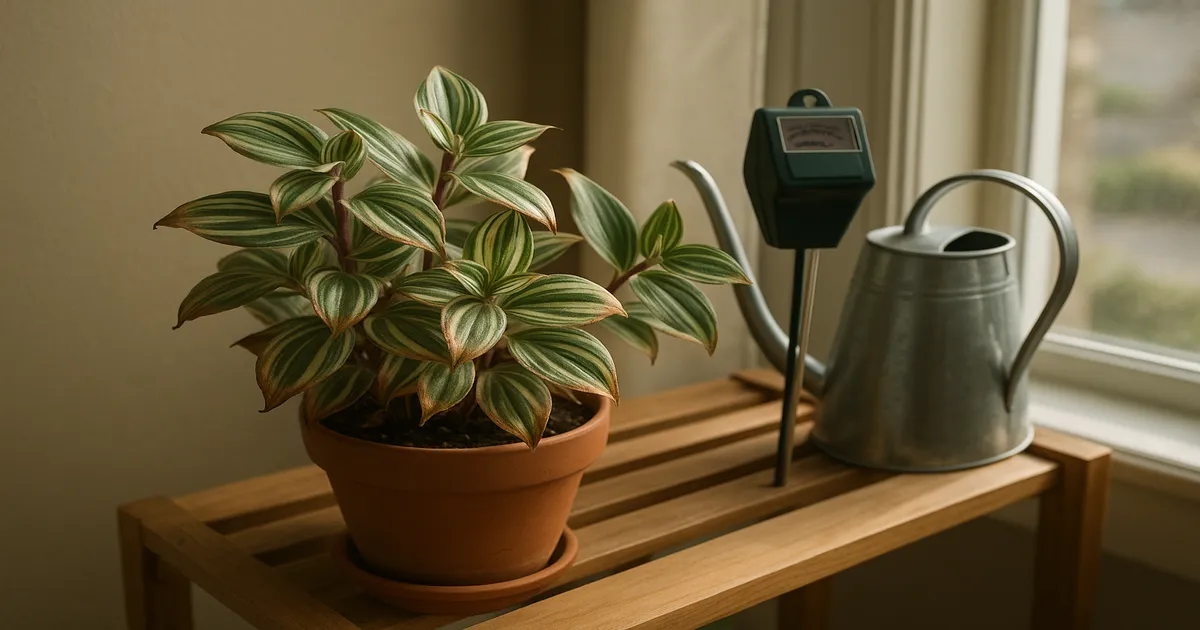
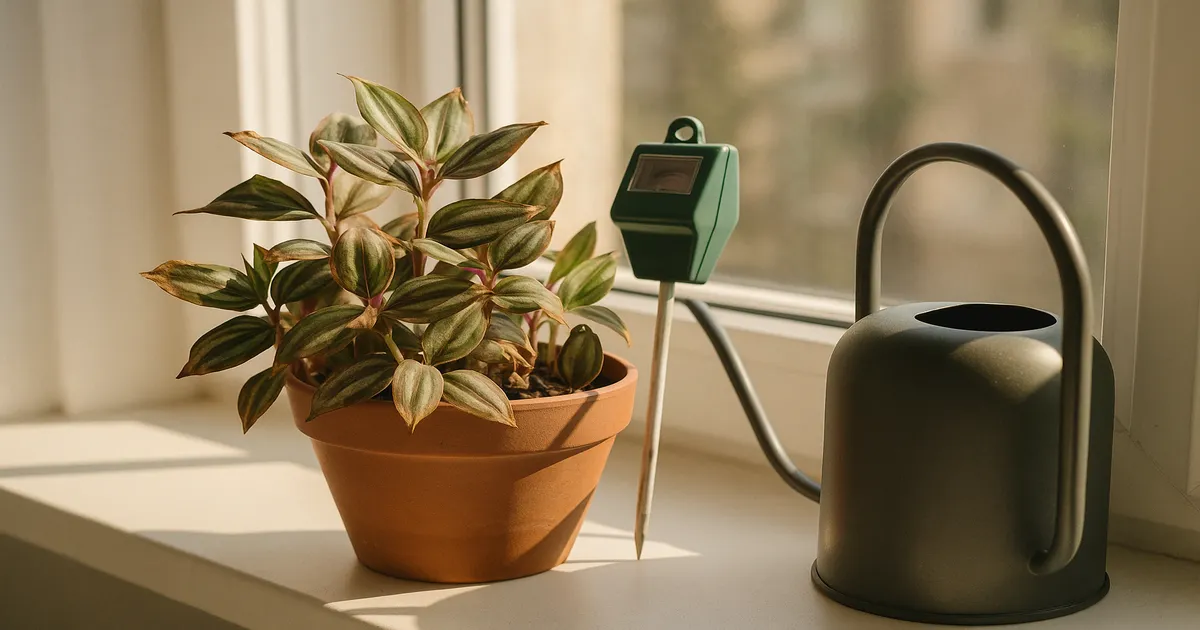
Allow the top 50–75% of soil to dry out before watering again — not just the surface. A (XLUX) calibrated probe moisture meter removes the guesswork entirely; water when it reads 3–4 out of 10 in the mid-to-lower root zone. Bottom-water whenever the soil has become very dry to ensure even rehydration.
Light, Temperature & Humidity Quick-Reference
| Parameter | Ideal Range | Limit |
|---|---|---|
| Light | Bright indirect (1,500–3,000 fc) | Min ~200 fc; avoid direct sun above 5,000 fc |
| Temperature | 65–85°F (18–29°C) | Never below 55°F (13°C) |
| Humidity | 60–80% RH | Below 40% causes chronic stress |
Seasonal Adjustments
- Spring–Summer: Water more frequently, fertilise every 2–4 weeks, watch for pests as temperatures rise
- Autumn: Taper watering and feeding as growth slows
- Winter: Stop fertilising, reduce watering significantly, supplement light if days are short, and monitor humidity as heating systems dry indoor air
Variegated forms need extra attention year-round — their reduced chlorophyll makes them more sensitive to both low light and cold stress.
When to Worry vs. When to Wait
Not every yellow leaf is a crisis. Older, lower leaves naturally yellow and drop as the plant matures — that’s normal senescence, not disease. A leaf or two dropping after repotting is expected. The warning signs worth acting on immediately are: multiple leaves yellowing at once, mushy tissue, foul smells, visible pests, or a complete halt to growth during the active season.
Resist the urge to “help” by watering more or repotting urgently. Both are among the most common ways well-meaning owners accidentally make things worse.
Frequently Asked Questions
Why is my Monkey Mask Monstera dying even though I water it regularly?
Regular watering is often the problem, not the solution. M. adansonii needs the soil to partially dry out between waterings — roughly the top 50–75% of the pot. If you’re watering on a fixed schedule regardless of soil moisture, you’re likely overwatering, which leads to root rot. Check the roots: if they’re brown, mushy, or smell sour, follow the root rot treatment steps above.
Why are my Monkey Mask Monstera leaves turning yellow?
Yellowing leaves most often signal overwatering or root rot, especially when lower leaves are affected first and the soil feels wet. If the yellowing shows a pattern — green veins with yellow between them — suspect a nutrient deficiency or a soil pH problem locking out iron or magnesium. Match the pattern to the deficiency guide above before treating.
Why does my Monkey Mask Monstera have brown crispy leaf edges?
Crispy brown edges almost always point to low humidity, underwatering, or fertiliser salt burn — sometimes all three at once. Check whether the soil is dry and the pot feels light (underwatering), whether you’re in a low-humidity environment below 40% RH, or whether there’s a white crust on the soil surface (salt buildup). Once leaf tissue is crispy it won’t recover, but new growth will come in healthy once the cause is fixed.
How do I save a Monstera adansonii with root rot?
Act fast. Unpot the plant, cut away all brown or mushy roots with sterilised scissors, and let the root ball air-dry for 30–60 minutes. Dust cut ends with powdered sulphur or activated charcoal, then repot into fresh, well-draining aroid mix in a terracotta pot with drainage holes. Water sparingly for 2–3 weeks. For severe cases, a Trichoderma-based biological fungicide watered into the soil gives the roots extra protection while they recover.
How often should I water a Monkey Mask Monstera?
There’s no universal schedule — frequency depends on pot size, soil mix, light levels, season, and humidity. In summer, that might mean watering every 7–10 days; in winter, every 14–21 days. The only reliable method is checking soil moisture directly: use a probe moisture meter or push your finger 2–3 inches into the soil. Water when the reading is 3–4 out of 10, or when the soil feels dry at that depth.