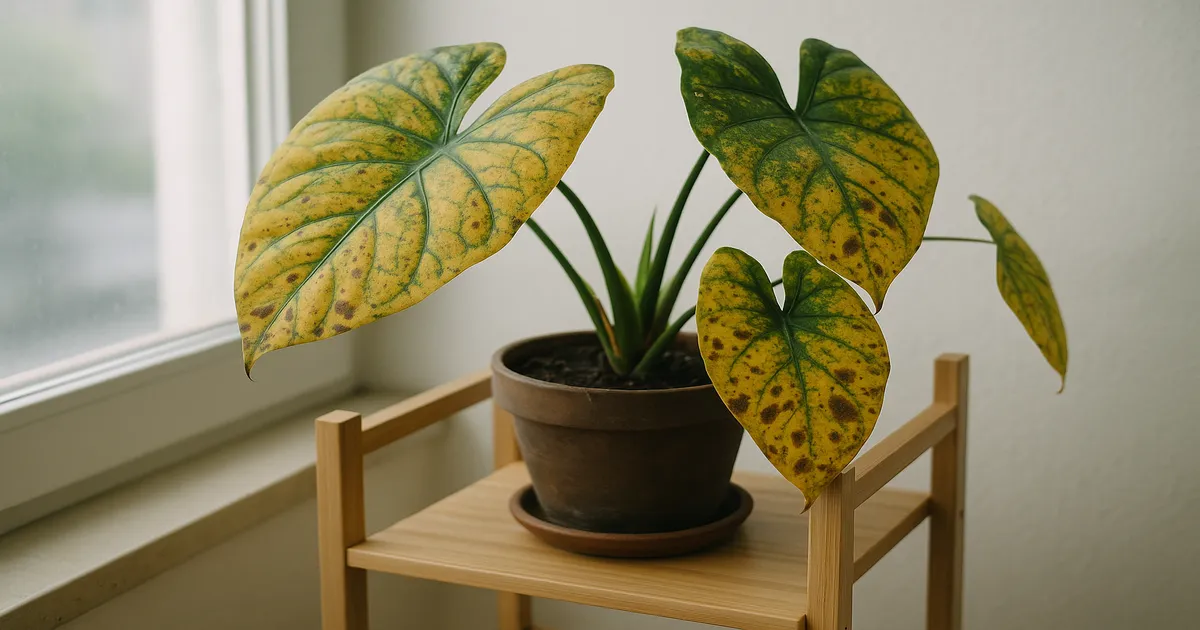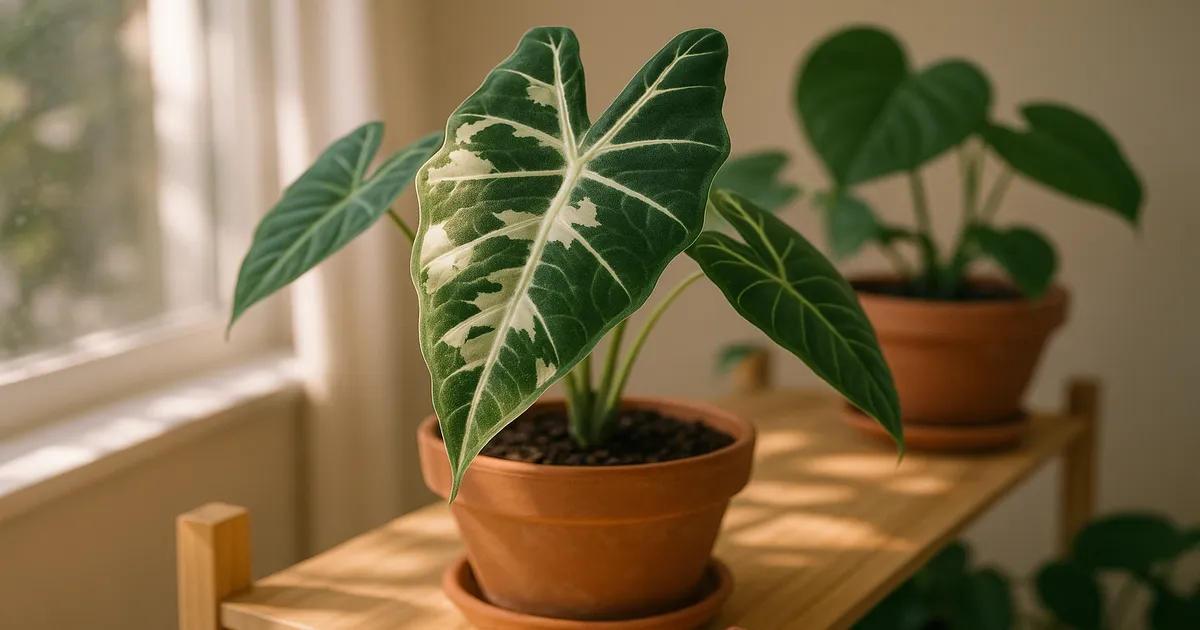
Quick Answer: Those speckles and light green patches on your Alocasia Frydek’s new leaves are most commonly caused by spider mites (fine pale stippling), thrips (silvery streaky marks with black frass dots), or nutrient deficiencies such as magnesium or iron (interveinal chlorosis). New leaves show symptoms first because they’re physiologically immature, with thinner cell walls and still-developing chloroplasts. The good news: once you identify the cause correctly, most cases are fully treatable.
If you’re staring at your Alocasia Frydek wondering why those gorgeous new leaves keep emerging with speckles or washed-out light green patches, you’re not alone. It’s one of the most common questions Frydek owners ask. The Green Velvet Alocasia is a showstopper, but that velvety texture and the plant’s sensitivity to its environment mean new growth can reveal problems fast. This guide walks through every likely cause, how to confirm it, and exactly what to do about it.
Why Alocasia Frydek New Leaves Show Speckles and Light Green Patches First
New Frydek leaves pass through two early stages: the cataphyll (the papery sheath enclosing the emerging leaf) and the emergent leaf (the unfurling blade itself). At both stages, vascular tissue is immature, chloroplasts are still developing, and epidermal cell walls are thinner than they’ll ever be again. Think of a new leaf like a soft-boiled egg — far easier to damage than a hard-boiled one.
This immaturity makes new growth the plant’s built-in early-warning system. Any stress — pest pressure, a nutrient gap, low humidity, or inconsistent watering — shows up on new leaves first, often before older foliage shows any sign of trouble.
How the Velvet Surface Increases Risk
That signature suede-like texture comes from a dense layer of trichomes — microscopic hair-like cells covering the upper leaf surface. It’s what makes Frydek unmistakable, but it creates two specific vulnerabilities. First, the trichomes form tiny micro-humidity pockets that spider mites find irresistible. Second, in low-humidity conditions, those same pockets can trap dry air against the leaf surface, paradoxically accelerating moisture loss during unfurling.
Smooth-leaved Alocasias like ‘Polly’ don’t face this to the same degree. The velvet is a feature worth protecting — which means understanding what threatens it.
Pest-Related Causes of Speckles on Alocasia Frydek
Spider Mites: The Most Common Cause of Fine Stippling
Spider mite damage is the single most frequent reason Frydek leaves develop speckles. You’ll see pale yellow or white dots scattered across the leaf surface — sometimes so numerous the leaf looks dusty or bronzed overall. The pattern tends to be fairly uniform and denser near the midrib.
The mechanism is straightforward but destructive. Tetranychus urticae (two-spotted spider mite) uses piercing-sucking mouthparts to puncture individual leaf cells and drain the chlorophyll-containing contents. Each puncture becomes a tiny pale dot. Multiply that by thousands of feeding sites and you get the stippled look. Frydek’s trichome surface is a preferred habitat — it offers shelter, reduced airflow, and easy access to tender new tissue.
To confirm: Use a 10× hand lens or jeweler’s loupe and check the undersides of affected leaves. Look for tiny moving dots about 0.5 mm in size, oval translucent eggs, and fine silky webbing in more severe infestations.
Thrips: Silvery Streaky Speckles and Frass Dots
Thrips damage looks different from mite damage once you know what to compare. Instead of uniform fine stippling, you’ll see irregular silver-gray or bronze streaks with a slightly scratched or scarred appearance — and crucially, small black dots of frass (insect droppings) scattered across the leaf surface.
Frankliniella occidentalis and Thrips tabaci rasp leaf tissue with asymmetrical mouthparts rather than piercing cleanly, which creates those irregular scars. What makes thrips particularly insidious on Frydek is their timing: they crawl inside the cataphyll sheath and feed on the developing leaf before it even unfurls. By the time you see the damage, the leaf has already been scarred.
To confirm: Hold the leaf over a sheet of white paper and tap it firmly. Thrips are slender, 1–2 mm long, and range from pale yellow to dark brown — they’ll move when they land on the paper.
Nutrient Deficiencies Causing Light Green Patches on Alocasia Frydek
Magnesium Deficiency: Interveinal Chlorosis Starting on Older Leaves
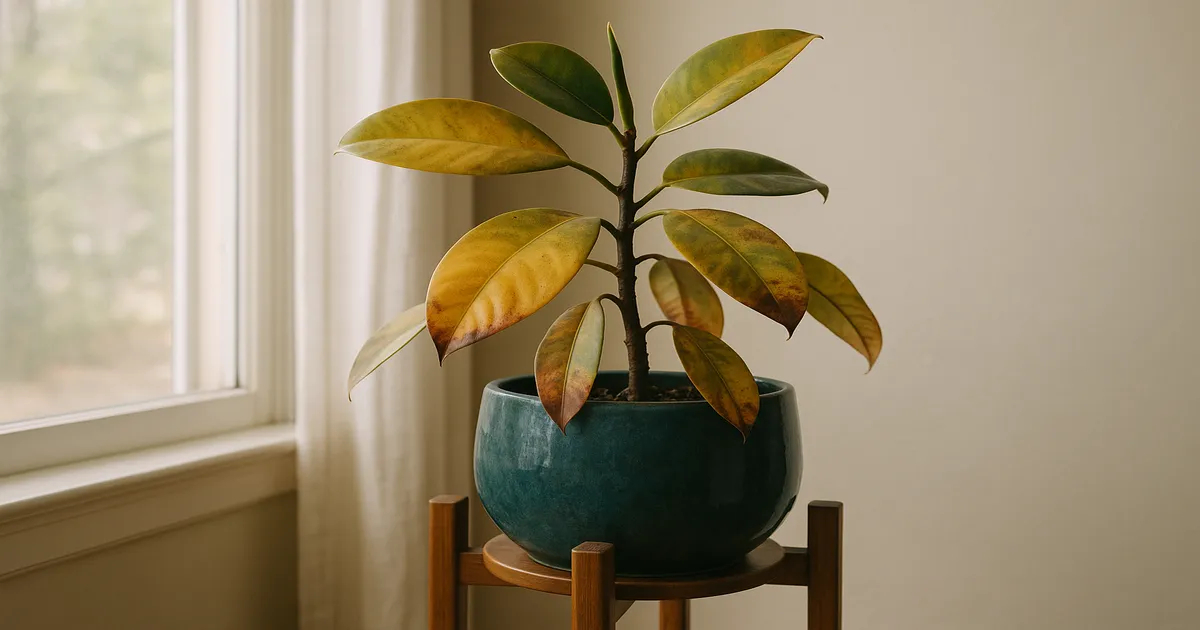
Magnesium is the central atom of every chlorophyll molecule, so when the plant runs short, photosynthetic tissue breaks down. You’ll see light green to yellow patches between the veins, while the veins themselves stay darker — this is called interveinal chlorosis. Because magnesium is a mobile nutrient, the plant pulls it from older leaves and redirects it to new growth, so deficiency classically starts on mature leaves and works upward.
Common culprits include high-calcium fertilizers (calcium and magnesium compete at root uptake sites), extended use of reverse osmosis water without remineralization, and fast-draining media that leaches minerals quickly.
Iron and Manganese Deficiency: Pale New Leaves with Green Veins
Iron and manganese deficiency produces a visually similar interveinal chlorosis, but with one key difference: these are immobile nutrients, so the plant can’t redistribute them from old tissue. Deficiency appears almost exclusively in the newest leaves — often dramatically pale or near-yellow between sharply green veins.
The most common trigger isn’t a lack of iron in the soil; it’s soil pH. Above pH 6.5–7.0, iron precipitates as insoluble iron hydroxides that roots simply cannot absorb, no matter how much is present in the medium.
How Soil pH Drives Nutrient Lockout
Frydek’s ideal soil pH is 5.5–6.5 — slightly acidic. Outside this range, multiple nutrients become chemically unavailable regardless of what you’re adding. If you’re fertilizing regularly but still seeing deficiency symptoms, checking pH is the first diagnostic step, not adding more fertilizer. A reliable digital pH meter — the Bluelab pH Pen is a popular choice among serious growers — is far more accurate than cheap test strips at the margins where Frydek’s needs sit.
Environmental Stress: Watering and Humidity
Overwatering, Root Rot, and Functional Nutrient Deficiency
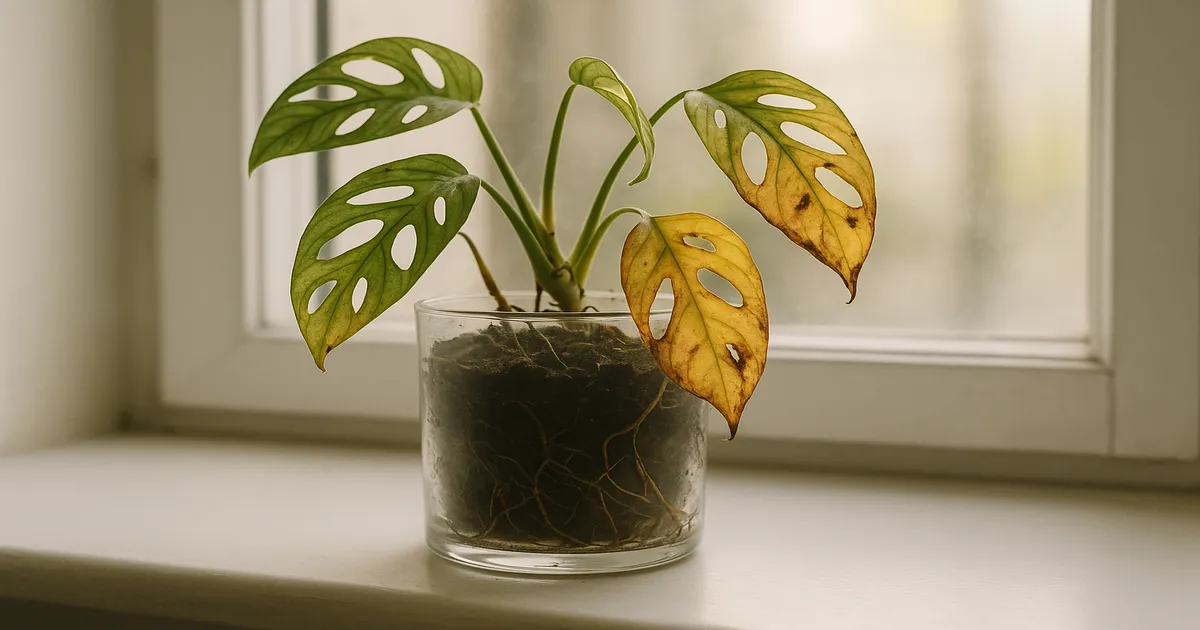
Overwatering starves roots of oxygen and creates conditions where Pythium and Phytophthora root rot pathogens thrive. Rotted roots can’t absorb water or dissolved minerals effectively, so the plant shows what looks exactly like a nutrient deficiency — pale, irregular patches on new growth — even when the soil is full of nutrients. It’s a functional deficiency caused by broken plumbing, not an empty tank.
Underwatering causes its own version of the problem. Developing cells in new leaves form under turgor stress, resulting in smaller, incompletely expanded cells with reduced chloroplast density. Those leaves emerge already pale.
The target: let the top 1–2 inches of soil dry out before watering again. A soil moisture meter takes the guesswork out of this — aim to water when the reading hits around 3–4 on a standard 1–10 scale. The XLUX Soil Moisture Meter is an inexpensive and reliable option.
Low Humidity During Leaf Unfurling
Frydek needs 60–80% relative humidity to thrive, and the unfurling phase is when humidity matters most. A new leaf at this stage is essentially an unprotected membrane. If relative humidity drops below roughly 50%, the leaf surface desiccates faster than the vascular system can compensate, causing localized cell death and chloroplast disruption. The result is pale, papery patches or speckle-like dots that look disturbingly similar to pest damage.
The trichome paradox applies here too: in dry conditions, those velvet hairs can trap dry air against the leaf surface and make desiccation worse, not better. This is also why direct misting on Frydek leaves is a bad idea — it deposits moisture on the surface without raising ambient humidity, and trapped water on that textured surface promotes fungal problems.
Other Causes: TC Artifacts and Viral Infection
Tissue Culture Artifacts: Temporary Irregular Pale Sectors
Many Frydeks sold today are tissue-cultured (TC) plants propagated in sterile lab conditions. The in vitro process can cause somaclonal variation — minor epigenetic changes that temporarily disrupt pigmentation. You might see inconsistent pale green, cream, or even white sectors on early leaves that look remarkably like variegation.
This is usually temporary. Most TC plants normalize within 3–6 leaf cycles as they acclimatize to real growing conditions. If the pale patterning appeared from the moment you bought the plant, there’s no pest evidence, and each new leaf looks a little more normal, TC artifacts are the likely explanation. No treatment needed — just patience and good care.
Dasheen Mosaic Virus: Mosaic Mottling That Does Not Improve
Dasheen mosaic virus (DsMV) is a potyvirus common in aroids, spread by aphids. Infected plants show a mosaic of light and dark green mottling, sometimes with distorted or stunted new growth. The critical diagnostic clue: symptoms don’t improve no matter how well you care for the plant. Optimal light, humidity, and nutrition make no difference because the problem is inside every infected cell.
There’s no cure. Quarantine the plant immediately to prevent aphid-mediated spread to your other aroids, then dispose of it. It’s a hard call, but one infected plant can compromise an entire collection.
How to Fix Speckles and Light Green Patches on Alocasia Frydek
Treating Spider Mites
- Isolate immediately — move the plant away from all others the moment you suspect mites.
- Shower the leaves — direct lukewarm water at leaf undersides to physically dislodge mites and eggs; repeat every 3–4 days.
- Apply insecticidal soap to all leaf surfaces, especially undersides; repeat every 5–7 days for 3–4 cycles. Bonide Insecticidal Soap Spray is a widely available ready-to-use option.
- Follow up with neem oil (cold-pressed, containing azadirachtin) as an evening foliar spray — daytime application degrades the active compounds quickly.
- Consider predatory mites — Phytoseiulus persimilis or Neoseiulus californicus are commercially available and highly effective against Tetranychus urticae.
- Raise humidity to 60%+ — spider mites thrive below 40% RH; higher humidity actively suppresses populations.
Avoid pyrethroid-based pesticides — they harm predatory mite populations and have limited efficacy against spider mites specifically.
Treating Thrips
- Place blue sticky traps near the plant (blue attracts thrips more reliably than yellow) to monitor and reduce adult numbers.
- Apply a spinosad-based foliar spray every 7–10 days — spinosad is derived from bacterial fermentation, highly effective against thrips, and low in mammalian toxicity.
- Use an imidacloprid soil drench for systemic protection. This matters especially for Frydek because thrips hiding inside cataphylls are completely protected from contact sprays; a systemic insecticide reaches them through the plant’s tissue.
Correcting Magnesium Deficiency
- Foliar spray: Dissolve 1 teaspoon of Epsom salt per liter of water and spray every two weeks. Foliar application bypasses soil pH issues and delivers magnesium directly.
- Soil drench: 1 tablespoon of Epsom salt per gallon of water, applied monthly.
- Check pH and amend if it’s above 6.5 — elemental sulfur or an acidifying fertilizer will bring it back into the 5.5–6.5 range.
Correcting Iron and Manganese Deficiency
Fix pH first — adding iron without addressing pH is pointless because it will just precipitate again. Lower soil pH to 5.5–6.0 using sulfur amendments or an acidifying fertilizer, then apply a chelated iron supplement. Chelated forms (Fe-EDTA or Fe-DTPA) stay soluble across a wider pH range than iron sulfate. Southern Ag Chelated Liquid Iron is a reliable and widely available choice.
Addressing Root Stress and Watering Problems
Unpot the plant and look at the roots honestly. Healthy roots are white to tan and firm; rotted ones are brown or black and mushy. Trim all rotted material with sterile scissors and dust cut ends with powdered cinnamon or horticultural sulfur. Repot into a well-draining aroid mix and adopt the top-1-to-2-inches-dry watering method going forward. Use filtered water, rainwater, or tap water that’s sat for 24 hours — softened water contains sodium that damages roots over time.
Improving Humidity for Healthy Leaf Unfurling
A cool-mist ultrasonic humidifier placed nearby is the most consistent solution — target 60–80% RH and verify with a digital hygrometer. The Levoit Classic 300S is a popular option with a large tank and app control. During the unfurling phase specifically, a clear plastic humidity tent (a bag with small ventilation holes) placed loosely over the plant can prevent desiccation damage. Never mist directly on the velvet leaves.
Preventing Future Leaf Problems: Optimal Alocasia Frydek Care
Keep Frydek in bright indirect light — around 1,500–3,000 foot-candles, a few feet from a bright east-facing window or shielded from direct rays near a south or west window. Maintain temperatures between 65–85°F and avoid anything below 60°F, which can trigger corm dormancy. Monitor humidity with a digital hygrometer and keep it consistently at 60–80%.
Water thoroughly until it flows freely from drainage holes, then wait until the top 1–2 inches of soil dry out. Use a balanced aroid fertilizer that includes secondary macronutrients, particularly magnesium. Test soil pH periodically and keep it in the 5.5–6.5 range — this single habit prevents the majority of nutrient deficiency problems.
For pest prevention, inspect new growth weekly with a loupe. Catching spider mites or thrips at five individuals is infinitely easier than dealing with a full infestation. Quarantine all new plant purchases for 2–4 weeks before introducing them to your collection, and maintain good airflow around the plant — spider mites prefer still, warm air.
Frequently Asked Questions
Are speckles on Alocasia Frydek new leaves always caused by pests?
No. Speckles and pale patches can also result from low-humidity desiccation during leaf unfurling, iron or magnesium deficiency, or tissue culture artifacts in newly purchased plants. Pests are the most common cause, but rule out environmental and nutritional factors before reaching for a spray — especially if you can’t find any insects on close inspection.
Can Alocasia Frydek leaves recover their dark green color after speckles appear?
Existing damaged leaves rarely return to full deep green — the cell damage is largely permanent. However, once you’ve identified and corrected the underlying cause, new leaves will emerge healthy and fully colored. It takes a few leaf cycles, but the plant will look right again. Don’t remove damaged leaves prematurely; they still photosynthesize and support recovery.
Why do only the newest Alocasia Frydek leaves show light green patches?
If chlorosis appears exclusively on the youngest leaves with green veins, this is the classic pattern of an immobile nutrient deficiency — most commonly iron or manganese. The plant cannot move these nutrients from old tissue to new, so the newest growth suffers first. New leaves are also simply more vulnerable to all stressors due to their immature vascular tissue and thinner cell walls.
How do I tell spider mite damage apart from thrips damage on Alocasia Frydek?
The key differences come down to pattern and evidence:
| Spider Mites | Thrips | |
|---|---|---|
| Speckle pattern | Uniform fine stippling, often dense near midrib | Irregular silvery streaks, scratched appearance |
| Additional evidence | Fine webbing on leaf undersides; tiny moving dots under loupe | Black frass dots scattered on leaf surface |
| Confirmation test | 10× loupe — look for mites, eggs, and webbing on undersides | Tap leaf over white paper — slender 1–2 mm insects will move |
Is irregular pale patterning on a new Frydek leaf a sign of variegation?
Almost certainly not. True genetic variegation in Frydek is extremely rare. Irregular pale sectors are far more likely to be tissue culture artifacts (which resolve within a few leaf cycles) or Dasheen mosaic virus (which doesn’t resolve and worsens over time). If the patterning is persistent, worsening, and accompanied by distorted growth, suspect viral infection rather than a lucky variegation find.