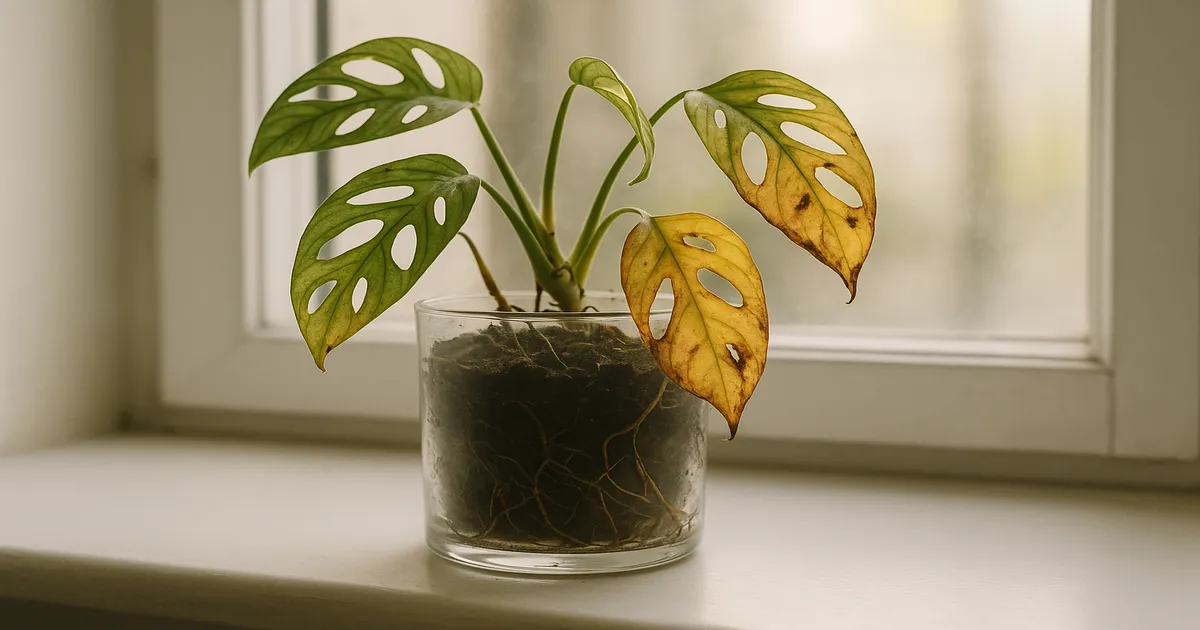
Quick Answer: The most common reasons your Monstera adansonii is struggling are overwatering, low light, or low humidity — three conditions that clash directly with its tropical rainforest origins. Check your soil moisture first, then evaluate your light and humidity levels. The sections below walk you through diagnosing and fixing each problem.
Monstera adansonii — the Swiss cheese vine — is a hemiepiphytic tropical climber native to Central and South America. In the wild, it scrambles up tree trunks in humid, dappled rainforest understories, clinging to bark rather than sitting in saturated soil. That background explains almost every problem it develops indoors. When something looks wrong with your Monstera adansonii, the cause almost always comes down to one of eight issues: overwatering, underwatering, poor light, low humidity, pests, nutrient deficiency, temperature stress, or a root-bound pot.
Find your symptom in the section headers below and jump straight to the fix.
Overwatering and Root Rot
Signs Your Monstera adansonii Is Overwatered
Overwatering is the most common — and most dangerous — mistake with this plant. Because M. adansonii evolved with aerated, bark-clinging roots, it cannot tolerate prolonged soil saturation. Watch for these warning signs:
- Lower leaves turning yellow, starting with the oldest
- Mushy or blackened stems at the soil line
- A sour, fermented smell rising from the pot
- Wilting even though the soil feels wet
- Roots that are brown, slimy, or hollow instead of white and firm
Waterlogged soil pushes oxygen out of the root zone. Without oxygen, roots can’t respire and begin to die. Opportunistic pathogens — Pythium, Phytophthora, and Fusarium — move in quickly. The result is a plant that wilts despite sitting in wet soil, because the roots can no longer move water upward.
How to Save an Overwatered Monstera adansonii
- Unpot the plant and inspect the roots carefully.
- Trim all brown, mushy, or hollow roots with sterile scissors or pruning shears.
- Dust cut surfaces with powdered sulfur or activated charcoal to discourage further fungal growth.
- Repot into a fresh, chunky mix — roughly 40% perlite or pumice, 40% quality potting mix, and 20% orchid bark. A well-formulated bagged mix like Fox Farm Happy Frog works well as the base component.
- Hold off on watering for 3–5 days to let cut root ends callous.
- Going forward: Water only when the top 1–2 inches of substrate are dry. A soil moisture meter removes the guesswork entirely.
- Never leave the plant sitting in standing water in a saucer for more than 30 minutes.
Underwatering and Drought Stress
How to Tell If Your Monstera adansonii Is Too Dry
Underwatering produces a distinct set of symptoms. The key difference from overwatering is the soil — bone dry, pulling away from the pot edges. Look for:
- Leaves curling inward (a protective response to reduce water loss)
- Brown, crispy edges and leaf tips
- Potting mix that’s dry several inches deep and shrinking from the pot walls
- Shriveled, papery aerial roots
When soil moisture drops too low, cells lose turgor pressure and the plant triggers stomatal closure, slowing photosynthesis. Prolonged drought causes irreversible cell damage.
Reviving a Drought-Stressed Plant
Don’t just pour water over the top. Dry, compacted soil often lets water run straight down the pot edges without ever reaching the root ball. Instead:
- Bottom-soak the pot in a basin of room-temperature water for 20–30 minutes.
- Trim dead, crispy tissue with sterile scissors — it won’t recover, but removing it keeps the plant tidy.
- Drop the calendar schedule. Check soil moisture every 3–4 days by pressing a finger 1–2 inches into the soil, and water when that depth feels dry.
Light Problems: Too Little or Too Much
Signs of Insufficient Light
If your Monstera adansonii is producing small, hole-free leaves on long, stretched stems, it isn’t getting enough light. This is etiolation — the plant is reaching toward a light source. Below roughly 200–400 foot-candles, it can’t fix enough carbon to sustain healthy growth, let alone develop those characteristic fenestrations. Pale or washed-out leaf color and stalled growth are other reliable signs.
Sunscald: Too Much Direct Sun
Move the plant too close to a south-facing window without any filter, and you’ll see the opposite problem: bleached, silvery, or tan patches appearing quickly on whichever side faces the sun. This is photoinhibition — excess light overwhelms the photosynthetic machinery and destroys chlorophyll. Damaged patches won’t recover, but new leaves will come in healthy once you move the plant.
Finding the Ideal Light Spot
Bright indirect light — 1,500–3,000 foot-candles — is the sweet spot. In practical terms:
- 3–5 feet from a south- or east-facing window (Northern Hemisphere) with no direct sun hitting the leaves
- A sheer curtain to diffuse harsh afternoon light
- A full-spectrum grow light running 12–14 hours per day if your space is genuinely dim. The Soltech Solutions Aspect is a popular option that blends into most interiors.
A free light meter app on your phone gives a rough foot-candle reading at the plant’s exact location — worth the 30 seconds it takes.
Nutrient Deficiencies and Fertilizer Problems
Identifying Common Deficiencies
The pattern of yellowing or distortion tells you which nutrient is missing:
- Nitrogen deficiency: Uniform yellowing of older, lower leaves first. Nitrogen is mobile, so the plant pulls it from old tissue to fuel new growth.
- Iron deficiency: Yellow tissue between green veins on new leaves (interveinal chlorosis). Usually a soil pH problem — when pH climbs above 7.0, iron locks into insoluble forms the roots can’t absorb.
- Magnesium deficiency: Interveinal chlorosis on older leaves, often with a yellowing halo around the margins.
- Calcium deficiency: Distorted, cupped, or stunted new growth with tip burn. Inconsistent watering is a common trigger, since calcium moves through the plant via the transpiration stream.
Over-fertilizing causes brown tips and margins — similar to drought stress — plus a white crusty deposit on the soil surface or pot edges from accumulated fertilizer salts.
How to Correct Nutrient Problems
- Test your soil pH with a digital meter. Aim for 5.5–6.5. Amend with dolomitic lime if too acidic, or elemental sulfur if too alkaline.
- Fertilize every 2–4 weeks during the growing season (spring through early fall) with a balanced fertilizer at half the recommended strength. Jack’s Classic 20-20-20 is a reliable, widely available option.
- For iron deficiency: Use chelated iron (EDTA or EDDHA form) as a soil drench — this bypasses pH-related lockout.
- For magnesium: A diluted Epsom salt solution (1 teaspoon per gallon) applied as a foliar spray or soil drench works quickly.
- For salt buildup: Flush the soil with 2–3 times the pot volume of clean water and let it drain completely.
Low Humidity and Brown Leaf Edges
Why Humidity Matters
Monstera adansonii prefers 60–80% relative humidity. Indoor air — especially in winter with heating running — can drop to 20–30% RH. That gap drives excessive water loss through the leaves, and the cells at leaf margins, farthest from the vascular supply, die first. The result is brown, crispy edges that spread inward as conditions worsen. Low humidity also makes the plant significantly more vulnerable to spider mite infestations, since mites thrive in dry air.
Best Methods to Raise Humidity
Do these:
- Run a cool-mist ultrasonic humidifier near your plants, targeting at least 60% RH. Use a hygrometer to measure it — guessing doesn’t work. The Levoit Classic 300S is a solid mid-range option with a built-in humidity sensor.
- Group plants together to create a shared microclimate through collective transpiration.
- Place the pot on a pebble tray with water sitting below the pot base for a modest 5–10% local RH boost.
Avoid this: Misting leaves directly is not a reliable humidity solution. It raises humidity for minutes, not hours, and wet leaf surfaces promote fungal leaf spot diseases.
Common Pests Attacking Monstera adansonii
Spider Mites
Spider mites are barely visible to the naked eye, but their damage is hard to miss: fine webbing on leaf undersides, a stippled or bronzed leaf surface, and a general dullness. They thrive when humidity drops below 40% RH, which is why maintaining good humidity is your first line of defense. Shower the plant with a strong stream of water, then apply insecticidal soap or diluted neem oil to all surfaces, especially leaf undersides. Repeat every 5–7 days for 3–4 cycles to catch hatching eggs.
Fungus Gnats, Mealybugs, Scale, and Thrips
- Fungus gnats: Adults are just annoying flies, but larvae live in moist soil and chew through fine root hairs. Let the top 2 inches of soil dry between waterings; apply a Bacillus thuringiensis var. israelensis (Bti) soil drench to kill larvae; use yellow sticky traps for adults.
- Mealybugs: White, cottony masses in leaf axils and along stems. Dab individual pests with a cotton swab dipped in 70% isopropyl alcohol, then follow up with insecticidal soap every 7–10 days.
- Scale insects: Brown or tan bumps on stems and leaf undersides. Treat the same way as mealybugs.
- Thrips: Cause silvery streaking and distorted new leaves. Apply a spinosad-based insecticide and remove heavily infested leaves immediately.
Quarantine every new plant for 2–4 weeks before it joins your collection. Most indoor pest infestations start with a single new arrival.
Temperature, Root-Bound Pots, and Container Choice
Cold Drafts and Temperature Stress
M. adansonii is comfortable between 65–85°F (18–29°C). Below 50°F (10°C), cellular membrane damage causes dark, water-soaked patches that turn black — sometimes from just a few hours against a cold winter windowpane. Above 95°F (35°C), rapid water loss causes wilting and leaf scorch. Drafts from air conditioning vents or heating registers cause localized desiccation even at otherwise acceptable temperatures. Keep the plant away from both.
Is Your Monstera adansonii Root Bound?
If the soil dries out within a day or two of watering, roots are visibly circling or escaping the drainage holes, and growth has stalled, your plant has outgrown its pot. Repot in spring into a container just 1–2 inches larger in diameter. Jumping to a much bigger pot is counterproductive — excess soil volume holds moisture the roots can’t use, raising rot risk.
Pot and Soil Choices
Always use a pot with drainage holes — no exceptions. Terracotta wicks moisture away faster, which helps if you tend to overwater. Glazed ceramic and plastic retain moisture longer, better suited for dry environments or growers who underwater. Either way, a chunky, aerated mix with 30–50% perlite or pumice content dramatically reduces overwatering risk from the start.
Prevention: Keeping Your Monstera adansonii Healthy
Preventing problems is far easier than fixing them. A simple routine covers most of what can go wrong.
Weekly habits:
- Before every watering, check soil moisture with your finger or a meter. Water only when the top 1–2 inches are dry.
- Glance at leaf undersides and stem axils for early signs of pests.
Monthly during the growing season: Fertilize at half strength.
Environmental targets:
- ✅ Bright indirect light (1,500–3,000 foot-candles) — verify with a light meter app
- ✅ 60–80% RH — measure with a hygrometer
- ✅ 65–85°F, away from drafts, cold glass, and vents
Think of the plant’s natural habitat — humid, airy, bright but shaded — and use that as your benchmark for every care decision.
Frequently Asked Questions About Monstera adansonii Problems
Why are my Monstera adansonii leaves turning yellow?
Yellowing most often signals overwatering and early root rot, which prevents the plant from absorbing water and nutrients. It can also indicate nitrogen deficiency, low light, or the natural aging of the oldest leaves. Check soil moisture first — if the soil is consistently wet, overwatering is the likely culprit.
Why does my Monstera adansonii have brown crispy leaf edges?
Crispy brown edges are almost always a humidity or underwatering issue. Indoor air — especially in winter — can drop well below the 60% RH this plant needs, causing marginal leaf cells to dry out and die. Fertilizer salt buildup or cold draft damage can produce the same symptom, so rule those out if humidity and watering seem fine.
Why is my Monstera adansonii not growing leaves with holes?
Fenestrations require adequate light and a mature, healthy plant. In spots below roughly 400 foot-candles, new leaves emerge small and hole-free. Move the plant closer to a bright window or add a grow light, and fenestrations should return with subsequent new growth.
How do I know if my Monstera adansonii has root rot?
Unpot the plant and inspect the roots directly. Healthy roots are white or light tan and firm; rotted roots are brown, black, slimy, or hollow. Above ground, root rot typically presents as yellowing leaves, a sour smell from the soil, and wilting despite wet soil — that combination is a strong indicator even before you check the roots.
How often should I water a Monstera adansonii?
There’s no universal answer — frequency depends on pot size, soil mix, light level, and season. The reliable rule is to water when the top 1–2 inches of soil are dry, which might mean every 5 days in summer or every 10–14 days in winter. Check the soil before every watering rather than following a fixed schedule.