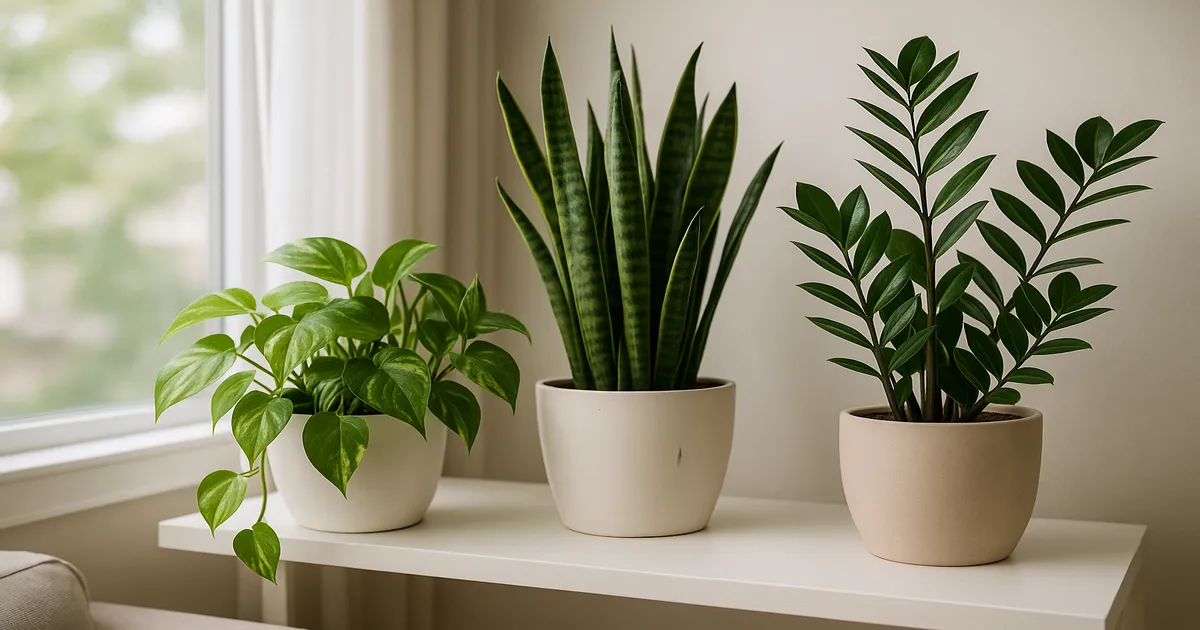
Quick Answer: For Indian beginners, the Money Plant (Pothos) is the single best starting plant — it survives low light, irregular watering, and temperatures up to 38°C. The Snake Plant is the perfect runner-up for anyone who forgets to water for weeks at a time. Both cost ₹50–300 at any local nursery or online at Ugaoo and Nurserylive.
Getting started with indoor plants in India can feel overwhelming. The market is flooded with options, care advice is usually written for temperate climates, and what works in a London apartment doesn’t always translate to a Mumbai flat in June. This guide answers the real question: what are the best low-maintenance indoor plants for beginners in India, evaluated specifically for Indian light levels, temperatures, humidity, and watering habits?
We’ve assessed seven plants across six practical criteria — light tolerance, watering forgiveness, heat adaptability, monsoon resilience, price, and availability — so you can pick the right plant the first time.
Best Low-Maintenance Indoor Plants for Indian Beginners: At a Glance
| Common Name | Botanical Name | Light Requirement | Watering Frequency | Temperature Range | Approx. Price (₹) | Best For |
|---|---|---|---|---|---|---|
| Money Plant | Epipremnum aureum | Low–Medium (100–500 fc) | When top 1 inch is dry | 18–38°C | 50–150 | Any beginner, any room |
| Snake Plant | Dracaena trifasciata | Low–Medium (200–1,000 fc) | Every 2–4 weeks | 18–38°C | 100–400 | Neglectful waterers, AC rooms |
| ZZ Plant | Zamioculcas zamiifolia | Very Low–Low (100–300 fc) | Every 3–4 weeks | 18–40°C | 150–500 | Dark rooms, offices |
| Rubber Plant | Ficus elastica | Medium–High (500–2,000 fc) | When top 2 inches are dry | 18–35°C | 200–800 | Statement plant, bright spots |
| Aloe Vera | Aloe barbadensis miller | High (2,000–5,000 fc) | Every 2–3 weeks | 20–40°C | 50–200 | Sunny balconies, windowsills |
| Peace Lily | Spathiphyllum wallisii | Low–Medium (200–500 fc) | When top inch is dry or plant droops | 18–35°C | 100–350 | Beginners wanting flowers |
| Chinese Evergreen | Aglaonema spp. | Very Low–Medium (100–500 fc) | When top inch is dry | 18–35°C | 150–600 | Colour in dim rooms |
What to Look For When Choosing a Beginner Indoor Plant in India
Light Tolerance: Matching Plants to Your Home’s Real Light Levels
This is where most Indian beginners go wrong. A room that looks bright to your eyes may only deliver 100–500 foot-candles of actual light, because human vision adapts logarithmically — we’re genuinely bad at estimating light intensity. North-facing balconies, deep-set windows, tinted glass, and heavy curtains are all common in Indian homes, and all dramatically reduce what’s available to plants.
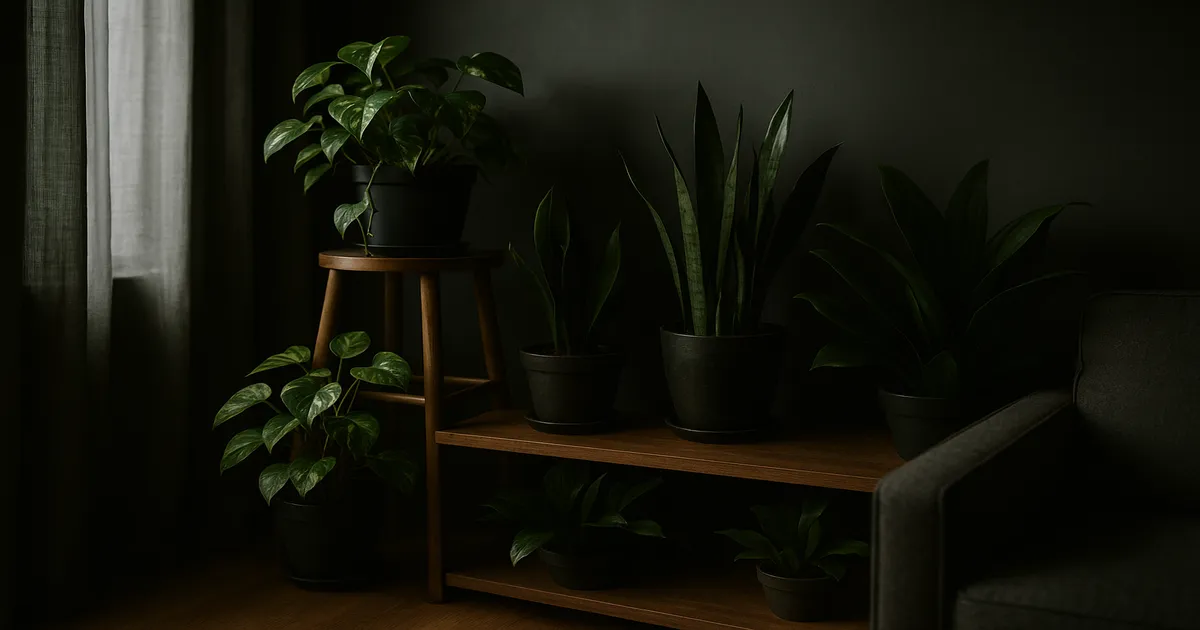
Before buying, assess your space honestly. If your room gets no direct sunlight and is lit mostly by ambient sky, you’re in low-light territory. Stick to ZZ Plant, Money Plant, or Chinese Evergreen — they’re among the very few plants that genuinely thrive below 300 foot-candles.
Watering: The Most Common Beginner Mistake
Daily watering kills more Indian houseplants than neglect ever does. The instinct to “care” by watering frequently, combined with decorative pots that have no drainage holes (extremely common in Indian gifting culture), creates waterlogged roots and rapid rot.
Choose plants with drought-tolerant traits: rhizomatous water storage (ZZ Plant), succulent leaves (Aloe Vera), or thick fleshy roots (Snake Plant). Then adopt a “check, don’t schedule” approach — poke your finger 2 inches into the soil and water only when it’s dry at that depth.
Heat, Humidity, and Indian Climate Zones
India isn’t one climate — it’s several. Mumbai’s coastal humidity (70–90% RH) suits moisture-loving plants like Peace Lily and Pothos beautifully. The same plants may struggle in Delhi’s dry pre-monsoon heat or in any AC room where humidity drops to 20–30% RH. Bengaluru’s mild plateau climate is arguably the easiest for indoor plants in the country.
For the widest compatibility, choose plants rated for 18–40°C with flexible humidity requirements. Snake Plant, ZZ Plant, and Money Plant all qualify. Rubber Plant and Aloe Vera handle dry heat well. Peace Lily prefers higher humidity — fine in Mumbai, trickier in a Delhi AC room.
Monsoon Pest and Fungal Resistance
India’s monsoon (June–September) pushes indoor humidity to 80–100% RH, creating ideal conditions for fungus gnats, root rot, grey mould, and scale insects. Fungus gnat larvae are particularly destructive — they feed on root hairs and are often mistaken for overwatering damage.
Prioritise plants with naturally pest-resistant foliage (ZZ Plant’s waxy leaves, Snake Plant’s tough skin). Reduce watering frequency significantly during monsoon, apply a neem oil soil drench every three to four weeks, and use yellow sticky traps near pots. Both are cheap and effective.
The 7 Best Low-Maintenance Indoor Plants for Beginners in India
1. Money Plant (Epipremnum aureum) — Best Overall
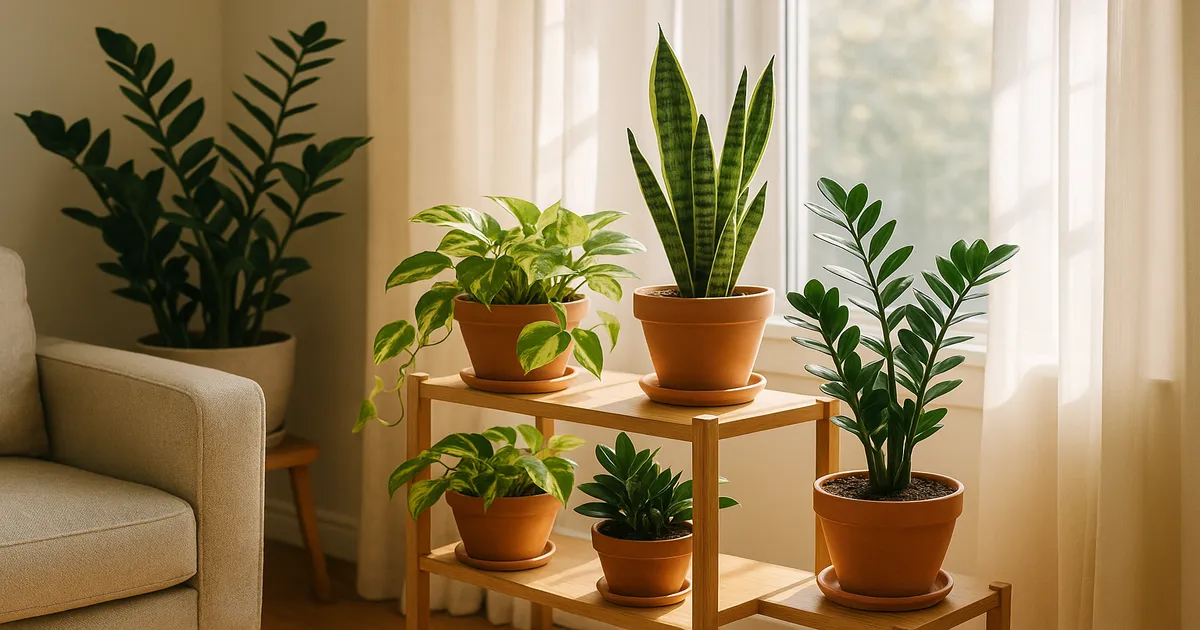
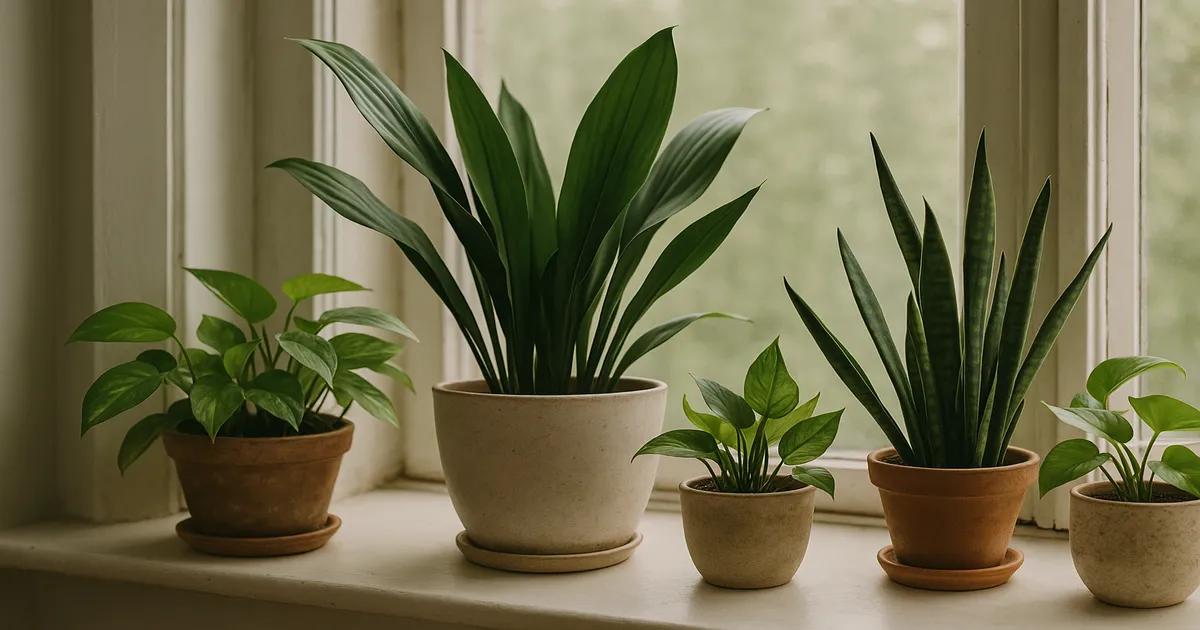
The Money Plant has earned its status as India’s most popular houseplant honestly. It tolerates dim north-facing rooms, forgotten watering schedules, and summer temperatures pushing 38°C — and still trails beautifully from a hanging pot or climbs a moss stick with minimal encouragement. Indian nurseries stock several cultivars: Golden Pothos (the most common and most forgiving), Marble Queen (needs slightly more light to maintain white variegation), and Neon (vivid chartreuse, best near a bright window).
Key specs: Light: 100–500 fc | Water: When top 1 inch is dry | Temp: 18–38°C | Price: ₹50–150
Pros
- Tolerates neglect, low light, and heat simultaneously — genuinely near-indestructible
- Grows in water or soil, making it one of the most flexible plants available
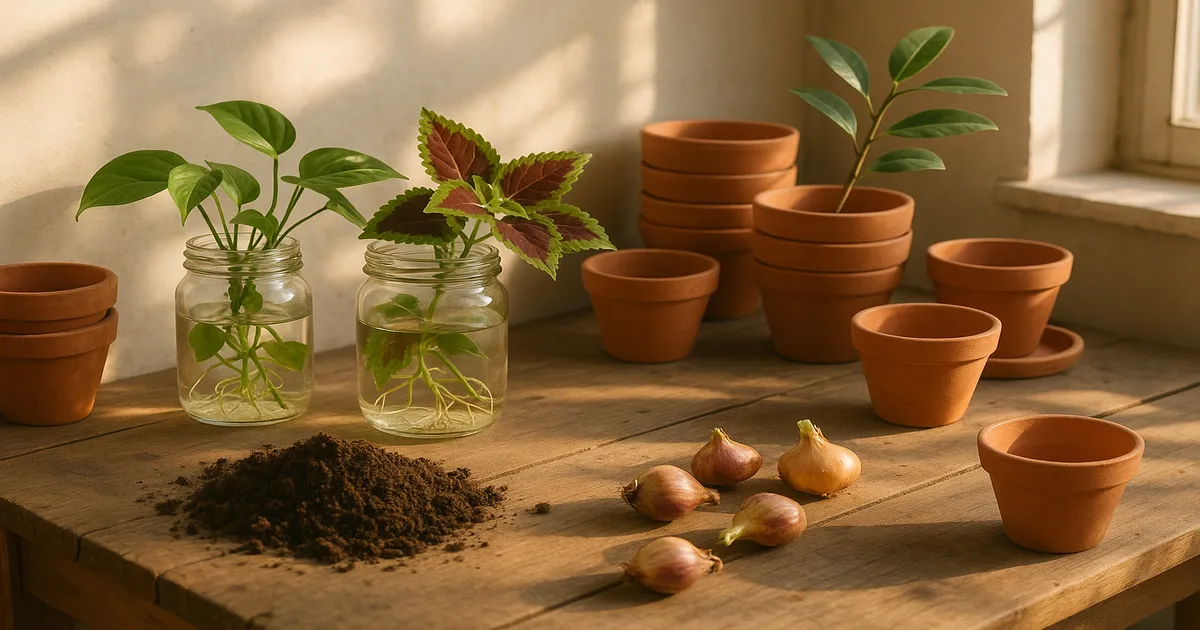
- Propagates from cuttings in plain water — free new plants every few months
- Trails from shelves, hangs from balconies, or climbs a coir pole
Cons
- Toxic to pets and children if ingested — keep out of reach in homes with dogs, cats, or toddlers
- Variegated cultivars (Marble Queen, N’Joy) revert toward plain green in very low light
- Becomes leggy and sparse in genuinely dark rooms — will survive, but won’t look its best
Best for: Any Indian beginner, in any room, at any skill level. If you’re starting with one plant, make it this one.
2. Snake Plant (Dracaena trifasciata) — Best for Neglectful Waterers
If the Money Plant is India’s most forgiving plant, the Snake Plant is its most drought-tolerant. Water it once every two to four weeks in winter and you’ll have a thriving, architectural plant that looks expensive and requires almost nothing from you. It handles AC rooms particularly well — where most tropical plants struggle with humidity dropping to 20–30% RH, the Snake Plant barely notices. Popular varieties include Laurentii (yellow-edged), Moonshine (silvery-grey), and Cylindrica (cylindrical leaves), all equally unfussy.
Key specs: Light: 200–1,000 fc | Water: Every 2–4 weeks; let soil dry completely | Temp: 18–38°C | Price: ₹100–400
Pros
- Extraordinary drought tolerance — the most forgiving plant for irregular watering schedules
- Handles cold AC drafts better than virtually any other tropical houseplant
- Clean, architectural shape suits modern Indian interiors
- Multiple attractive varieties available at similar price points
Cons
- Slow-growing — don’t expect dramatic size changes in the first year
- Toxic to pets (causes nausea and vomiting in cats and dogs)
- Highly susceptible to root rot if watered too frequently in heavy, non-draining soil — a well-draining cocopeat-perlite mix is essential
Best for: Busy professionals, frequent travellers, or anyone who genuinely forgets to water for weeks at a time.
3. ZZ Plant (Zamioculcas zamiifolia) — Best for Very Dark Rooms
The ZZ Plant’s secret weapon is its rhizomatous root system — thick, potato-like rhizomes that store water and nutrients, allowing the plant to survive weeks of complete neglect in rooms that would defeat almost anything else. It’s one of very few plants that genuinely thrives below 200 foot-candles, making it the top choice for north-facing Indian rooms, internal office spaces, or hallways with no direct natural light. The glossy, deep-green foliage looks polished and contemporary without any effort on your part.
Key specs: Light: 100–300 fc | Water: Every 3–4 weeks; let soil dry completely | Temp: 18–40°C | Price: ₹150–500
Pros
- Survives extreme neglect in genuinely dark conditions where other plants fail
- Glossy, architectural foliage that looks like it belongs in a design magazine
- Rarely troubled by pests — waxy leaves deter most common insects
- Tolerates the full range of Indian temperatures without supplemental heating or cooling
Cons
- Very slow-growing — patience required; don’t expect rapid size gains
- Toxic if ingested (calcium oxalate crystals) — handle with gloves if you have sensitive skin
- Slightly pricier than Pothos or Snake Plant at most nurseries
- Will not tolerate direct outdoor sun — strictly an indoor plant
Best for: Dark Indian living rooms, windowless offices, or any space where other plants have previously failed due to low light.
4. Rubber Plant (Ficus elastica) — Best Statement Plant
Here’s something most people don’t know: the Rubber Plant is native to Northeast India, commercially cultivated in Assam and Meghalaya, and genuinely pre-adapted to Indian growing conditions. That native heritage shows in how well it handles Indian heat, humidity swings, and the general chaos of Indian seasons. Given a bright spot near an east or south-facing window, it grows into a bold, dramatic indoor tree with large, glossy leaves that make a real statement in any room.
Key specs: Light: 500–2,000 fc | Water: When top 2 inches of soil are dry | Temp: 18–35°C | Price: ₹200–800
Pros
- Native to India — genuinely climate-adapted in a way that imported species aren’t
- Fast-growing with good light; can reach ceiling height within a few years
- Bold, large-leafed form suits both traditional and contemporary Indian interiors
- Propagates easily from stem cuttings
Cons
- Needs significantly more light than Pothos or ZZ Plant — not suitable for dark rooms
- Milky sap is a skin irritant and toxic to pets; wear gloves when pruning
- Leaves accumulate dust rapidly in Indian metros — wipe monthly with a damp cloth or the plant looks dull
- Sensitive to cold drafts directly from AC units
Best for: Beginners who want a fast-growing, dramatic indoor tree and have a bright spot within 1–2 metres of an east or south-facing window.
5. Aloe Vera (Aloe barbadensis miller) — Best for Sunny Balconies
Aloe Vera is the one plant on this list that actively wants Indian summer sun. It’s also deeply embedded in Indian domestic culture through Ayurvedic and home remedy traditions — the gel from a broken leaf is a household first-aid staple for burns, minor cuts, and skincare. On a south or west-facing windowsill or balcony, it thrives with almost no intervention, handles temperatures up to 40°C without stress, and produces offsets (baby plants) you can pot up and give away. The main way to kill it is to overwater it or put it somewhere dark.
Key specs: Light: 2,000–5,000 fc | Water: Every 2–3 weeks; let soil dry completely | Temp: 20–40°C | Price: ₹50–200
Pros
- Thrives in Indian heat and direct sun that would stress most other houseplants
- Practical medicinal uses make it genuinely useful, not just decorative
- Extremely drought-tolerant; produces free offsets for propagation
- One of the cheapest plants available across India
Cons
- Will etiolate (stretch, pale, and weaken) in low light — not a plant for dark interiors
- Prone to root rot if overwatered or planted in standard nursery soil; needs a gritty, fast-draining mix (minimum 40% coarse sand or perlite)
- Not suitable for rooms without significant natural light
Best for: Beginners with a sunny south or west-facing window or balcony who want a near-zero-maintenance, genuinely useful plant.
6. Peace Lily (Spathiphyllum wallisii) — Best for Flowers Indoors
The Peace Lily has a feature that’s uniquely valuable for beginners: it tells you when it’s thirsty. Leaves droop visibly when the plant needs water, then perk back up within hours of a good drink — a built-in feedback loop that teaches you to read plant signals rather than follow a rigid schedule. It’s also one of very few genuinely low-light plants that flowers indoors, producing elegant white spathes that last for weeks. The catch is its sensitivity to fluoride and hard water, which causes the notorious brown leaf tips that frustrate Indian growers in cities with high-TDS municipal water.
Key specs: Light: 200–500 fc | Water: When top inch is dry, or when leaves begin to droop | Temp: 18–35°C | Price: ₹100–350
Pros
- Visible wilt signal when thirsty — excellent feedback for beginners learning plant care
- One of very few low-light plants that blooms indoors reliably
- Tolerates Indian monsoon humidity well — actually enjoys it
- Widely available at nurseries and online across India
Cons
- Highly sensitive to fluoride and hard water — causes brown leaf tips, a near-universal complaint among Indian Peace Lily owners in cities with hard municipal water
- Toxic to pets and children
- Prone to overwatering in decorative pots without drainage holes — extremely common since Peace Lilies are popular gifts in India
Best for: Beginners who want flowering plants indoors and are willing to use overnight-rested tap water or RO water to prevent brown tips.
7. Chinese Evergreen (Aglaonema spp.) — Best for Colour in Low Light
Aglaonemas combine genuine low-light tolerance with spectacular colour. Cultivars like Red Siam (deep burgundy-red), Pink Dalmatian (pink-splashed green), and Silver Bay (silver-grey) bring serious visual interest to rooms where most colourful plants would simply fade and die. Green varieties are the most shade-tolerant; red and pink cultivars need slightly more light to hold their colour. All are slow-growing, which means they won’t outgrow their pots in a hurry — a genuine convenience for beginners.
Key specs: Light: 100–500 fc (green varieties most tolerant) | Water: When top inch of soil is dry | Temp: 18–35°C | Price: ₹150–600
Pros
- Extreme low-light tolerance, especially in green cultivars like Silver Bay
- Stunning range of colours and patterns — easily the most decorative plant on this list
- Slow-growing, so it stays in proportion with its pot for longer than most plants
- Increasingly available at Indian nurseries and on Ugaoo and Nurserylive
Cons
- Red and pink cultivars need more light than green counterparts to maintain colour — in very dim rooms they’ll slowly revert toward green
- Toxic to pets (calcium oxalate)
- Slightly more expensive than Pothos or Snake Plant, especially for named cultivars
Best for: Indian beginners who want a decorative, colourful statement plant for a dim interior room and are willing to invest a little more upfront.
Our Verdict: Best Indoor Plant for Every Type of Indian Beginner
Best Overall: Money Plant (Pothos) — Tolerates virtually every mistake a beginner can make: overwatering, underwatering, low light, high heat. Start here.
Best for Neglectful Waterers: Snake Plant — Water it once a fortnight (or once a month in winter) and it will reward you with clean, architectural foliage indefinitely.
Best for Very Dark Rooms: ZZ Plant — The only plant on this list that genuinely thrives below 200 foot-candles. If other plants have died in your space, try this one.
Best Statement Plant: Rubber Plant — Native to India, fast-growing with good light, and dramatic enough to anchor an entire room. Give it a bright east or south-facing spot.
Best for Sunny Balconies: Aloe Vera — The plant that actually wants Indian summer sun. Useful, nearly free to maintain, and deeply culturally resonant.
Best for Flowers Indoors: Peace Lily — Droops visibly when thirsty, blooms in low light, and teaches you to read plant signals. Use RO or rested water to avoid brown tips.
Best for Colour in Low Light: Chinese Evergreen (Aglaonema) — Unmatched colour variety for genuinely dim rooms. Spend a little more upfront and you’ll have a striking, long-lived plant.
The Single Most Important Care Tip for Indian Beginners
Adopt a “check, don’t schedule” watering routine from day one. Check the soil every two to three days; water only when it’s dry at a depth of 1–2 inches for most plants, or completely dry for succulents and Snake Plants. Most indoor plant failures in India come from overwatering in non-draining pots — not from choosing the wrong plant.
When you bring any plant home, repot it promptly into a mix of 60% cocopeat + 30% perlite + 10% vermicompost and make sure the pot has drainage holes. That single step eliminates the most common cause of beginner plant death in India.
All seven plants in this guide are available at local nurseries across the country, and online at Ugaoo, Nurserylive, and Amazon India. You don’t need to spend a lot to get started — you just need to start.
Frequently Asked Questions
Which indoor plant is easiest to grow in India for absolute beginners?
The Money Plant (Epipremnum aureum) is the single easiest indoor plant for Indian beginners. It tolerates low light (as little as 100 foot-candles), survives irregular watering, and handles temperatures up to 38°C. It grows in water or soil, costs ₹50–150 at virtually any nursery, and is almost impossible to kill through ordinary neglect. Start here.
Why do my indoor plant leaves turn yellow in India?
Yellow leaves are most commonly caused by one of three things. Overwatering is the most frequent culprit — waterlogged roots can’t absorb nutrients, so leaves yellow and drop. Insufficient light is the second cause — plants in rooms below 100 foot-candles slowly exhaust their chlorophyll. Nutrient depletion is the third — after three to six months in the same soil without fertilising, most plants run low on nitrogen and begin to yellow. Check your watering frequency first, assess your light honestly, then start feeding with a diluted balanced liquid fertiliser (NPK 19-19-19 at half strength) once a month during the growing season (February–October).
How do I care for indoor plants during India’s monsoon season?
Monsoon brings three specific risks: fungus gnats (whose larvae destroy roots), root rot from persistently moist soil, and fungal mould on foliage and soil surfaces. Reduce watering frequency significantly — soil stays moist far longer when ambient humidity is 80–100% RH. Improve air circulation with a small fan near your plants. Apply a neem oil soil drench (5 ml neem oil + 2 ml dish soap per litre of water) every three to four weeks, and place yellow sticky traps to monitor for fungus gnats. Avoid misting during monsoon — the air is already saturated.
Can indoor plants survive in air-conditioned rooms in India?
Yes, with two caveats. AC rooms create cold drafts (18–20°C directly under vents) and low humidity (20–30% RH). Snake Plant and ZZ Plant handle both conditions better than any other plants on this list. For more humidity-sensitive plants like Peace Lily, place a shallow tray of water and pebbles under the pot to raise local humidity, and keep plants at least one metre away from the AC vent. Avoid misting in AC rooms — it encourages fungal issues without meaningfully raising humidity.
Are Indian nursery plants safe to bring home, or do they carry pests?
Nursery plants frequently carry pests — most commonly mealybugs, fungus gnats, and spider mites. Before bringing any new plant indoors, quarantine it on a balcony or separate room for two weeks and inspect the undersides of leaves and the soil surface carefully. A preventive neem oil spray on the foliage and a soil drench on arrival will eliminate most common pests before they spread to your other plants.