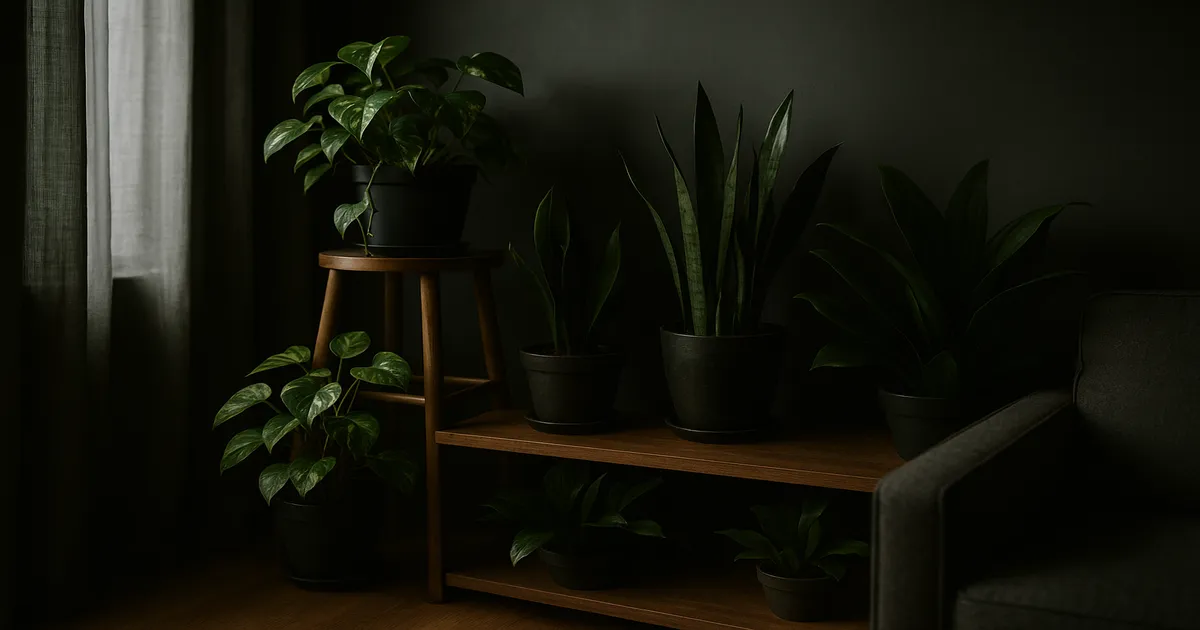
Quick Answer: The Cast Iron Plant (Aspidistra elatior) is the single best plant for truly dark rooms, surviving at just 10–15 foot-candles where almost nothing else will. The ZZ Plant (Zamioculcas zamiifolia) is the best all-rounder — it tolerates near-dark conditions, forgives irregular watering, and looks great doing it.
Finding the best plants for dark rooms is harder than it sounds. Every garden centre sells “low-light plants,” but most of those labels are optimistic. A north-facing hallway, a windowless office, or an interior bathroom can easily drop below 25 foot-candles — a level that will slowly kill most plants sold as “shade tolerant.” This guide cuts through the noise with real light thresholds, honest pros and cons, and clear recommendations for every situation.
Best Plants for Dark Rooms: Quick Comparison
| Common Name | Scientific Name | Min. Light (fc) | Best For | Key Feature |
|---|---|---|---|---|
| Cast Iron Plant | Aspidistra elatior | 10–15 fc | Truly dark rooms | Lowest light tolerance of any common houseplant |
| ZZ Plant | Zamioculcas zamiifolia | 25 fc | All-round low-maintenance | Rhizomes store water; near-indestructible |
| Snake Plant | Dracaena trifasciata | 25–50 fc | Sculptural, minimal watering | CAM photosynthesis; water once a month |
| Chinese Evergreen | Aglaonema spp. | 25–75 fc | Patterned foliage, moderate dark | Adapts to wide light range |
| Peace Lily | Spathiphyllum wallisii | 25–75 fc | Flowering in low light | Droops visibly when thirsty |
| Heartleaf Philodendron | Philodendron hederaceum | 50–100 fc | Trailing greenery, moderate dim | Fast grower; easy to propagate |
| Pothos | Epipremnum aureum | 50–100 fc | Budget beginners | Nearly indestructible; trails well |
| Parlor Palm | Chamaedorea elegans | 25–75 fc | Pet-safe tropical focal point | Non-toxic; most low-light-tolerant palm |
| Bird’s Nest Fern | Asplenium nidus | 50–100 fc | Humid dark bathrooms | Bold architectural fronds |
How Dark Is Your Room? Measure Before You Buy
Most people dramatically overestimate how much light a room receives. A spot that feels “bright enough” to human eyes may only deliver 15–30 foot-candles, because our pupils adjust automatically in ways a plant cannot.
The easiest method is a free smartphone app such as Lux Light Meter or Light Meter (iOS/Android). Hold your phone at plant canopy height, point the camera toward the brightest light source, and take several readings at different times of day. For more consistent results, a dedicated lux meter — the Dr.Meter LX1330B Digital Illuminance Meter is a reliable option for under $20 — removes the variability of phone sensors. Divide any lux reading by 10.76 to convert to foot-candles.
Practical thresholds:
- Under 25 fc: Only Aspidistra elatior and possibly ZZ Plant will hold long-term
- 25–75 fc: Most species in this guide will survive; some will thrive
- 75–150 fc: Good range for nearly all low-light plants
What Makes a Plant Suitable for Dark Rooms?
Light Compensation Point
Every plant has a light compensation point — the minimum intensity at which photosynthesis produces exactly as much energy as respiration consumes. Below that point, the plant slowly starves. Shade-adapted species can have compensation points as low as 5–10 µmol/m²/s. Sun-lovers may need 50–100 µmol/m²/s just to break even. Always match the plant’s minimum tolerance to your measured light level.
Leaf Colour: Why All-Green Wins in Low Light
Variegated plants look beautiful, but white, cream, and yellow leaf sections contain no chlorophyll. In a dark room, the plant simply doesn’t have enough photosynthetic surface area to sustain itself. The ‘Marble Queen’ pothos, for example, needs roughly twice the light of the all-green ‘Golden’ pothos to achieve the same photosynthesis rate. Stick to all-green or deep-green cultivars whenever possible.
Watering and Root Rot Resistance
Low light dramatically slows a plant’s water demand. Stomata open less often, transpiration drops, and soil stays wet far longer than it would in a bright spot. Overwatering — not darkness — is the number one killer of dark-room plants. Species with built-in water storage (ZZ plant rhizomes, snake plant’s thick leaves, cast iron plant’s robust rhizomes) are far more forgiving of the wet-dry cycles that inevitably happen in low-light care.
Toxicity
Several excellent dark-room plants — ZZ plant, peace lily, Chinese evergreen, pothos, snake plant — are toxic to pets or children if ingested. The ASPCA’s Animal Poison Control database is the most reliable reference. Pet-safe options in this guide include the cast iron plant, parlor palm, and bird’s nest fern.
The 9 Best Plants for Dark Rooms, Reviewed
1. Cast Iron Plant (Aspidistra elatior)
Aspidistra elatior earned its name honestly. This Victorian parlour favourite has survived gas-lit rooms, coal dust, and chronic neglect for over 150 years. It remains the only common houseplant genuinely rated for 10–15 fc (~110 lux) — the kind of light found in a dim hallway or a room lit mainly by overhead artificial lighting. Growth is slow, the strap-like foliage is elegant, and established plants have been known to live for decades with minimal intervention.
Key specs: Min. light: 10–15 fc | PPFD: 5–15 µmol/m²/s | Water: every 2–4 weeks | Humidity: 40–60% RH | Pet safe: Yes
Pros
- Unmatched low-light tolerance — the only reliable choice for near-windowless spaces
- Extremely drought and pest resistant; rarely troubled by spider mites or fungus gnats
- Long-lived and architecturally elegant; adds a refined quality to dark spaces
- Non-toxic to pets and children
Cons
- Very slow grower — don’t expect visible changes week to week
- Limited cultivar variety compared to other houseplants (though ‘Milky Way’ and ‘Asahi’ are worth seeking out)
- More expensive than most beginner plants due to slow propagation timelines
Best for: Any room under 25 fc where you need a plant that will simply survive — and look good doing it — for years.
2. ZZ Plant (Zamioculcas zamiifolia)
The ZZ plant’s secret weapon is its root system. Thick, waxy rhizomes store water and nutrients, acting as a buffer against both drought and low-light stress. The result is a plant that declines so slowly under poor conditions that most owners don’t notice a problem until they improve its environment and watch it suddenly take off. The glossy, deep-green foliage looks almost artificial — in the best possible way. The ‘Raven’ cultivar, with near-black leaves, is one of the most striking houseplants available at any light level.
Key specs: Min. light: 25 fc (~270 lux) | PPFD: 10–20 µmol/m²/s | Water: every 2–3 weeks | Humidity: 40–60% RH | Pet safe: No
Pros
- Rhizomatous water storage makes it exceptionally forgiving of irregular watering
- Glossy, architectural foliage that looks polished in any interior
- Slow to show decline — very forgiving of imperfect conditions
- Widely available at most garden centres and online retailers
Cons
- Toxic to pets and children if ingested — a real disqualifier for some households
- Slow grower; filling out a large pot takes patience
- Expanding rhizomes can crack plastic nursery pots over time — repot into a sturdy ceramic container
Best for: Dark rooms where pet safety isn’t a concern and you want a low-maintenance, high-impact plant that genuinely tolerates neglect.
3. Snake Plant (Dracaena trifasciata)
The snake plant’s edge in low light comes from its CAM (Crassulacean Acid Metabolism) photosynthesis pathway. Unlike most plants, it opens its stomata and fixes CO₂ at night, then uses that stored carbon during the day. This means it functions with minimal daytime light intensity and loses very little water through transpiration — a real advantage when overwatering is the primary risk. Cultivar choices are vast: ‘Laurentii’ has classic yellow-edged leaves, ‘Moonshine’ offers silvery-green colouring, and ‘Cylindrica’ produces dramatic round spikes. For dark rooms, always choose all-green varieties over variegated ones.
Key specs: Min. light: 25–50 fc (~270–540 lux) | PPFD: 10–25 µmol/m²/s | Water: every 3–6 weeks | Humidity: 30–50% RH | Pet safe: Mildly toxic
Pros
- CAM metabolism gives it a genuine physiological advantage in low-light survival
- Strong architectural form suits modern and minimalist interiors
- Enormous cultivar range for different aesthetics
- Among the lowest water needs of any foliage houseplant
Cons
- Variegated types (‘Laurentii’, ‘Gold Hahnii’) need noticeably more light than all-green varieties
- Mildly toxic to pets — can cause nausea and vomiting if ingested
- Highly susceptible to root rot if overwatered, particularly in low light
Best for: Beginners who want a sculptural, nearly indestructible plant for a moderately dark room and are comfortable watering as infrequently as once a month.
4. Chinese Evergreen (Aglaonema spp.)
Green-leaved Chinese evergreens are among the most light-flexible houseplants you can buy. Cultivars like ‘Silver Bay’, ‘Maria’, and ‘Emerald Beauty’ adapt to a wide range of conditions — from 25 fc in a dim corner to 200 fc near a bright window — without drama. The silver-marked foliage adds genuine visual interest without needing bright light to maintain its colouring. One important caveat: pink, red, and orange cultivars need significantly more light and will deteriorate quickly in dark rooms. Stick strictly to green and silver varieties.
Key specs: Min. light: 25–75 fc (~270–810 lux) | PPFD: 15–30 µmol/m²/s | Water: every 1–2 weeks | Humidity: 50–70% RH | Pet safe: No
Pros
- Exceptional light flexibility — adapts to a wide range of indoor conditions
- Attractive silver-patterned foliage on green cultivars without needing bright light
- Tolerates moderate humidity; not as demanding as ferns
- Easy to find at most plant retailers
Cons
- Colourful pink and red cultivars are completely unsuitable for dark rooms — easy to accidentally buy the wrong one
- Toxic to pets
- Sensitive to cold drafts; keep away from exterior doors and AC vents
Best for: Readers who want ornamental, patterned foliage in a moderately dark room — provided they choose green or silver cultivars only.
5. Peace Lily (Spathiphyllum wallisii)
The peace lily does something almost no other low-light plant can: it flowers in the shade. Those elegant white spathes aren’t guaranteed in very dark conditions, but even at 50 fc a healthy plant will produce blooms periodically — a rare treat in a dim room. It also has one of the most reliable watering signals of any houseplant. When it needs water, the leaves droop dramatically. Water it, and within an hour it stands back up. That clear communication dramatically reduces the overwatering risk that kills so many dark-room plants. The trade-off is humidity — it prefers 50–70% RH and will develop brown leaf tips in dry air.
Key specs: Min. light: 25–75 fc (~270–810 lux) | PPFD: 15–30 µmol/m²/s | Water: when top inch of soil dries | Humidity: 50–70% RH | Pet safe: No
Pros
- One of the very few low-light plants that will produce flowers
- Dramatic wilting signal tells you exactly when to water, reducing overwatering risk
- Widely available and affordable
- Tolerates a range of light levels well
Cons
- Toxic to pets and humans — calcium oxalate crystals cause mouth irritation and swelling
- Brown leaf tips develop quickly in humidity below 50% RH
- Drooping can alarm new owners, though it recovers quickly with water
Best for: Dark-room owners who want occasional blooms and a built-in watering indicator, with no pets or small children in the household.
6. Heartleaf Philodendron (Philodendron hederaceum)
The heartleaf philodendron grows fast, trails beautifully, and forgives a lot. In a moderately dim room — 50–100 fc — it produces a steady stream of heart-shaped, velvety leaves that look lush cascading from a shelf or climbing a moss pole. The ‘Micans’ cultivar, with its iridescent bronze-green foliage, is particularly striking. It’s more forgiving of inconsistent watering than pothos, tolerating both slightly dry and slightly overwatered conditions without immediate drama. The caveat: in very low light below 50 fc, it becomes leggy quickly, with long bare gaps between leaves.
Key specs: Min. light: 50–100 fc (~540–1,080 lux) | PPFD: 20–40 µmol/m²/s | Water: when top 1–2 inches dry | Humidity: 50–70% RH | Pet safe: No
Pros
- Fast grower that fills out a space quickly in adequate low light
- Trailing habit suits hanging baskets, shelves, and moss poles
- Easy to propagate in water — a single cutting roots within weeks
- More forgiving of inconsistent watering than most fast growers
Cons
- Toxic to pets
- Needs more light than the top-tier dark-room picks; etiolates below 50 fc
- Can become an untidy tangle without occasional pruning
Best for: Readers wanting fast-growing trailing greenery in a moderately dim room (50 fc or above) with no pets in the household.
7. Pothos (Epipremnum aureum)
Pothos is the plant that taught a generation of beginners they could keep plants alive. It’s nearly indestructible, grows quickly, trails elegantly, and propagates in a glass of water. For dark rooms specifically, the all-green ‘Golden’ pothos is the cultivar to choose. The variegated ‘Marble Queen’ and ‘N’Joy’ cultivars have significant white sections that contain no chlorophyll — in low light, they don’t have enough green leaf area to sustain themselves and will decline steadily. ‘Neon’ pothos is all-green but prefers slightly brighter conditions to maintain its chartreuse colour, so ‘Golden’ remains the safest dark-room bet.
Key specs: Min. light: 50–100 fc (~540–1,080 lux) | PPFD: 20–40 µmol/m²/s | Water: when top 1–2 inches dry | Humidity: 40–60% RH | Pet safe: No
Pros
- Extremely forgiving of imperfect care — the classic beginner plant for good reason
- Fast growing; fills a trailing display quickly
- Propagates effortlessly in water; great for expanding your collection cheaply
- Widely available and very affordable
Cons
- Variegated cultivars are unsuitable for dark rooms — easy to accidentally buy the wrong one
- Toxic to pets
- Becomes leggy and sparse if light drops below 50 fc consistently
Best for: Budget-conscious beginners in moderately dark rooms — but only with the all-green ‘Golden’ cultivar.
8. Parlor Palm (Chamaedorea elegans)
If you want a tropical statement plant in a dark room and you have pets or children, the parlor palm is your answer. It’s the most low-light-tolerant true palm available, and one of the very few palms confirmed non-toxic by the ASPCA. The arching, feathery fronds add a genuinely tropical feel without demanding the bright light most palms require. Growth is slow, which actually works in its favour — it won’t outgrow a corner quickly, and its modest energy demands suit low-light conditions well. The main vulnerability is spider mites, which thrive when humidity drops below 40%.
Key specs: Min. light: 25–75 fc (~270–810 lux) | PPFD: 15–30 µmol/m²/s | Water: when top inch dries | Humidity: 50–70% RH | Pet safe: Yes
Pros
- Pet and child safe — one of very few dark-room options that ticks this box
- Elegant, tropical appearance that genuinely elevates a dim space
- Slow growth keeps it manageable for years without repotting
- Tolerates low light better than almost any other palm species
Cons
- Susceptible to spider mites, especially when humidity drops in dry indoor air
- Frond tips brown in low humidity — cosmetically frustrating
- Slow to recover from overwatering; root rot is a real risk
Best for: Pet owners who want a dramatic tropical focal point in a dark room without the toxicity risk of most other statement plants.
9. Bird’s Nest Fern (Asplenium nidus)
The bird’s nest fern is the most forgiving fern you can grow indoors — a low bar, perhaps, but a meaningful one. Unlike the notoriously difficult maidenhair fern, Asplenium nidus tolerates some inconsistency and rewards the right conditions with bold, wavy fronds that can reach 2 feet long. The ‘Crispy Wave’ cultivar, with its deeply ruffled edges, is particularly architectural. The catch is humidity. This plant evolved on tropical forest floors where RH regularly exceeds 70%, and it will show brown, crispy frond edges in the dry air of most interior rooms. It excels in humid bathrooms, especially with a small grow light to supplement dim natural light — a compact full-spectrum LED such as the GE BR30 Full Spectrum LED Grow Light screwed into a standard fixture works well here.
Key specs: Min. light: 50–100 fc (~540–1,080 lux) | PPFD: 20–40 µmol/m²/s | Water: when top inch dries; never water directly into the crown | Humidity: 60–80% RH | Pet safe: Yes
Pros
- Bold, architectural foliage unlike most other low-light plants
- Pet and child safe
- Thrives in the humid, low-light conditions of a bathroom
- Easier and more forgiving than most fern species
Cons
- Needs 60–80% RH — too demanding for most dry interior rooms
- Sensitive to water collecting in the central crown, which causes rot
- Fronds brown quickly in dry air; not suitable for rooms with forced-air heating
Best for: Humid dark bathrooms, ideally supplemented with a small full-spectrum grow light; not recommended for dry interior rooms.
Our Verdict: Best Dark-Room Plant by Use Case
Best overall — Cast Iron Plant. Nothing else survives at 10–15 fc. If your room is genuinely dark, Aspidistra elatior is the only plant that won’t slowly decline on you. It’s slow, it’s not cheap, and it won’t wow anyone with rapid growth — but it will still be alive and looking good in ten years.
Best for beginners — ZZ Plant. The rhizomatous water storage and near-cast-iron light tolerance make it almost impossible to kill. The snake plant is a close second if you want something more sculptural and are happy watering just once a month.
Best for pet owners — Parlor Palm for a statement plant, Cast Iron Plant for a no-fuss option. Both are confirmed non-toxic by the ASPCA.
Best for flowering — Peace Lily. It’s the only plant on this list that will reliably bloom in low light, and its built-in wilt signal makes watering almost foolproof.
Best for trailing displays — Golden Pothos in a moderately dim room (50 fc+), or Heartleaf Philodendron ‘Micans’ if you want something more refined.
Best for humid bathrooms — Bird’s Nest Fern. Pair it with a small grow light and it will thrive where almost nothing else looks interesting.
Best patterned foliage — Chinese Evergreen ‘Silver Bay’. Adaptable, attractive, and genuinely tolerant of the 25–75 fc range where most dark rooms sit.
Frequently Asked Questions
Can any plant survive in a room with no natural light at all? No plant can survive indefinitely on zero light. However, the cast iron plant and ZZ plant can persist for extended periods under typical artificial overhead lighting (roughly 10–25 fc from standard LED or fluorescent fixtures). For truly windowless rooms, supplement with a dedicated grow light on a 12-hour timer.
How do I know if my dark-room plant is getting too little light? The clearest signs are etiolation (new growth that is pale, stretched, and widely spaced), yellowing of lower leaves, and a complete halt in new growth. Variegated plants may also revert to all-green as the plant prioritises chlorophyll production.
What is the best potting mix for plants in dark rooms? Use a well-draining mix to offset the slower drying that happens in low light. A blend of standard potting soil with added perlite works well — something like Fox Farm Ocean Forest mixed 2:1 with perlite reduces compaction and improves drainage significantly. Avoid moisture-retaining mixes marketed for tropical plants; they stay too wet in low-light conditions.
Should I fertilise dark-room plants? Yes, but sparingly. In low light, plants grow slowly and have limited capacity to use nutrients. Fertilise at half the recommended dose, no more than once a month during the growing season (spring and summer), and not at all in autumn and winter. Over-fertilising in low light causes salt build-up and leaf burn.
Are grow lights worth it for dark rooms? Absolutely, especially for rooms below 25 fc. A full-spectrum LED grow light on a 12–14 hour daily timer can effectively double or triple the usable plant range for a dark room, opening up options like pothos, philodendron, and even some herbs. The GE BR30 Full Spectrum LED Grow Light screws into a standard bulb socket and is one of the most cost-effective entry points.
Light measurements referenced throughout this guide use foot-candles (fc) and lux. To convert: lux ÷ 10.76 = foot-candles. PPFD values (µmol/m²/s) are approximate daily averages assuming a 12-hour photoperiod.