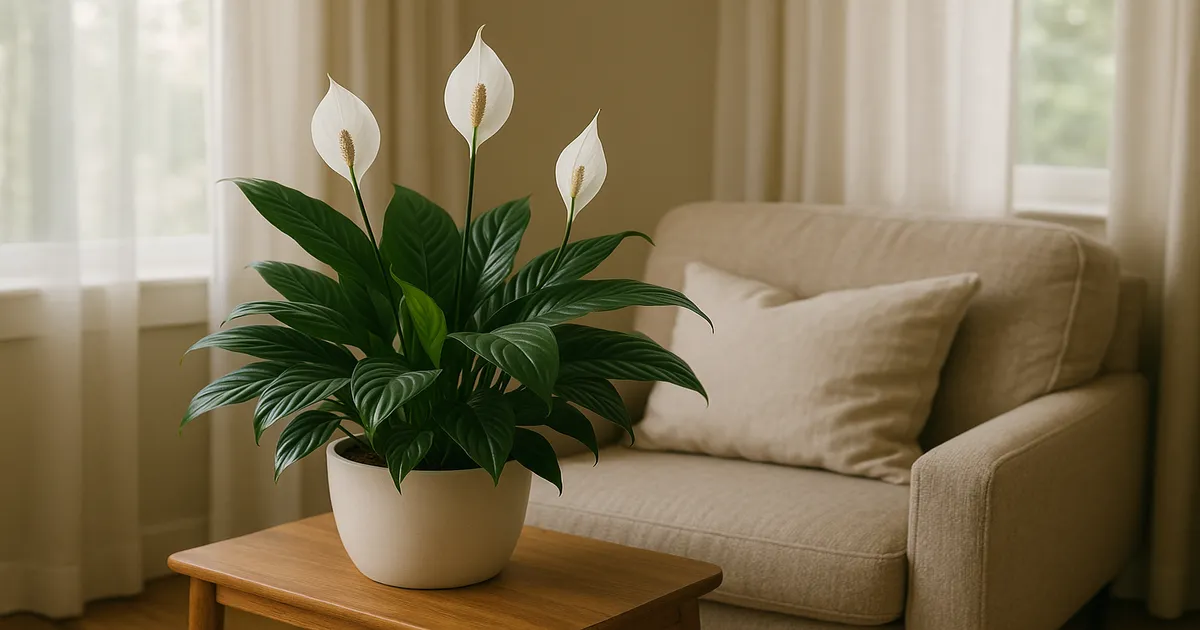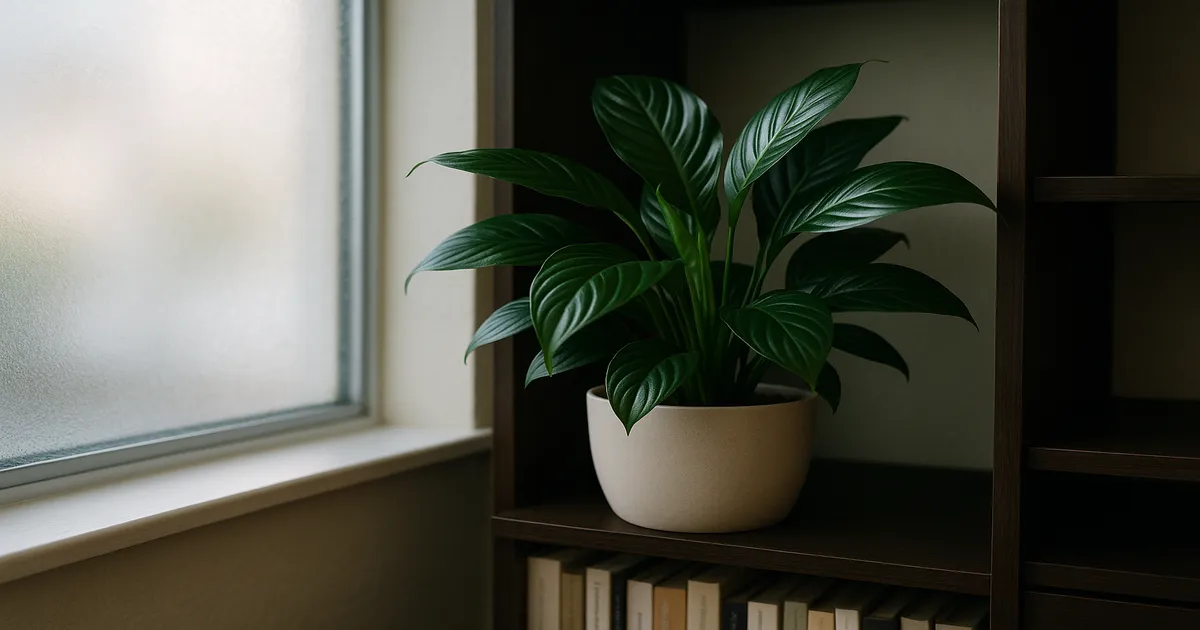
Quick Answer: Peace lilies need medium indirect light (500–1,500 foot-candles) for healthy foliage and bright indirect light (1,500–3,000 foot-candles) to flower reliably. They can survive in low light (25–50 foot-candles), but won’t bloom and will grow very slowly. If you’re asking “will this peace lily get enough light here?” — measure first, then place.
Will This Peace Lily Get Enough Light Here? The Short Answer
Peace lilies are genuinely shade-tolerant, but “tolerates low light” doesn’t mean “thrives in low light.” There’s a real difference between a plant that survives and one that grows well and flowers. Most homes sit somewhere in the middle — the trick is knowing where your spot actually falls on the scale.
For lush foliage, target medium indirect light (500–1,500 foot-candles). For those iconic white blooms, push into bright indirect light (1,500–3,000 foot-candles). Drop below 50 foot-candles and the plant is essentially just staying alive.
Foot-Candle Cheat Sheet
| Light Level | Foot-Candles | What to Expect |
|---|---|---|
| Minimum survival | 25–50 fc | Plant lives, no growth, no flowers |
| Low light | 50–500 fc | Slow growth, unlikely to flower |
| Optimal for foliage | 500–1,500 fc | Healthy, glossy leaves, steady growth |
| Optimal for flowering | 1,500–3,000 fc | Regular blooms, vigorous growth |
| Damage threshold | 3,000+ fc (direct sun) | Bleaching, crispy edges, leaf scorch |
Understanding Peace Lily Light Needs
Why Peace Lilies Evolved for Shade
Spathiphyllum species come from the floors of tropical rainforests in Central and South America, growing beneath dense canopies where only dappled, filtered light reaches the ground. To compensate, they evolved broad, dark-green leaves packed with chlorophyll — essentially large solar panels optimised for low-light environments. That’s why they look so at home in dim offices and hallways where most plants would struggle.
Light Compensation and Saturation Points
Every plant has a light compensation point — the minimum light needed for photosynthesis to outpace respiration. For peace lilies, that’s roughly 50–75 foot-candles, which is low by houseplant standards. Above that threshold, the plant starts building energy and growing. There’s also a ceiling: the light saturation point, around 1,000–1,500 foot-candles, beyond which extra light yields diminishing growth returns and can begin causing damage.
This is why a peace lily can sit on a north-facing windowsill and survive — but it’s also why it rarely flowers there.
How Cultivar Choice Affects Light Tolerance
Not all peace lilies behave the same way. The cultivar matters more than most people realise.
| Cultivar | Size | Light Tolerance |
|---|---|---|
| ’Mauna Loa Supreme’ | Large (up to 4 ft) | Benefits from bright indirect light (1,500–3,000 fc) for best flowering |
| ’Sensation’ | Very large (up to 6 ft) | Most light-tolerant; does well in medium indirect light (500–1,500 fc) |
| ‘Domino’ | Medium (variegated) | Needs more light than green varieties due to reduced chlorophyll |
| ’Petite’ | Compact (12–15 in) | Thrives in lower light; great for offices and north-facing rooms |
| ’Clevelandii’ | Medium | Reliable bloomer; needs at least 500–1,000 fc to flower |
The variegated ‘Domino’ deserves special attention. Those white and cream patches look beautiful, but they contain no chlorophyll — meaning that portion of the leaf does zero photosynthesis. Give ‘Domino’ at least one light level brighter than you’d give a solid-green variety.
How to Measure the Light Where You Plan to Place Your Peace Lily
Using a Lux Meter or Smartphone App
The most reliable approach is a dedicated lux meter — a model like the Dr.Meter LX1330B Digital Illuminance Meter is accurate and inexpensive. Smartphone apps work well enough for rough comparisons, but can vary ±20–30% from professional meters, so treat readings as ballpark figures. To convert lux to foot-candles, divide by 10.76.
When and Where to Take Readings
Take readings at three points in the day — 9 AM, 12 PM, and 3 PM — to capture how light shifts across your space. A windowsill that reads 2,000 foot-candles at noon might drop to 400 by late afternoon. Re-measure in winter too; a spot that’s perfect in July can fall below the minimum threshold by December.
Hold the meter at the height of the plant’s leaves, not at eye level. That’s the light your plant actually experiences.
The Inverse Square Law: Why Distance Matters So Much
Here’s the key insight for anyone wondering “will this peace lily get enough light here?” from across the room: doubling your distance from a window reduces light intensity to roughly one-quarter. A plant at 2 feet from the glass might receive 1,500 foot-candles; at 8 feet, it might get only 100. That’s not a small difference — it’s the gap between flowering and barely surviving.
6 Reasons Your Peace Lily Might Not Be Getting Enough Light
Placed too far from a window. At 8 feet from a window, even on a bright day, you might see just 50–150 foot-candles. The plant will tell you: look for elongated, leggy stems, smaller new leaves, and no flowers. Growth will be slow even if the leaves still look dark green.
Wrong window orientation. North-facing windows in the Northern Hemisphere typically deliver only 25–200 foot-candles — enough for survival, rarely enough for flowering. East-facing windows offer gentle morning light and often hit the sweet spot of 500–2,000 foot-candles. West-facing windows work well too, though afternoon heat can stress the plant. South-facing windows provide the most light but require filtering.
Seasonal light reduction. The winter sun sits lower on the horizon, enters rooms at a shallower angle, and shines for fewer hours. The result is a 40–60% reduction in daily light intake at the same window. If your peace lily stops flowering in October and picks back up in spring, this is almost certainly why — and it’s completely normal.
Obstructions you haven’t noticed. A mature deciduous tree can reduce summer light by up to 90% compared to winter. Heavy curtains, closed blinds, and dirty glass compound the problem. Grimy glass alone can cut light transmission by 10–30%.
Too much direct sun. Direct midday sun through a south or west window can reach 8,000–10,000 foot-candles — well above the peace lily’s damage threshold. You’ll see bleached or washed-out patches, crispy brown edges, and leaves curling away from the light. Wilting despite moist soil is another telltale sign.
Inadequate artificial light. A standard 60-watt incandescent bulb 2 feet from your plant delivers roughly 50 foot-candles — survival territory, nothing more. Incandescent and cool-white fluorescent bulbs are also weak in the red (630–700 nm) and blue (430–470 nm) wavelengths that drive photosynthesis. The plant may sit under what looks like plenty of light while receiving very little usable energy.
How to Fix Peace Lily Light Problems
Best Window Orientations for Peace Lilies
In order of preference: East > West (with afternoon shade) > South (with sheer curtain) > North (needs supplemental light). An east-facing window is the gold standard — bright, gentle morning light with no risk of scorching. South is excellent for flowering but requires a sheer curtain or frosted window film to bring intense direct sun down from 8,000+ foot-candles to a safer 1,000–2,500 foot-candles.
Using Reflective Surfaces
If repositioning isn’t practical, place a white wall, mirror, or reflective panel opposite the window. This can boost ambient light reaching the plant by 20–40% — a simple trick that makes a real difference in darker rooms.
Choosing and Positioning a Grow Light
For north-facing rooms or winter supplementation, a full-spectrum LED grow light is the most reliable fix. The Soltech Aspect Grow Light is a popular choice that blends into home décor without looking clinical. Look for output in both blue (430–470 nm) and red (630–700 nm) wavelengths, and aim for 100–200 µmol/m²/s at canopy level. Position it 12–24 inches above the plant and run it on a timer for 12–16 hours per day, with a consistent 8–12 hour dark period.
Seasonal Adjustments
Move the plant 1–2 feet closer to the window in October. The lower winter sun angle reduces burn risk anyway, so a south-facing spot that needed filtering in July may be fine unfiltered by January. A plug-in timer outlet makes running a grow light through the darker months effortless — set it and forget it.
Treating Sunburned Leaves
Sunburned leaves will not recover. Those bleached patches and crispy edges are permanent. Remove damaged leaves at the base with clean pruning snips — the Fiskars Micro-Tip Pruning Snips work well for this — then adjust the plant’s position so new growth emerges in appropriate light. Don’t mist leaves exposed to direct sun; water droplets can act as lenses and intensify burning.
Pairing Light With Watering and Feeding
Light level directly controls how often you need to water. More light means faster transpiration and faster water use. A peace lily in low light (50–200 foot-candles) may only need watering every 2–3 weeks in winter. The same plant in medium-bright indirect light (500–1,500 foot-candles) will likely need water every 7–10 days. Overwatering a low-light peace lily is the most common way to kill one.
A well-draining aroid mix helps enormously — try 60% potting mix, 20% perlite, and 20% orchid bark, or a pre-mixed aroid blend. Check soil moisture with a meter rather than guessing by schedule.
A plant in low light photosynthesises slowly and can’t use nutrients efficiently. Fertilising it anyway leads to salt buildup and root burn. Wait until the plant is in adequate light before feeding, then use a balanced liquid fertiliser (20-20-20 NPK) at half strength every 4–6 weeks from March through September. Stop completely from October to February and flush the soil with plain water every 3–4 months to clear accumulated salts.
How to Choose the Right Spot Before You Place Your Peace Lily
The single best thing you can do is measure light before the plant goes down. Spend a day taking readings at 9 AM, 12 PM, and 3 PM in your candidate spots. Target 500+ foot-candles for 8+ hours for healthy foliage, and 1,000+ foot-candles for 8+ hours if you want flowers.
Match the cultivar to the room, not the other way around:
- North-facing room or office: Choose ‘Petite’ — the most forgiving in genuinely low light
- East- or west-facing room: Most cultivars will do well; ‘Clevelandii’ and ‘Mauna Loa Supreme’ will reward you with flowers
- Bright south-facing room with filtering: ‘Sensation’ or ‘Mauna Loa Supreme’ will thrive
- Variegated look: ‘Domino’ only in bright indirect light (1,000–2,000 fc) — not a dark corner
Rotate the plant 90° every two weeks to prevent it leaning toward the light source. A wheeled plant caddy makes this effortless.
Frequently Asked Questions About Peace Lily Light
Will this peace lily get enough light in a room with no windows?
Only with a quality grow light. A peace lily needs a minimum of 50–75 foot-candles just to survive, which a full-spectrum LED running 12–16 hours per day can provide. Without any light source — natural or artificial — the plant will slowly decline over several months.
Why is my peace lily not flowering even though it looks healthy?
Insufficient light is the most likely cause. Healthy foliage can persist at 200–500 foot-candles, but reliable flowering requires 1,500–3,000 foot-candles of bright indirect light. If the plant looks good but hasn’t bloomed in over a year, move it 1–2 feet closer to your brightest window. Also check the season — peace lilies naturally pause flowering in autumn and winter even in ideal conditions.
How far from a window can a peace lily be placed?
As a rough guide, most peace lilies placed more than 6–8 feet from a window will receive fewer than 100 foot-candles — enough to survive but not to thrive or flower. The exact distance depends on window size, orientation, and whether anything is blocking the glass. Measure rather than guess.
Can a peace lily get too much light?
Yes. Direct sun above 3,000 foot-candles causes bleaching, crispy brown edges, and wilting even in moist soil. Peace lilies need bright indirect light, not direct sun. A sheer curtain over a south- or west-facing window usually solves the problem.
My peace lily’s leaves are yellowing — is it a light problem?
Yellowing has several causes, and light is just one of them. Overwatering is more common. In low light, the plant photosynthesises slowly, so excess water sits in the soil and suffocates roots. Check soil moisture before adjusting light. If the soil is consistently wet and the plant is in a dim spot, fix both issues at once: improve drainage, reduce watering frequency, and move the plant closer to a window.