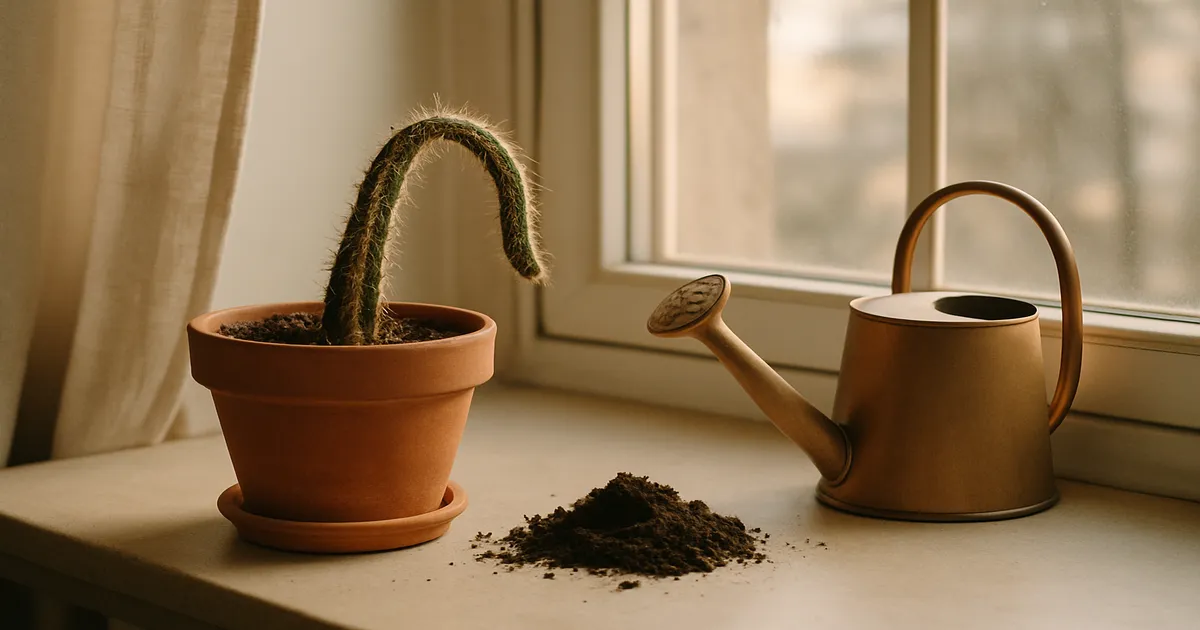
Quick Answer: Yes, most dying cacti can be saved — but you need to act fast and diagnose the right problem first. The single most important test is checking whether firm, healthy tissue remains beneath the skin. If it does, you have a real shot at recovery.
If you’ve found yourself staring at a sad, soft, or shriveled cactus and asking “can I save this cactus, and if so how?” — the answer is almost always maybe, and often yes. Cacti are remarkably resilient plants, but they do have a point of no return. This guide walks you through diagnosing exactly what’s wrong and fixing it, step by step.
Can You Save a Dying Cactus? Here’s How to Tell
The Squeeze-and-Look Test
The most reliable survival test takes about 30 seconds. Gently press the base of the stem — firm resistance is a good sign. Then use a clean knife to nick a small section of skin and check the tissue just beneath: if it’s green or pale white, the plant is still alive and worth saving.
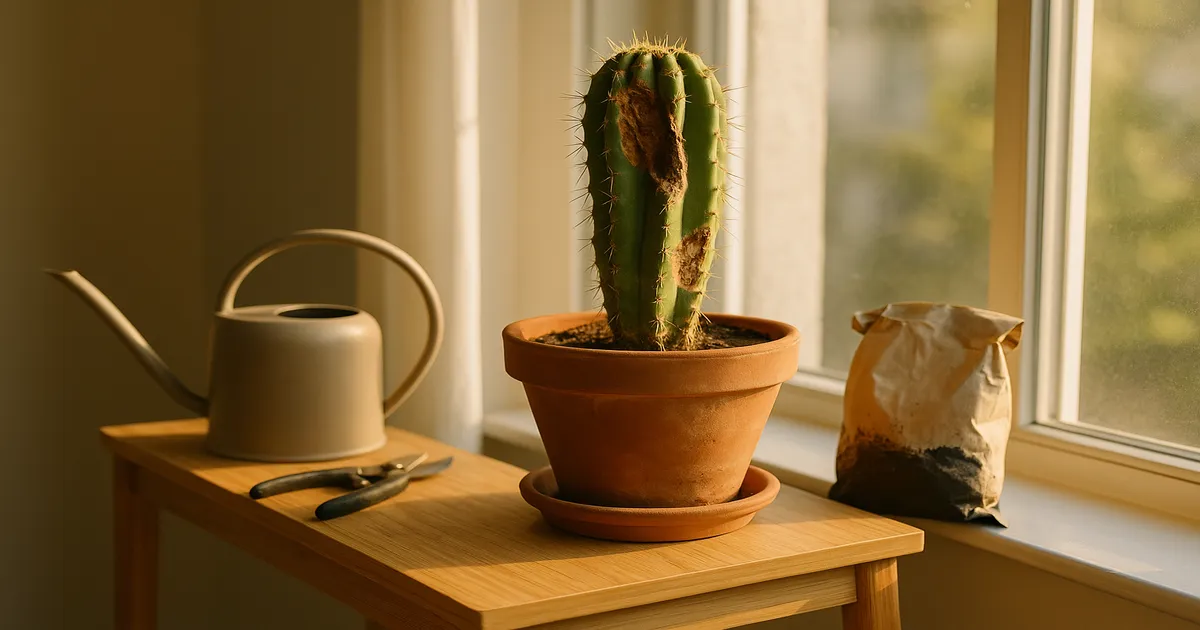
Dead tissue tells a different story. If you cut into the stem and find nothing but brown, gray, or black all the way through — no white core, no green layer anywhere — the rot has consumed the vascular system and recovery isn’t possible. The same applies when the entire base has collapsed into a mushy, foul-smelling heap with no firm tissue remaining on a cross-section cut.
How to Diagnose What’s Wrong With Your Cactus
Before you treat anything, you need to know what you’re dealing with. Here’s a symptom-by-symptom breakdown.
| Symptom | Most Likely Cause |
|---|---|
| Soft, mushy base with bad smell | Root rot (overwatering) |
| Wrinkled, pleated, or shriveled stem | Dehydration |
| Pale, elongated, lopsided new growth | Light deficiency (etiolation) |
| Cottony deposits or sticky residue | Mealybugs or scale insects |
| Fine webbing, stippled skin | Spider mites |
| Translucent or corky patches | Frost or cold damage |
| Sunken, discolored lesions | Fungal or bacterial infection |
| Tilting scion at a junction line | Graft failure |
Soft, Mushy, or Smelly Base — Root Rot
This is the most common cactus killer. Excess moisture creates anaerobic conditions in the soil, allowing water molds like Phytophthora and Pythium — plus fungi like Fusarium — to destroy root tissue and travel upward into the stem. Golden barrel cacti and grafted moon cacti are especially vulnerable.
Wrinkled or Shriveled Stem — Dehydration
When a cactus runs out of stored water, its parenchyma cells lose turgor pressure and the stem collapses inward like a deflated accordion. The pot will feel unusually light and the soil will be bone dry. Note that mild wrinkling in winter is normal dormancy behavior, not a crisis.
Pale, Elongated New Growth — Light Deficiency
This is called etiolation. Without enough light, the cactus stretches desperately toward any available source, producing thin, pale, structurally weak growth. That weakened tissue is also more vulnerable to rot and pests, so poor light creates a cascade of problems.
Cottony Deposits or Stippling — Pest Infestation
White fluffy clusters in the areoles point to mealybugs. Waxy brown bumps on the stem are scale insects. Fine webbing and a sandpapery texture mean spider mites. Sticky honeydew residue is a byproduct of sap-feeding insects and often signals a secondary sooty mold problem.
Translucent or Corky Patches — Cold Damage
Exposure below 40°F (4°C) causes ice crystals to rupture cell membranes. You’ll see water-soaked, translucent patches that turn brown or black, with corky scarring where the plant has tried to seal off the damage. It’s usually concentrated on the side facing a cold window or drafty wall.
Sunken Lesions or Dry Brown Patches — Fungal or Bacterial Infection
Erwinia bacteria cause a rapidly spreading, foul-smelling soft rot. Colletotrichum causes sunken anthracnose lesions. Dry rot (Helminthosporium) looks brown and corky without spreading quickly. Orange or pink spore masses on the surface confirm a fungal issue.
Tilting Scion — Graft Failure
This one is specific to grafted cacti like the moon cactus. If the colorful top portion (scion) is tilting, softening at the joint, or separating from the green base (rootstock), the graft union has failed — usually due to rot, physical damage, or rootstock decline.
How to Save a Cactus With Root Rot
This is the scenario most people are dealing with, so it gets the most detail.
Step 1 — Unpot and assess. Wrap the cactus in several layers of newspaper or use thick leather gloves, then ease it out of its pot. Shake off every bit of old soil. Healthy roots are white to tan and feel firm. Dead roots are brown or black, mushy, and may fall away when touched.
Step 2 — Cut away all rotted tissue. Sterilize a sharp knife with 70% isopropyl alcohol before every cut. Remove all dead roots, then cut into the stem if needed — keep going until every cut surface shows only clean white or pale green tissue. Leaving even a small patch of infected tissue will cause the rot to return.
Step 3 — Disinfect and callus. Dust all cut surfaces generously with powdered sulfur or activated charcoal to seal the wounds. Then set the cactus aside in a warm, dry spot with good airflow for 3–7 days (larger cuts may need up to two weeks). Do not skip this step — planting a fresh cut directly into soil is an open invitation for rot.
Step 4 — Repot in fast-draining mix. Use a mix that’s 50–70% inorganic material — perlite, pumice, or coarse horticultural grit (not fine beach sand, which compacts). A quality pre-blended cactus soil such as Bonsai Jack Succulent and Cactus Soil already hits this ratio and takes the guesswork out of mixing your own. Choose a pot only 1–2 inches larger than the remaining root ball, with at least one drainage hole.
Step 5 — Restart watering slowly. Keep the repotted cactus in bright indirect light (1,500–3,000 foot-candles) for the first two to three weeks, then transition it back to its normal spot. Hold off watering for 2–4 weeks after repotting to encourage new roots to grow outward in search of moisture. When you do water, soak thoroughly, then let the soil dry completely before watering again.
How to Rehydrate a Severely Underwatered Cactus
A little wrinkling in winter is just your cactus slowing down. True dehydration looks more dramatic: deep pleating, a dull matte surface, a pot that feels almost weightless, and sometimes leaning because the roots have died back.
Don’t flood it. A sudden influx of water can rupture cells that have shrunk and hardened. Instead, use bottom watering: set the pot in a shallow tray of water for 20–30 minutes, let it absorb from below, then remove it. Repeat every two days for a week. Mild wrinkling typically resolves within one to two weeks; severe cases may take four to eight weeks.
If the soil has become hydrophobic — water runs straight through without absorbing — replace the entire mix with fresh cactus soil. There’s no reliable way to rehydrate hydrophobic soil in a small pot.
How to Fix a Cactus With Too Little Light
Most desert cacti need bright direct light (3,000–8,000+ foot-candles) for at least four to six hours a day. In the Northern Hemisphere, a south-facing windowsill is the gold standard. East or west windows can work as a secondary option but may not be enough for high-light species like golden barrels or columnar cereus.
The minimum most cacti can tolerate is bright indirect light (1,500–3,000 foot-candles) — a few feet back from a sunny window. Below that, etiolation is almost inevitable.
For low-light homes, a full-spectrum LED grow light positioned 6–12 inches above the plant and run for 12–16 hours per day makes a real difference. A timer-equipped grow light such as the Spider Farmer SF-1000 takes the daily guesswork out of the schedule entirely.
One important caveat: the stretched, pale growth that’s already there won’t shrink back or firm up. Fix the light situation, and the plant will produce new compact growth from that point forward. Once it’s stable, you can prune the etiolated section to improve the appearance.
How to Treat Common Cactus Pests
Isolate any affected plant immediately before treating — most cactus pests spread fast.
- Mealybugs: Dab individual bugs with a cotton swab dipped in 70% isopropyl alcohol, then spray the whole plant with diluted neem oil or insecticidal soap. Repeat every 5–7 days for at least three to four cycles to break the egg cycle.
- Scale insects: Scrub them off with a soft toothbrush soaked in isopropyl alcohol, then follow up with a neem oil or horticultural oil spray. Multiple treatment rounds are required.
- Spider mites: These thrive in hot, dry conditions. Temporarily raising humidity to 50–60% makes the environment less hospitable. Apply a miticide or neem oil — a ready-to-use formula such as Bonide Neem Oil works well — every 3–5 days for three to four cycles. Standard insecticides typically don’t work on mites.
- Fungus gnats: Let the soil dry out completely between waterings (larvae can’t survive in dry soil) and apply a Bacillus thuringiensis israelensis (Bti) soil drench such as Mosquito Bits by Summit to kill larvae. A 1-inch top-dressing of coarse sand deters egg-laying.
- Root mealybugs: These live in the root zone and cause mysterious decline with no visible above-ground pests. If your cactus is wilting despite correct care, unpot it and inspect the roots. Treat by soaking roots in diluted neem oil solution for 10–15 minutes, then repot in fresh sterile soil.
Repotting, Soil, and Other Fixable Problems
Root-bound signs: Roots poking out of drainage holes, soil that dries out within a day or two, and stunted growth despite good care all suggest the cactus has outgrown its pot.
Repotting basics: Spring is the ideal time — repotting at the start of the growing season gives roots the best chance to establish. Gently loosen any circling roots and trim dead ones with sterile scissors before settling the plant into its new home. Aim for a soil pH of 6.0–7.0; a soil pH meter such as the Apera Instruments AI209 makes this easy to check.
Temperature and frost damage: Move a cold-damaged cactus to a warm spot (65–80°F / 18–27°C) immediately and do not water. Wait two to four weeks before cutting anything away — some areas that look dead will callus over and recover on their own.
Nutrient issues: Uniform pale yellowing usually means nitrogen deficiency. Yellow tissue between green veins (interveinal chlorosis) points to iron or magnesium deficiency, often caused by soil pH above 7.5. White crusty deposits on the soil surface signal fertilizer salt buildup — flush thoroughly with plain water or repot entirely. During the growing season, a diluted balanced cactus fertilizer applied once a month is sufficient.
How to Prevent Cactus Problems in the Future
Check soil before every watering. Never water on a fixed schedule. Push your finger an inch into the soil — if it feels even slightly damp, wait. A moisture meter such as the XLUX Soil Moisture Meter removes the guesswork entirely and is worth the small investment.
Adjust for the seasons. During the active growing season (spring through early fall), water every 2–4 weeks. In winter dormancy, pull back to every 4–8 weeks — or even less for small pots in cool rooms. The plant’s metabolism slows dramatically and it simply doesn’t need much.
Get the foundation right. A pot with drainage, an inorganic-heavy soil mix, and an appropriately sized container eliminate the conditions that cause root rot, which is responsible for the majority of cactus deaths.
Inspect monthly. Check the areoles for cottony deposits, gently press the base for any softness, and look at the soil surface for gnat activity. Rotate the pot 90° every two to four weeks for even light exposure. Catching a pest infestation or early rot when it’s small makes the difference between a quick fix and a major rescue operation.
Frequently Asked Questions
Can I save this cactus if it has root rot?
Yes, if caught early enough. Healthy, firm tissue must still remain somewhere on the plant. Cut away all rotted material, dust the wounds with powdered sulfur or activated charcoal, let the plant callus for 3–7 days, and repot in fast-draining soil. Many cacti make a full recovery after aggressive root rot surgery.
How do I know if my cactus is dead or just dormant?
A dormant cactus is firm to the touch and may show mild wrinkling, but the tissue beneath the skin is still green or white. A dead cactus will be mushy, hollow, or completely brown all the way through when you cut into it. If in doubt, do the squeeze test — dormant cacti always feel solid.
Why is my cactus soft and mushy at the base?
A soft, mushy base almost always means root rot caused by overwatering or poor drainage. Water mold pathogens (Phytophthora, Pythium) destroy root tissue in waterlogged soil, and the decay travels upward into the stem. Unpot the plant immediately and assess how far the damage has spread.
How often should I water a cactus indoors?
Every 2–4 weeks during the growing season (spring through early fall), and every 4–8 weeks in winter. Always confirm the soil is completely dry before watering again — exact frequency depends on pot size, soil mix, humidity, and light level, so use the finger-test or a moisture meter rather than a calendar.
Can I cut off the rotted part and replant the healthy section?
Yes — this is the standard rescue technique. Cut back to completely healthy tissue (white or pale green on the cut surface), dust the wound with powdered sulfur or activated charcoal, and allow it to callus for at least 3–7 days before placing it in fresh, fast-draining cactus mix. Keep it dry and in bright indirect light until new roots establish.