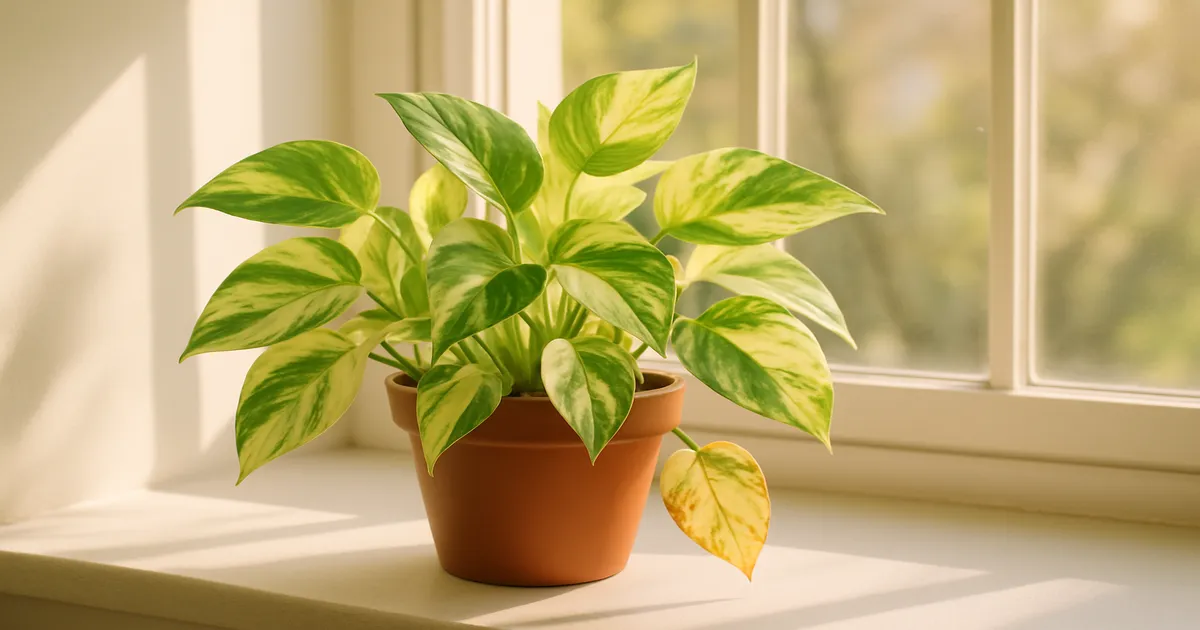
Quick Answer: If you’re wondering what is going on with your Lemon Meringue pothos, the most likely culprits are incorrect light, overwatering, low humidity, pests, or nutrient deficiencies. This cultivar is more sensitive than standard green pothos because its yellow variegation contains less chlorophyll — making it slower to recover from stress and quicker to show symptoms.
What Is Going On With Your Lemon Meringue Pothos? Start Here.
Something looks off and you need answers fast. Yellowing leaves, brown tips, fading color, or just a generally sad-looking plant — here are the usual suspects:
- Too little or too much light — causes color loss, scorching, or leggy growth
- Overwatering or root rot — the single most common killer of pothos
- Underwatering — less common but easy to fix
- Low humidity — leads to crispy brown tips and edges
- Pest infestations — spider mites, mealybugs, and fungus gnats are frequent offenders
- Nutrient deficiencies or fertilizer burn — show up as specific yellowing patterns
- Variegation reversion — green shoots taking over, not a disease
Why Lemon Meringue Is More Sensitive Than Other Pothos
Lemon Meringue’s two-toned leaves are the result of chimeral variegation — the yellow and chartreuse sections contain fewer functional chloroplasts than fully green tissue. Less chlorophyll means a lower photosynthetic rate, slower growth, and reduced stress tolerance. It also means the plant uses water more slowly, so it’s easier to overwater than a Golden Pothos or Neon Pothos. Keep that in mind as you work through each section — what’s a minor inconvenience for a green pothos can become a real problem for this one.
Know Your Plant: Lemon Meringue Pothos Basics
Epipremnum aureum ‘Lemon Meringue’ is closely related to Neon Pothos but visually distinct. Where Neon is uniformly electric green, Lemon Meringue has a two-toned pattern — buttery yellow blending into chartreuse, sometimes with creamy streaks — that earns its dessert-inspired name. Leaves are heart-shaped, glossy, and typically 3–6 inches long indoors. Like all pothos, it’s a vigorous viner that can reach 6–10 feet with support.
Chimeral variegation isn’t a pigment overlay — it’s a structural difference in the plant’s cell layers. The yellow sections literally have fewer working chloroplasts. This makes the plant respond more dramatically to changes in light, water, and nutrients than a fully green variety would.
One important note: like all pothos, Lemon Meringue is toxic to cats, dogs, and humans if ingested. Calcium oxalate crystals cause oral irritation, drooling, and GI distress. Keep it out of reach of pets and children.
Light Problems: Fading Color, Scorching, and Leggy Growth
Too Little Light
In low light, Lemon Meringue does something counterintuitive — it starts producing more chlorophyll in the variegated sections, causing the bright yellow to green up and fade. You’ll also notice longer gaps between leaves on the vine, smaller new leaves, and sluggish growth overall. The plant isn’t dying, but it’s compensating, and the color you bought it for will gradually disappear.
Too Much Direct Sun
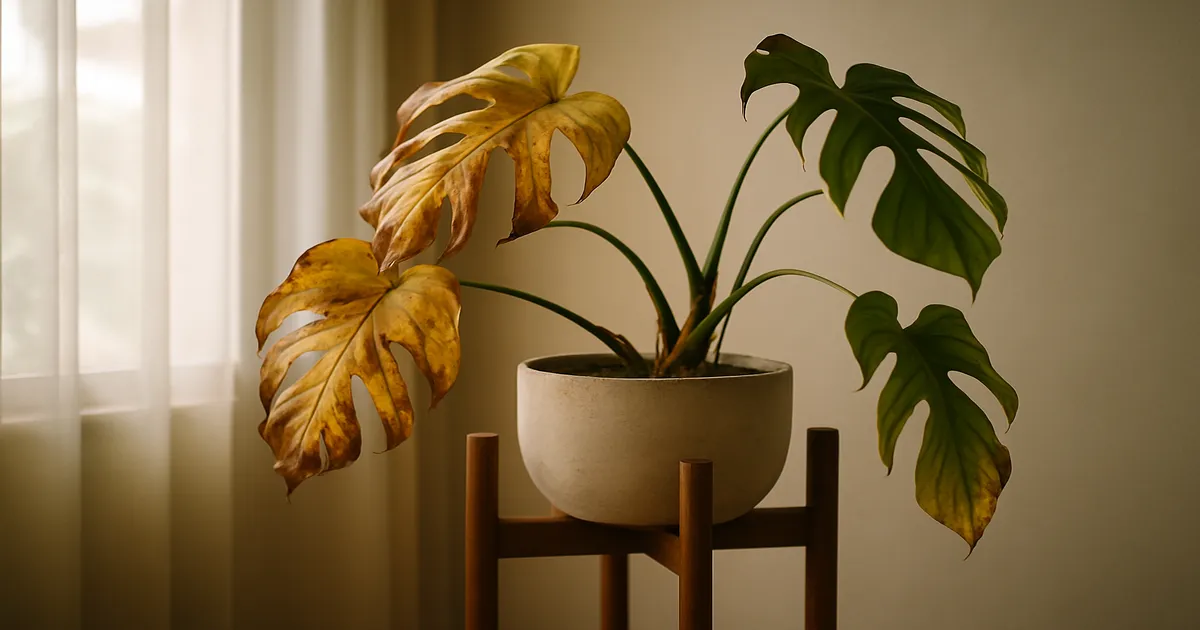
Direct sun hits the low-chlorophyll variegated cells hardest. Those cells photooxidize quickly, producing white or tan bleached patches, crispy brown edges, and curling leaves. If your Lemon Meringue sits in a south- or west-facing window with no filter, that’s likely your problem. Trim scorched leaves with sterile scissors — damaged tissue won’t recover, but the plant will push healthy new growth once conditions improve.
Finding the Right Spot
The sweet spot is bright indirect light, roughly 1,500–3,000 foot-candles. An east-facing windowsill is nearly perfect. A south- or west-facing window works if the plant sits a few feet back or behind a sheer curtain. If you want to stop guessing, a dedicated foot-candle meter gives you an exact reading at the spot where your plant sits. When natural light falls short, a full-spectrum LED grow light positioned 6–12 inches above the plant and running 12–14 hours per day will keep both color and growth rate on track.
Watering Issues: Overwatering, Root Rot, and Drought Stress
Signs of Overwatering
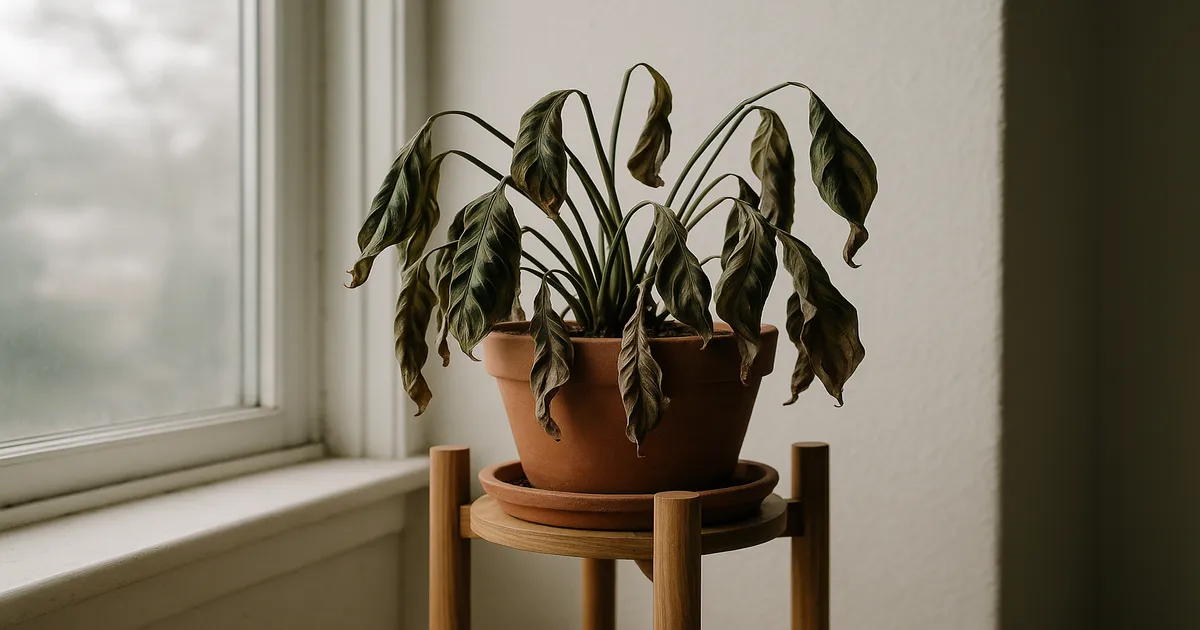
Overwatering symptoms include yellowing lower leaves, soft or mushy stems near the base, wilting despite wet soil, and a sour smell from the pot. The wilting is particularly confusing — it looks like the plant needs water, but the roots are rotting and can’t transport moisture. Pathogens like Phytophthora, Pythium, and Fusarium thrive in waterlogged, anaerobic soil.
Because Lemon Meringue photosynthesize more slowly than all-green varieties, it simply doesn’t drink as fast. A watering schedule that works for your Golden Pothos may be too frequent for this cultivar.
Treating Root Rot: Step by Step
Act quickly — root rot spreads fast.
- Unpot the plant and shake off as much old soil as possible.
- Inspect the roots. Healthy roots are white to tan and firm. Rotted roots are brown or black, mushy, and smell bad.
- Trim all rotted roots with sterile scissors, cutting back to healthy tissue.
- Dust cut surfaces with powdered cinnamon or sulfur — both have mild antifungal properties.
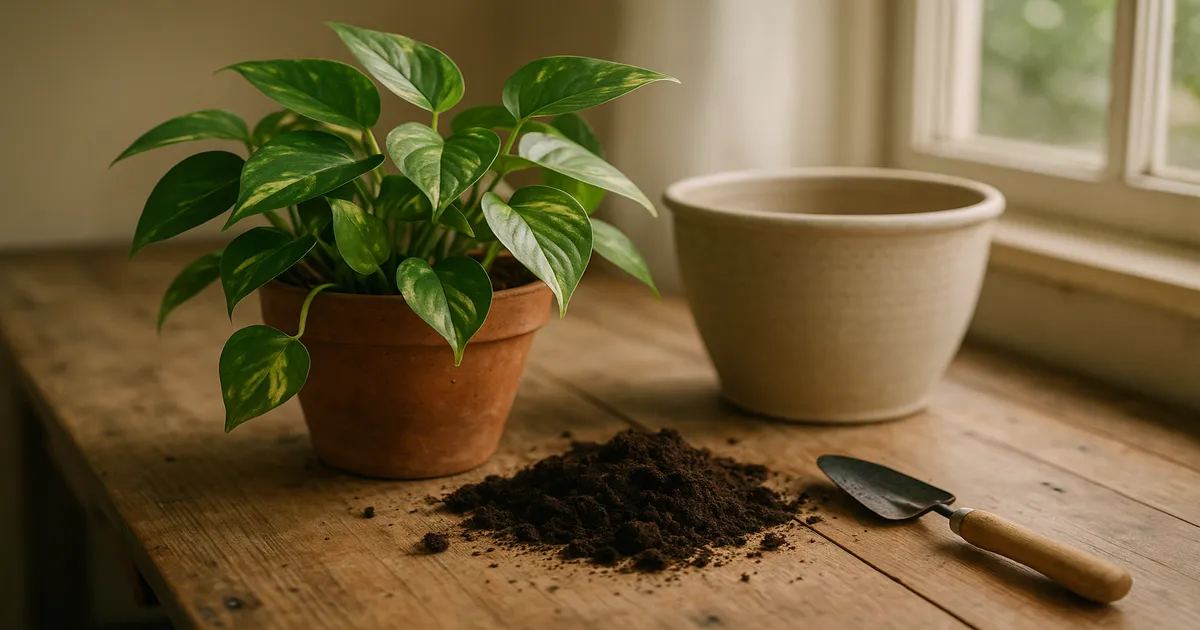
- Repot into fresh, well-draining mix. Never reuse old soil.
- Choose a terracotta pot with drainage holes — terracotta wicks moisture through its walls, giving overwatering-prone growers a natural buffer.
- Hold off on watering for 3–5 days, then resume using the finger test below.
Signs of Underwatering
Underwatered leaves curl inward, feel papery or thin, and develop dry brown tips. The soil will be bone dry and the pot will feel noticeably light. If the soil has become hydrophobic — water runs straight through without absorbing — try bottom watering: set the pot in a tray of room-temperature water for 20–30 minutes and let the soil wick moisture up from below.
How to Know When to Water
Push your finger 2 inches into the soil. If it feels wet or cool, wait. Water only when the top 1–2 inches are dry. You can also lift the pot — a light pot means dry soil, a heavy pot means it still has moisture. A soil moisture meter removes the guesswork entirely and is worth the small investment.
Nutrient Deficiencies and Fertilizer Problems
Reading the Visual Clues
Each deficiency has a distinct pattern:
- Nitrogen deficiency: Uniform pale yellowing starting on older, lower leaves and moving upward. Growth slows noticeably.
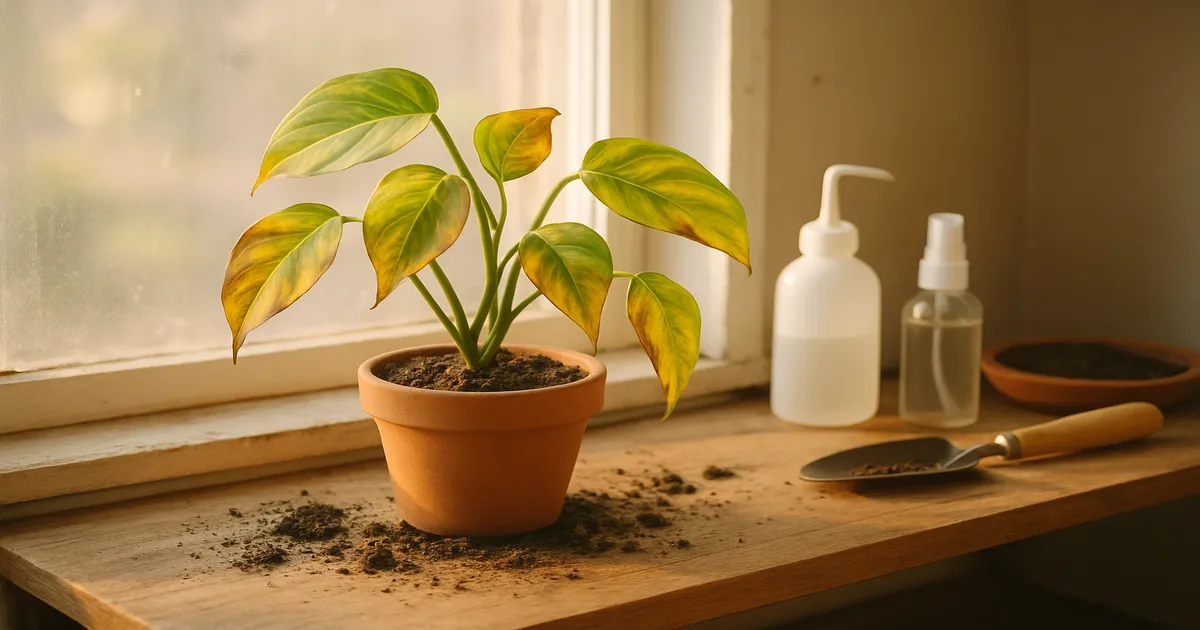
- Iron deficiency (interveinal chlorosis): New leaves emerge with yellow tissue between distinctly green veins. This is almost always a soil pH problem rather than a true lack of iron.
- Magnesium deficiency: Similar interveinal chlorosis, but on older leaves. Look for a V-shaped yellow pattern spreading inward from the leaf margins.
- Calcium deficiency: Distorted, cupped, or stunted new growth; brown edges on emerging leaves.
Even if nutrients are present in the soil, the plant can’t access them if pH is off. Lemon Meringue needs a soil pH of 5.5–6.5. Above 6.5, iron becomes chemically unavailable — which is why interveinal chlorosis on new leaves so often points to a pH issue rather than a fertilizer gap. Test your soil with a pH kit before adding supplements.
For iron chlorosis, apply a chelated iron supplement as a soil drench after correcting pH. For magnesium deficiency, a monthly drench of Epsom salt (1 teaspoon per gallon of water) works well.
Fertilizer Burn
Fertilizer burn looks a lot like underwatering — crispy brown tips and edges — but you’ll also see white crusty salt deposits on the soil surface. Flush the soil thoroughly with plain water (pour through 3–4 times the pot volume), then withhold fertilizer for 4–6 weeks. During the growing season (spring through early fall), feed with a balanced liquid fertilizer at half-strength every 2–4 weeks. Don’t fertilize in winter.
Pests, Diseases, and Environmental Stress
Common Pests
- Spider mites: Tiny white or yellow stippling on leaf surfaces, fine webbing on undersides. They thrive when humidity drops below 40% RH.
- Mealybugs: White cottony masses in leaf axils and along stems, often with sticky honeydew residue.
- Scale: Brown or tan bumps on stems and leaf undersides; sticky residue; yellowing and dieback.
- Thrips: Silver-streaked or bronzed leaf surfaces, distorted new growth, tiny dark fecal specks. Thrips can also transmit plant viruses.
- Fungus gnats: Larvae live in the top 2–3 inches of moist soil and feed on root hairs, weakening the plant and opening wounds for pathogens. Let the top layer dry out between waterings and apply a Bti (Bacillus thuringiensis israelensis) drench to kill existing larvae.
For spider mites, shower the plant to dislodge them, then apply neem oil solution (2 tsp neem oil + 1 tsp dish soap per quart of water) to all leaf surfaces. Repeat every 5–7 days for 3–4 weeks. For mealybugs, dab individual insects with a cotton swab dipped in 70% isopropyl alcohol, then follow up with insecticidal soap. Always quarantine new plants for 2–3 weeks before placing them near your collection.
Diseases
Bacterial leaf spot (Pseudomonas or Erwinia spp.) shows up as water-soaked lesions that turn dark brown or black with yellow halos. It spreads quickly in high humidity with poor air circulation. Rhizoctonia stem rot causes brown, sunken lesions at the soil line — a common consequence of overwatering. Pothos mosaic virus produces mosaic patterns and distorted growth; it’s spread by thrips and has no cure, so infected plants should be discarded.
Humidity, Temperature, and Drafts
Lemon Meringue evolved in tropical conditions. Most homes run 30–50% relative humidity, and in winter with heating on, that can drop even lower. Below 40% RH, you’ll see classic brown crispy tips and marginal necrosis. Aim for 50–70% RH — a small humidifier near your plant collection is the most effective solution. A pebble tray or grouping plants together provides a modest boost if a humidifier isn’t practical.
Keep the plant between 65–85°F (18–29°C). Below 50°F, growth stalls. Below 45°F, chilling injury occurs — water in the intercellular spaces begins to rupture cells, leaving dark, water-soaked patches that turn brown as tissue dies. Also check that your plant isn’t sitting above a heating vent, below an AC unit, or near a drafty window — these spots create unpredictable temperature swings that keep the plant perpetually stressed.
Soil, Pot Size, and Repotting
Roots poking out of drainage holes, soil that dries out within a day or two, and stunted growth despite good conditions all point to a rootbound plant. The ideal potting mix is chunky and well-draining: roughly 60% quality potting mix and 40% perlite or pumice. This keeps roots oxygenated and prevents the waterlogging that Lemon Meringue is particularly vulnerable to. Avoid pots without drainage holes entirely.
Repot in spring, going up only 1–2 pot sizes — a pot that’s too large holds excess moisture the roots can’t yet absorb, which circles right back to overwatering risk. Water lightly after repotting and keep the plant in bright indirect light while it settles in.
Variegation Reversion: Why Your Lemon Meringue Is Turning Green
Chimeral variegation is genetically unstable. The plant contains both variegated and fully green cell layers, and sometimes the green layer produces a shoot that’s entirely green — more photosynthetically efficient and therefore a faster grower. Without intervention, these green shoots can outcompete the variegated growth and gradually take over. Low light accelerates this, because the plant increases chlorophyll production to compensate.
You can’t force an already-green shoot back to variegated — that cell-layer change is permanent. But you can stop the spread. Prune any fully green reverted stems back to a node where variegation is still present, and move the plant to brighter indirect light to encourage the variegated cell layer to dominate new growth. Think of it as editing the plant rather than curing a disease — because that’s exactly what it is.
Frequently Asked Questions
What is going on with my Lemon Meringue pothos when the leaves turn yellow?
Yellow leaves most often signal overwatering, a nutrient deficiency, or insufficient light. Check soil moisture first — if it’s wet and the pot smells sour, root rot may already be underway. If the soil is fine, look at the pattern: uniform fading on older leaves suggests nitrogen deficiency, while yellowing between green veins on new leaves points to iron deficiency or high soil pH.
Why is my Lemon Meringue pothos losing its variegation and turning green?
This is chimeral reversion — the plant is producing growth from its fully green cell layer, which outcompetes variegated growth, especially in low light. It’s not a disease or deficiency. Move the plant to brighter indirect light and prune back any fully green stems to a node where variegation is still present.
Why does my Lemon Meringue pothos have brown tips?
Brown tips are almost always caused by low humidity, fertilizer salt buildup, or fluoride/chlorine in tap water. Raise humidity to 50–70% RH, flush the soil if you see white crusty deposits on the surface, and switch to filtered or rainwater if tap water is heavily treated.
Why is my Lemon Meringue pothos wilting even though the soil is wet?
Wilting in wet soil is a classic sign of root rot. The roots are damaged and can’t transport water, so the plant wilts despite having plenty of moisture available. Unpot the plant, trim any brown or mushy roots, and repot into fresh, well-draining mix in a terracotta pot with drainage holes.
How often should I water my Lemon Meringue pothos?
There’s no fixed schedule — it depends on pot size, soil mix, light level, and season. The reliable method is the finger test: water only when the top 1–2 inches of soil are dry. In most home conditions, that works out to roughly every 7–14 days in summer and every 14–21 days in winter. When in doubt, wait an extra day.