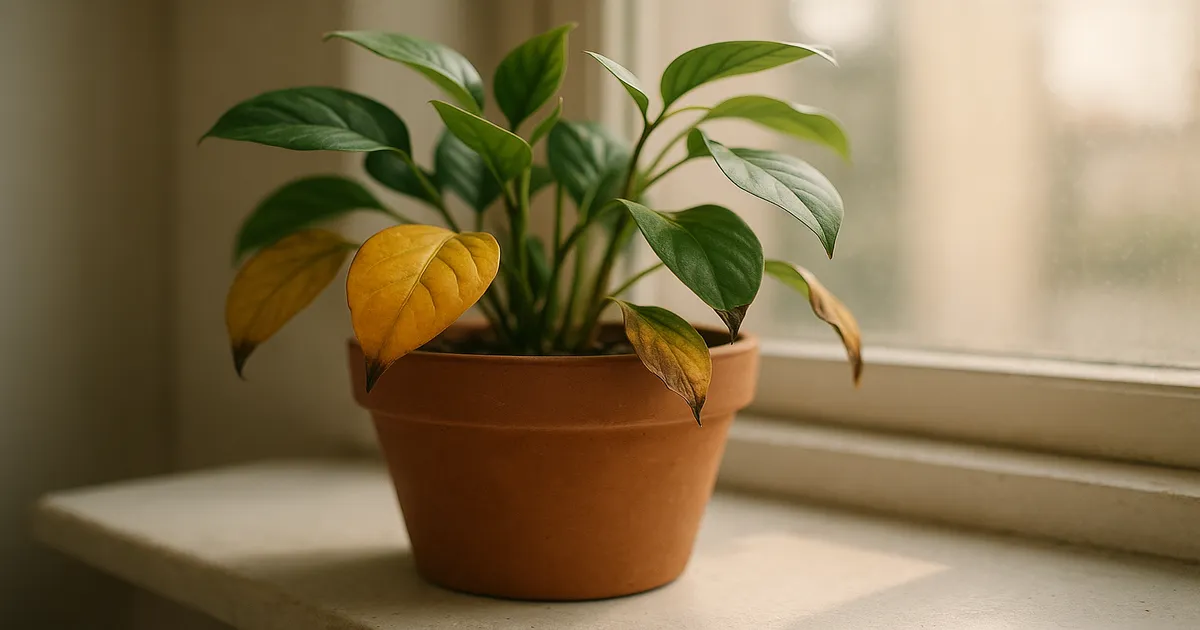
Quick Answer: Most leaf problems are fixable — and many aren’t even problems at all. A single yellowing lower leaf or a minor brown tip is usually normal. Act fast if you see mushy spots spreading across multiple leaves, sudden widespread wilting, or visible bugs. Once you identify the cause, almost every common leaf issue can be turned around.
Staring at a weird-looking leaf and wondering should I worry about this leaf? is a rite of passage for every plant parent. The good news: leaves are your most reliable window into your plant’s health, and most of what they’re telling you is fixable once you know how to read the signals. This guide walks you through every common symptom — from yellowing and brown tips to pests and rot — so you can diagnose the problem and act with confidence.
Should I Worry About This Leaf? How to Tell at a Glance
Signs You Can Relax
Some leaf changes are completely normal and need no intervention:
- One old lower leaf turning yellow — plants routinely shed their oldest leaves as they push out new growth
- Minor brown tips on an otherwise healthy plant in a dry home
- Small cosmetic spots that aren’t spreading and don’t appear on new growth
- Slight drooping in the afternoon heat that recovers by morning
Signs You Should Act Today
These symptoms mean something is genuinely wrong:
- Mushy, water-soaked spots spreading across multiple leaves
- Sudden widespread wilting across the whole plant (not just afternoon droop)
- Visible bugs, webbing, or cottony masses on leaves or stems
- Distorted, stunted, or curled new growth
- Leaves dropping en masse without yellowing first
Why Leaves Are Your Best Plant Health Diagnostic Tool
A leaf is essentially a solar panel and a breathing system rolled into one. It captures light energy through chloroplasts and releases up to 97% of the water the plant absorbs through tiny pores called stomata. When something goes wrong — too little water, a pest, a nutrient shortage — these systems are disrupted almost immediately. The leaf changes colour, texture, or shape in response. No other part of the plant gives you that kind of real-time feedback.
Read the Pattern, Not Just the Symptom
Before you diagnose anything, ask two questions: Where on the plant is the problem? and What does the affected leaf feel like?
- Mushy or translucent → overwatering or disease
- Crispy and dry → underwatering, low humidity, or light burn
- Spots with defined edges → fungal or bacterial issue
- Distorted or streaked → pests or viral problems
Location matters just as much as texture. Symptoms on older, lower leaves almost always point to mobile nutrient issues or overwatering. Symptoms on new, young growth suggest immobile nutrient deficiencies, pests, or viral problems.
Old Leaves vs. New Leaves: A Critical Distinction
This single distinction will save you hours of guessing. Nitrogen, potassium, and magnesium are mobile nutrients — the plant can pull them from old tissue to feed new growth, so deficiencies show up on the bottom leaves first. Calcium and iron are immobile, so deficiencies damage new growth first. If your new leaves look perfect and only the old ones are yellowing, that’s a very different diagnosis than if your fresh growth is coming in pale or deformed.
The 5 Most Common Reasons a Leaf Looks Off
1. Overwatering
Waterlogged soil cuts off oxygen to roots, creating conditions where rot-causing pathogens like Pythium thrive. Once roots start dying, the plant can’t take up water — so an overwatered plant often looks like it’s dying of thirst. This is the most common misdiagnosis in houseplant care.
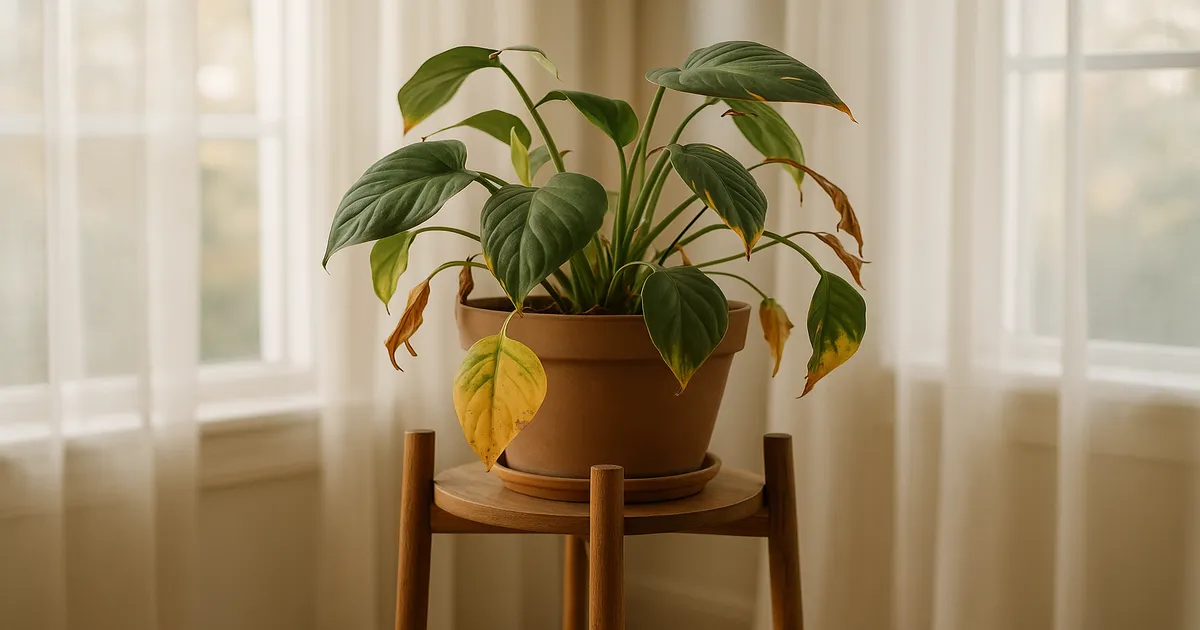
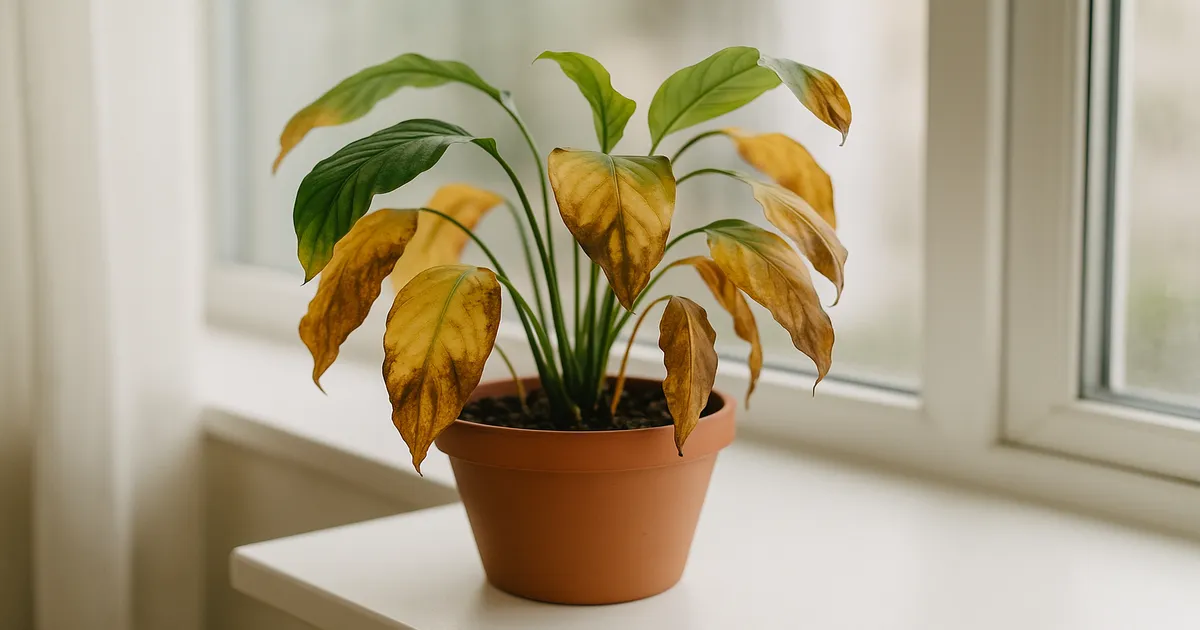
Symptoms: Uniform yellowing starting on lower leaves, soft or mushy leaf texture, translucency, wilting despite wet soil.
Diagnostic clue: Pick up the pot. If it feels heavy and the soil is still wet several days after watering, overwatering is almost certainly your culprit.
2. Underwatering
When soil dries out completely, leaf cells lose turgor pressure and collapse. The plant responds by closing its stomata and curling its leaves inward to slow water loss.
Symptoms: Crispy brown tips and edges, inward-curling leaves, thin papery texture, dull colour.
Diagnostic clue: Bone-dry soil and a very light pot. The leaves will feel thin and almost papery between your fingers.
3. Too Much or Too Little Light
Too little light produces pale, stretched growth as the plant reaches for photons. Too much direct sun overwhelms the leaf’s protective systems and bleaches the chlorophyll — you’ll see white or tan patches on whichever side faces the light source.
Light level reference:
- Low light: 25–100 foot-candles
- Medium indirect: 100–1,500 foot-candles
- Bright indirect: 1,500–3,000 foot-candles (ideal for most tropicals)
- Full direct sun: 3,000–10,000+ foot-candles
4. Low Humidity
Most popular houseplants evolved in environments with 60–90% relative humidity. The average home runs at 30–50% RH, which forces leaves to lose water faster than roots can replace it. The tips and margins — furthest from the plant’s vascular supply — dry out first.
Symptoms: Crispy brown tips and edges (dry, not mushy), curling leaves, premature yellowing. Ferns, Calathea, and Alocasia are the most sensitive.
5. Nutrient Deficiencies and Fertiliser Burn
| Nutrient | Deficiency Symptoms | Appears On |
|---|---|---|
| Nitrogen (N) | Uniform pale yellow-green | Older leaves first |
| Magnesium (Mg) | Interveinal chlorosis, V-shaped yellowing | Older leaves first |
| Potassium (K) | Marginal scorch progressing inward | Older leaves first |
| Iron (Fe) | Interveinal chlorosis (veins stay green) | New growth first |
| Calcium (Ca) | Distorted, cupped, or necrotic new tips | New growth first |
Over-fertilising causes the opposite problem: excess salts draw water out of root cells, scorching tips and edges. White crusty deposits on the soil surface are a giveaway.
Pests and Diseases: When Your Leaf Problem Is Alive
Always check leaf undersides and new growth first — that’s where pests hide and feed.
- Spider mites: Fine stippling or bronzing on the upper surface; fine webbing underneath. Thrive in hot, dry conditions below 40% RH.
- Mealybugs: White cottony masses in leaf axils and along stems; sticky honeydew; yellowing and distorted growth.
- Scale: Brown waxy bumps on stems and leaf undersides; sooty black mould growing on honeydew.
- Thrips: Silver-streaked or bronzed patches; distorted new growth. Tiny but fast-moving.
- Aphids: Clustered on new growth; leaves curl and distort; sticky residue.
- Fungus gnats: Adults are harmless, but larvae eat roots. The result — yellowing and wilting — looks exactly like overwatering.
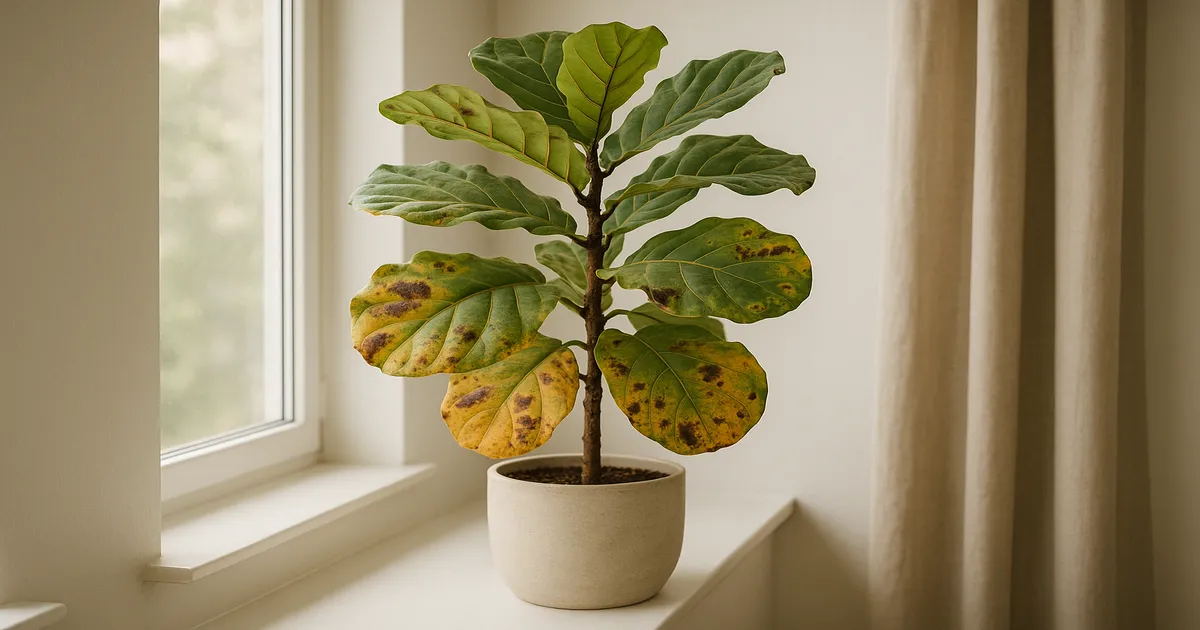
Fungal spots typically have defined, circular margins and may have yellow halos. They spread via water splash, so overhead watering and poor air circulation make them worse. Bacterial spots look different: they’re angular rather than round (spreading along leaf veins), have a greasy or water-soaked appearance, and turn dark brown or black quickly.
Environmental problems tend to affect the whole plant fairly evenly and follow a pattern — tips, margins, or lower leaves. Pest and disease problems are often patchy or concentrated on new growth. When in doubt, grab a magnifying glass and check the undersides of several leaves. Isolate any plant where you suspect pests immediately — before you’ve even confirmed the diagnosis.
How to Fix the Most Common Leaf Problems
Fix Overwatering: Root Inspection and Repotting
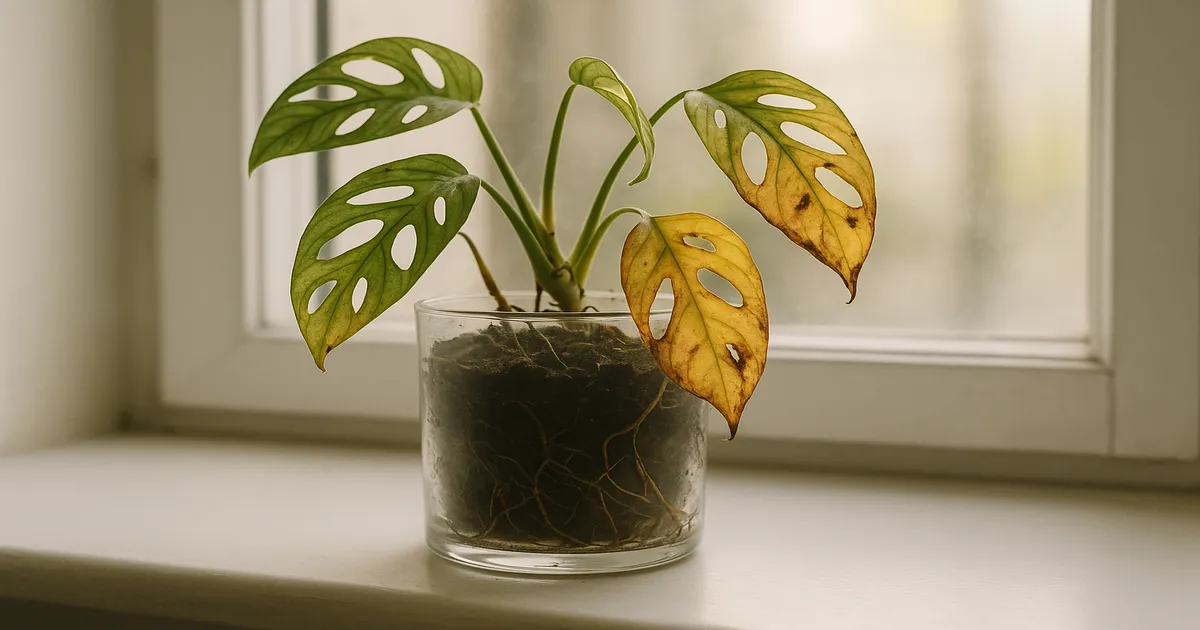
- Remove the plant from its pot and inspect the roots. Healthy roots are white and firm; rotted roots are brown, mushy, and may smell.
- Trim all damaged roots with sterile scissors. Dust cut ends with powdered cinnamon — a natural antifungal.
- Repot into fresh, well-draining mix: 60% coco coir, 30% perlite, 10% orchid bark works well for most tropicals.
- Hold off watering for 3–5 days to let cut roots callous.
- Going forward, only water when the top 2 inches of soil are dry.
Fix Underwatering: Bottom Watering and Soil Rehydration
Place the pot in a basin of room-temperature water for 20–30 minutes and let the soil absorb moisture from the bottom up. This is especially important if the soil has become hydrophobic — you’ll know because water runs straight through without being absorbed. If that keeps happening, add one drop of liquid dish soap per litre of water temporarily to break surface tension, or repot with fresh mix.
Correct Light Levels Without Shocking Your Plant
Move plants gradually — a sudden jump from low light to a south-facing window can cause sunburn even on sun-loving species. If natural light is limited, a full-spectrum LED grow light positioned 15–30 cm above the foliage and providing 2,000–5,000 lux at plant level is a solid investment. The Soltech Solutions Aspect is a popular choice that blends into home décor without looking clinical. Burned or bleached leaves won’t recover, so prune them off to redirect the plant’s energy.
Raise Humidity Effectively
Ranked by effectiveness:
- Electric humidifier — the only method that meaningfully and consistently raises ambient RH. Aim for 50–70% for most tropicals. The Levoit Classic 300S is a reliable mid-range option with a large tank and app control.
- Grouping plants together — transpiration from multiple plants raises local humidity modestly.
- Pebble tray — pot sits above water on pebbles; evaporation adds roughly 5–10% RH locally.
- Misting — provides a few minutes of relief at best and can promote fungal disease if leaves stay wet. Not recommended as a primary strategy.
Treat Nutrient Deficiencies
- General feeding: A balanced liquid fertiliser at half the recommended strength, applied monthly during spring and summer. Jack’s Classic 20-20-20 All Purpose Fertilizer is a consistent performer and widely available.
- Iron deficiency (interveinal chlorosis on new growth): Use chelated iron and check that soil pH sits between 5.5 and 6.5 — iron becomes unavailable above pH 7.0.
- Magnesium deficiency: Dissolve 1 teaspoon of Epsom salt per litre of water and apply as a soil drench every 2–4 weeks.
- Flush your soil every 3–6 months by running a large volume of plain water through the pot to leach accumulated salts.
Eliminate Pests: Treatment Schedules That Work
A single treatment rarely works — you need to break the reproductive cycle.
- Spider mites and mealybugs: Spray with insecticidal soap or neem oil emulsion, focusing on leaf undersides. Bonide Insecticidal Soap is effective and gentle enough for most houseplants. Repeat every 5–7 days for 3–4 cycles.
- Mealybugs (spot treatment): Dab individual insects with 70% isopropyl alcohol on a cotton swab before the full spray treatment.
- Scale: Scrape off physically first, then treat with horticultural oil.
- Fungus gnats: Let soil dry more between waterings and apply a Bacillus thuringiensis var. israelensis (Bti) soil drench to kill larvae — Mosquito Bits by Summit works well and is safe for indoor use. Yellow sticky traps catch adults.
Damaged leaves will not heal. Once pests are under control, prune badly affected leaves to help the plant redirect energy into healthy new growth.
Species-Specific Leaf Problems
Aroids (Monstera, Philodendron, Pothos, Alocasia)
Aroids are the most popular houseplants and among the most frequently misdiagnosed. Their leaves can last 2–5 years, so any premature yellowing or dropping is worth investigating. Overwatering and low humidity are the two most common culprits. Alocasia in particular will drop leaves dramatically if conditions shift — check the roots before assuming the worst.
Succulents and Cacti
With succulents, the leaves tell a very clear story. Translucency and mushiness mean overwatering — the cells have burst from excess water. Shrivelling and softness mean underwatering — stored water reserves are depleted. The fix is opposite for each, so getting the diagnosis right matters.
Ferns
Crispy brown tips on ferns almost always mean one of two things: humidity below 50% RH, or fluoride in tap water. Ferns are among the most fluoride-sensitive houseplants. Switch to filtered water or collected rainwater and run a humidifier nearby. Affected fronds won’t recover — cut them back and focus on preventing new damage.
Ficus
Ficus lyrata and Ficus elastica are notorious for dropping dozens of leaves seemingly overnight. The trigger is almost always an environmental change — moving the pot, a new heating or cooling vent, a shift in light. Find a spot with bright indirect light (1,500–3,000 foot-candles), keep it away from drafts, and don’t move it. The plant will stabilise.
Orchids
With Phalaenopsis orchids, the roots are largely hidden inside an opaque pot, so leaves become the primary health indicator. Yellowing or wrinkled leaves often reflect root problems rather than leaf problems. Healthy orchid roots are green when wet and silvery-grey when dry. Brown, hollow, or mushy roots need to be trimmed and the plant repotted in fresh orchid bark.
Prevention: Stop Leaf Problems Before They Start
Get watering right. Push your finger 2 inches into the soil — if it feels moist, wait. For succulents and cacti, let the entire pot dry out completely. A soil moisture meter removes the guesswork entirely, especially for plants in opaque pots. The XLUX Soil Moisture Meter is inexpensive and accurate enough for everyday use.
Choose the right pot and soil. Drainage holes are non-negotiable. Terracotta dries out faster than plastic or glazed ceramic — great for succulents and anything prone to overwatering, but it means more frequent watering for moisture-loving tropicals. Match your pot material to your watering habits, not just to aesthetics.
Adjust for seasonal light changes. The plant that thrived on your windowsill in July may struggle in the same spot in December. As the sun’s angle changes, light levels can drop from bright indirect to low light in the same location. Check your plants’ positioning seasonally and consider a grow light through winter for light-hungry species.
Fertilise only during active growth — spring through summer. Use a balanced formula at half strength to reduce salt build-up. Stop fertilising entirely in autumn and winter when most houseplants slow down.
Inspect monthly. Flip a few leaves over, check the new growth, and glance at the soil surface. A spider mite colony that takes two spray treatments to eliminate in week one becomes a weeks-long battle if left until week six.
Frequently Asked Questions
Should I worry about this leaf if it’s just one yellow lower leaf?
Probably not. A single yellowing lower leaf is one of the most common — and least alarming — things a houseplant does. Plants routinely shed their oldest leaves as they push energy into new growth. If the rest of the plant looks healthy and no new leaves are yellowing, it’s almost certainly natural leaf senescence. Keep an eye on it, but don’t change anything yet.
Why are my houseplant’s leaves turning yellow?
Yellowing is the most common houseplant complaint, and the cause is almost always one of four things: overwatering, underwatering, insufficient light, or nitrogen deficiency. Check soil moisture first — a heavy, wet pot points to overwatering, while bone-dry soil points to underwatering. If multiple leaves are yellowing rapidly, investigate further using the symptom patterns above.
What do brown leaf tips mean?
Brown tips are almost always an environmental issue rather than a disease. The most common causes are low humidity, fluoride or salt accumulation in the soil, or inconsistent watering. Crispy, dry brown tips suggest humidity or watering stress; mushy brown tips suggest overwatering or disease. Switching to filtered water and flushing the soil every few months prevents most tip browning.
Can a damaged leaf recover?
It depends on the damage. Leaves that are yellowing due to overwatering or nutrient deficiency can sometimes green up once the underlying problem is fixed — but slowly, and not always completely. Crispy, burned, or physically damaged tissue is permanent. Rather than waiting, prune off badly damaged leaves so the plant redirects energy into healthy new growth.
How do I know if my plant has pests or just an environmental problem?
Environmental problems — overwatering, low humidity, light issues — tend to affect the whole plant fairly evenly and follow a predictable pattern (tips, margins, or lower leaves). Pest damage is usually patchy, clustered, or concentrated on new growth. The quickest way to tell: grab a magnifying glass and check the undersides of several leaves. Webbing, tiny moving dots, cottony masses, or sticky residue all point to pests. When in doubt, isolate the plant immediately.