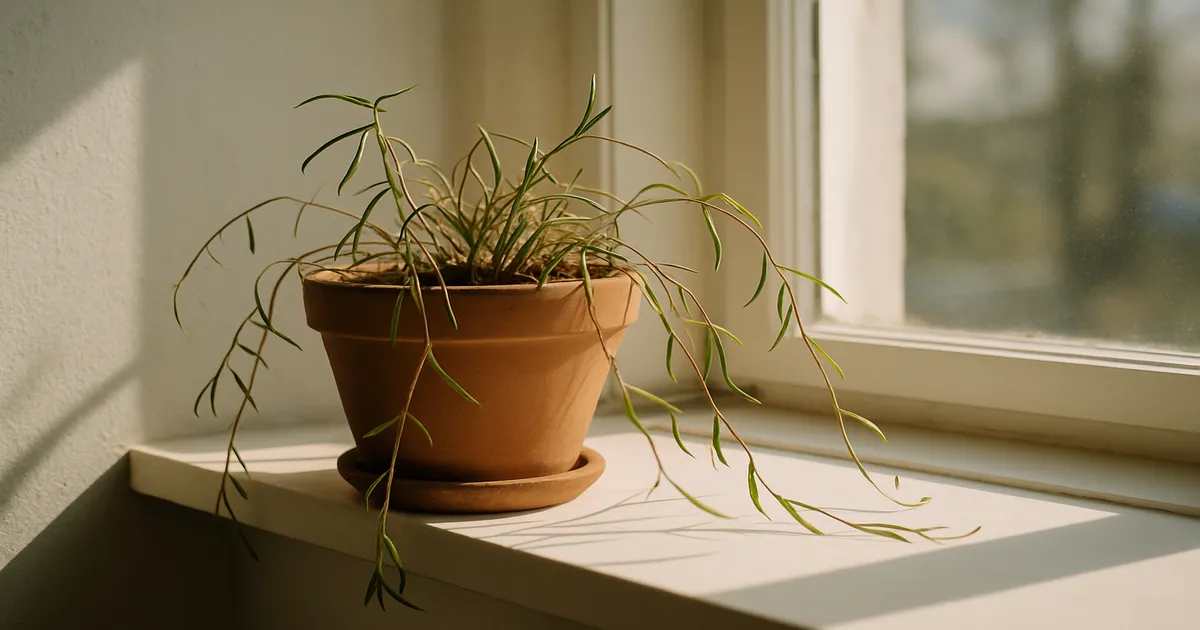
Quick Answer: Yes, you can almost certainly save a struggling Hoya linearis — but you need to act fast. This species is far less forgiving than most Hoyas because its thin, fuzzy leaves store almost no water, meaning problems escalate in days, not weeks. Identify the root cause first, then follow the targeted fix below.
If you’ve found yourself Googling “can I save this Hoya linearis?” at midnight while staring at a drooping, yellowing, or rapidly defoliating plant, take a breath. Most struggling H. linearis plants can be brought back — but this species punishes guesswork more than almost any other Hoya. Getting the diagnosis right matters more than acting fast.
Can You Save a Dying Hoya Linearis?
How to Tell If Your Plant Is Still Alive
Before you do anything else, do the scratch test. Use your fingernail or a clean blade to gently scratch the surface of a stem near the base. Green or white tissue underneath means that stem is alive. Brown, dry, or hollow tissue means it’s gone. Work your way up the plant — even if the lower stems are dead, live growth higher up gives you something to work with.
Also squeeze the stems gently. Firm and pliable is good. Mushy means rot. Papery and brittle means desiccation. Both are recoverable if caught in time, but they need completely opposite treatments — which is exactly why diagnosis comes before action.
The Most Important First Step
Resist the urge to water, fertilize, or repot immediately “just in case.” Pick one likely cause from the eight listed below, confirm it matches your plant’s symptoms, then act. Treating for the wrong problem — watering a root-rot victim, for example — will finish the plant off faster than doing nothing.
What Makes Hoya Linearis So Tricky
Thin Leaves Mean Almost No Water Reserve
Most Hoyas are semi-succulent. H. carnosa, H. kerrii, H. obovata — they all have thick, waxy leaves that act as onboard water tanks, buying you time when conditions slip. H. linearis has none of that. Its needle-like leaves are roughly 3–5 cm long and 2–4 mm wide, covered in soft hairs, and store almost no moisture. When conditions go wrong, you have days to respond, not weeks.
Its Native Habitat vs. Your Living Room
In the wild, H. linearis grows as an epiphyte and lithophyte in the cool, misty montane forests of northern India, Nepal, Bhutan, and southwestern China — at elevations of 1,500–2,500 m. Think 60–80% humidity, strong air circulation, cool nights, and roots anchored to bark or mossy rock rather than sitting in dense soil. A centrally heated living room with 35% humidity and a peat-based potting mix is about as far from that as you can get.
One practical note: H. linearis is occasionally sold as or confused with Hoya retusa, which has flat, strap-like leaves and slightly different care needs. If your plant doesn’t match the needle-and-fuzz description, double-check your ID before following this guide.
8 Reasons Your Hoya Linearis Is Struggling
1. Overwatering and Root Rot
This is the most common cause of death. H. linearis has epiphytic roots that need clear wet-dry cycles with plenty of oxygen between waterings. Consistently moist medium starves roots of air and invites Pythium, Phytophthora, and Fusarium almost immediately.
Signs: Yellowing leaves starting at stem bases, blackened or mushy stem bases, foul-smelling mix, large-scale leaf drop, brown or black roots with no white tips.
2. Underwatering and Desiccation
With no water reserve in those thin leaves, H. linearis wilts and desiccates surprisingly fast — especially in warm, dry rooms. Many owners overcorrect after a root-rot scare and end up with the same dead plant, just for a different reason.
Signs: Wrinkled, shriveled, or crispy leaves; limp thread-like stems; bone-dry medium pulling away from the pot edges.
3. Low Humidity
This one is chronically underestimated. The plant’s native habitat runs at 60–80% relative humidity. Most homes sit at 30–50%, and heated winter air can drop below 25%. Even with perfect watering, low humidity means leaves lose moisture faster than roots can replace it.
Signs: Brown leaf tips, leaf curl, premature leaf drop, stunted new growth, a general crispy look despite adequate watering.
4. Too Much or Too Little Light
H. linearis wants bright indirect light — roughly 1,500–3,000 foot-candles (16,000–32,000 lux). Too little and it stretches, yellows, and becomes vulnerable to pests and rot. Too much direct sun and those thin, hairy leaves scorch almost instantly; the hairs trap heat against the leaf surface, making burns worse than you’d expect.
Signs (too little): Pale, etiolated growth with wide gaps between leaves; failure to flower. Signs (too much): Bleached white or tan patches appearing rapidly on leaf surfaces.
5. Temperature Stress and Cold Drafts
H. linearis tolerates cool conditions but hates sudden swings. Temperatures below 10°C (50°F) cause cellular damage, and cold drafts from windows or AC vents can trigger the plant to drop dozens of leaves overnight — often without any yellowing first, which makes this cause easy to miss.
Signs: Sudden mass leaf drop, blackened or translucent patches on leaves, decline appearing after a weather change or furniture rearrangement.
6. Pest Infestations
The hairy leaves that make this plant beautiful also make pest detection harder — insects hide in the fuzz. Mealybugs are the most frequent offender. Spider mites thrive in the dry conditions H. linearis often ends up in, and fungus gnats are a reliable sign that overwatering is also in play.
Signs: White cottony masses in leaf axils (mealybugs), fine webbing and bronzed foliage (spider mites), tiny flies hovering around the soil (fungus gnats), brown bumps on stems with sticky honeydew residue (scale).
7. Wrong Potting Mix or Pot Size
Standard potting soil is too dense and moisture-retentive for epiphytic roots — it causes rot even with careful watering. Overpotting is equally dangerous: a pot much larger than the root ball leaves excess wet medium surrounding the roots with nowhere to dry out.
Signs: Water pools on the surface and drains slowly, medium smells sour, plant declining despite apparently correct care.
8. Fertilizer Burn or Nutrient Deficiency
H. linearis is a light feeder. Too much fertilizer causes salt buildup that draws water out of roots via osmosis, mimicking drought stress. Too little over many seasons leads to interveinal chlorosis from iron or magnesium deficiency.
Signs (over-feeding): White crusty deposits on the soil surface or pot rim, brown leaf tips and edges, wilting despite moist soil. Signs (under-feeding): Pale or yellow leaves (especially older ones), no new growth, failure to flower.
How to Save a Hoya Linearis With Root Rot
Root rot is the most urgent scenario, so it gets the most detailed treatment.
Step-by-Step Root Inspection and Pruning
- Unpot the plant and shake off as much old medium as possible.
- Inspect the roots. Healthy roots are white to tan and firm. Rotted roots are brown or black, mushy, and may smell foul.
- Trim all rotted roots with sterile scissors — sterilize with 70% isopropyl alcohol between cuts.
- Dust all cut surfaces with powdered cinnamon or horticultural sulfur as a mild antifungal barrier.
- Let the roots air-dry for 30–60 minutes before repotting.
- For severe rot, apply a systemic fungicide drench containing thiophanate-methyl, or water in a diluted hydrogen peroxide solution (3% hydrogen peroxide mixed 1:4 with water) after potting. A product like Bonide Infuse Systemic Disease Control works well here.
The Best Potting Mix for Hoya Linearis
Skip anything labeled “potting soil” or “all-purpose mix.” A reliable recipe is:
- 40% fine orchid bark (fir bark, 5–10 mm grade)
- 30% perlite (medium grade, 3–5 mm)
- 20% coco coir
- 10% horticultural charcoal
This mix drains fast, holds just enough moisture, and keeps oxygen available to epiphytic roots. Aim for a pH of 6.0–6.5. If you’d rather buy ready-made, a quality epiphytic mix amended with 30–40% extra perlite works well — rePotme Hoya Imperial Potting Mix is a popular option that needs only a perlite boost.
Pot Choice and Post-Repot Watering
Terracotta is the best pot material for this species. It’s porous, allows oxygen exchange through the walls, and lets excess moisture evaporate faster than plastic or glazed ceramic. That extra drying margin can make the difference between a healthy plant and another repotting emergency. Go only 1–2 cm larger than the root ball.
After repotting, withhold water for 5–7 days to let cut root ends callous. Then water lightly and resume normal wet-dry cycles. Hold off on fertilizer for at least 4–6 weeks — a stressed plant can’t process nutrients, and fertilizer salts will only add to the damage.
Fixing Humidity, Light, and Temperature
Raising Humidity to 60–70%
A cool-mist ultrasonic humidifier placed nearby — not blowing directly on the foliage — is the most reliable solution. Target 60–70% relative humidity. The Levoit Classic 300S is a well-regarded option that covers a typical room easily. Grouping plants together also helps, since transpiration from multiple plants raises local humidity by 5–10%.
Do not mist H. linearis directly. Water trapped in those hairy leaves invites Botrytis (gray mold). Pebble trays provide a modest 3–5% RH bump and are worth doing, but they won’t solve a serious humidity deficit on their own. In very dry climates, an enclosed glass cabinet or IKEA greenhouse cabinet can maintain consistent humidity around the plant.
Finding the Right Light
Bright indirect light (1,500–3,000 foot-candles) is the target. An east-facing window with gentle morning sun is often perfect. South- or west-facing windows work if you filter afternoon sun with a sheer curtain. Full-spectrum LED grow lights on a 12–14 hour photoperiod are a great option when natural light is limited — position them 30–45 cm (12–18 inches) from the foliage.
Burned leaves won’t recover, so trim scorched foliage and move the plant to a better spot. When increasing light exposure, acclimate gradually — add 30 minutes of extra light per day over two weeks.
Safe Temperature Range
Keep H. linearis between 18–24°C (64–75°F) during the growing season. Check for drafts from windows, exterior walls, AC vents, and heating vents — these are easy to overlook after moving furniture. If cold damage has occurred, trim back blackened or translucent tissue to healthy green stems.
One useful trick: a slightly cooler period of 15–18°C (59–64°F) in autumn, combined with reduced watering, mimics the plant’s natural highland season and is one of the most reliable ways to trigger flowering.
Treating Pests on Hoya Linearis
The fuzzy leaves make it genuinely harder to spot pests early than on smooth-leaved Hoyas. Check leaf axils, stem joints, and leaf undersides closely — use a magnifying glass if you have one.
Mealybugs and scale: Isolate the plant immediately. Dab individual insects with a cotton swab dipped in 70% isopropyl alcohol. Apply insecticidal soap or neem oil emulsion to all surfaces and repeat every 5–7 days for 3–4 cycles. For severe infestations, use a systemic insecticide containing imidacloprid as a soil drench.
Spider mites: Raise humidity right away — mites hate it. Rinse foliage gently under a shower to physically remove mites and webbing, then apply a spinosad- or abamectin-based miticide. Rotate active ingredients to prevent resistance.
Fungus gnats: Let the medium dry more thoroughly between waterings. Drench the soil with Bacillus thuringiensis israelensis (Bti), a biological larvicide that targets larvae without harming roots — Gnatrol WDG is a reliable product for this. Use yellow sticky traps to catch adults and monitor population levels.
Quarantine every new plant for at least 2–3 weeks before introducing it to your collection. Good air circulation around H. linearis discourages both spider mites and fungal issues.
Ongoing Care to Keep Hoya Linearis Healthy
Watering
Water thoroughly, then wait. The goal is for the top 50–75% of the medium to dry out before you water again. A moisture meter takes the guesswork out — water when the reading drops to 2–3 out of 10. Always use room-temperature filtered or rainwater; H. linearis is sensitive to fluoride and chlorine, which cause tip burn over time. If you only have tap water, leave it in an open container for 24 hours to off-gas chlorine. In warm summer conditions you may water every 7–10 days; in a cool winter room, every 2–3 weeks is more typical.
Fertilizing
Feed at ¼ to ½ the recommended strength of a balanced liquid fertilizer (around 5-5-3 NPK or similar) every 3–4 weeks in spring and summer. In late summer, switch to a low-nitrogen, higher-phosphorus formula (such as 2-10-10) to support flower bud development. Never fertilize a stressed, recently repotted, or dormant plant.
Repotting and Flowering
H. linearis prefers being slightly root-bound and often flowers better that way. Repot only when roots are visibly circling the pot base, emerging from drainage holes, or when the medium has degraded — typically every 2–3 years. Always go up just 1–2 cm in diameter and use fresh epiphytic mix.
Don’t remove old flower spurs after blooming. H. linearis can rebloom from the same spur the following year, so cutting them off costs you future flowers.
Frequently Asked Questions About Saving Hoya Linearis
Why are my Hoya linearis leaves shriveling and falling off?
Shriveling usually points to underwatering, very low humidity, or both — especially if the potting mix is dry and indoor humidity is below 40%. However, root rot can cause identical symptoms if the roots are too damaged to take up water even when the medium is moist. Do the scratch test on stems and check root condition before deciding on a fix.
How often should I water Hoya linearis?
There’s no fixed schedule — it depends on pot size, medium, temperature, and humidity. The reliable method is to wait until the top 50–75% of the medium has dried out, then water thoroughly. A moisture meter reading of 2–3 out of 10 is the clearest signal to water.
Can Hoya linearis recover from root rot?
Yes, if healthy roots remain. Unpot the plant, trim all mushy brown roots back to healthy white tissue with sterile scissors, dust cut ends with cinnamon or horticultural sulfur, and repot into a fast-draining epiphytic mix in a terracotta pot. Withhold water for 5–7 days afterward. Recovery is very possible as long as some viable root tissue survives.
What humidity does Hoya linearis need indoors?
Aim for at least 60% relative humidity — 60–70% is ideal. Most homes run at 30–50%, so a dedicated humidifier is usually necessary rather than optional. Avoid misting the leaves directly, as water trapped in the leaf hairs promotes gray mold (Botrytis).
Should I cut off dead stems when trying to save my Hoya linearis?
Yes. Once the scratch test confirms a stem is dead — brown, dry, or hollow tissue beneath the surface — remove it with sterile scissors. Dead stems won’t recover and can harbour fungal pathogens that spread to healthy tissue. Cut back to the nearest point of live, green growth.