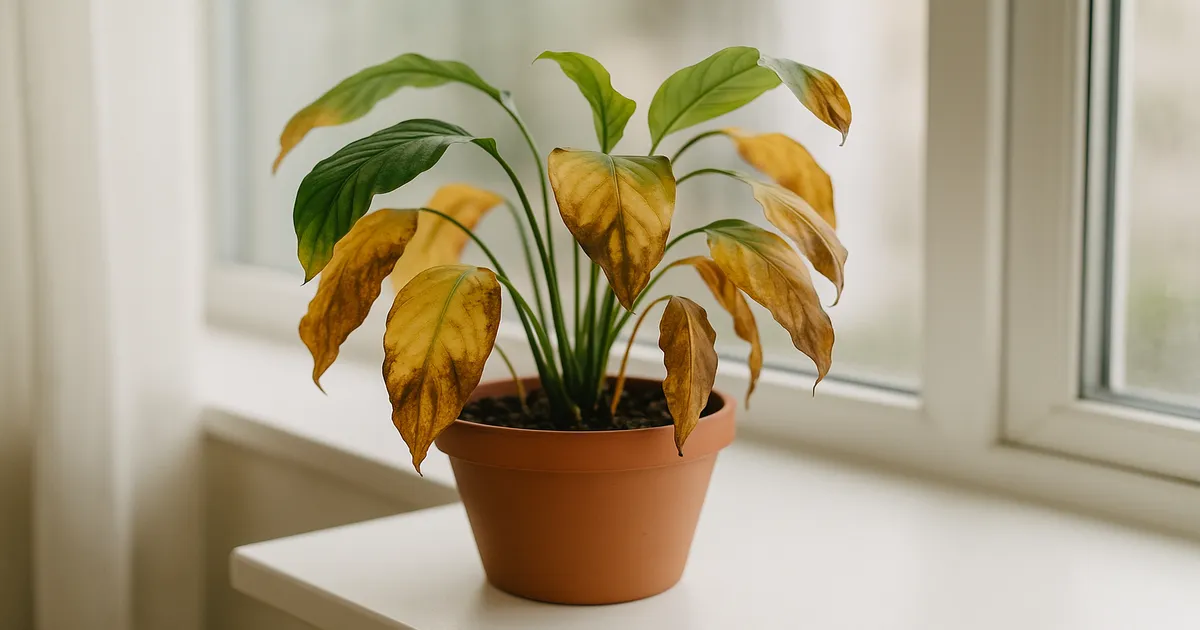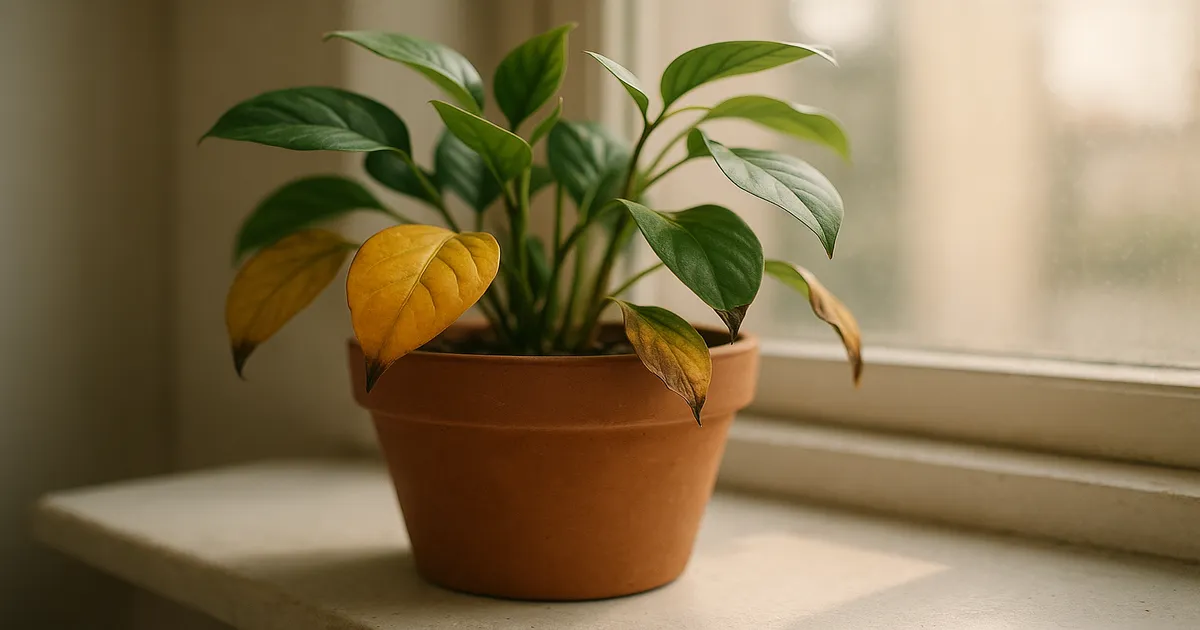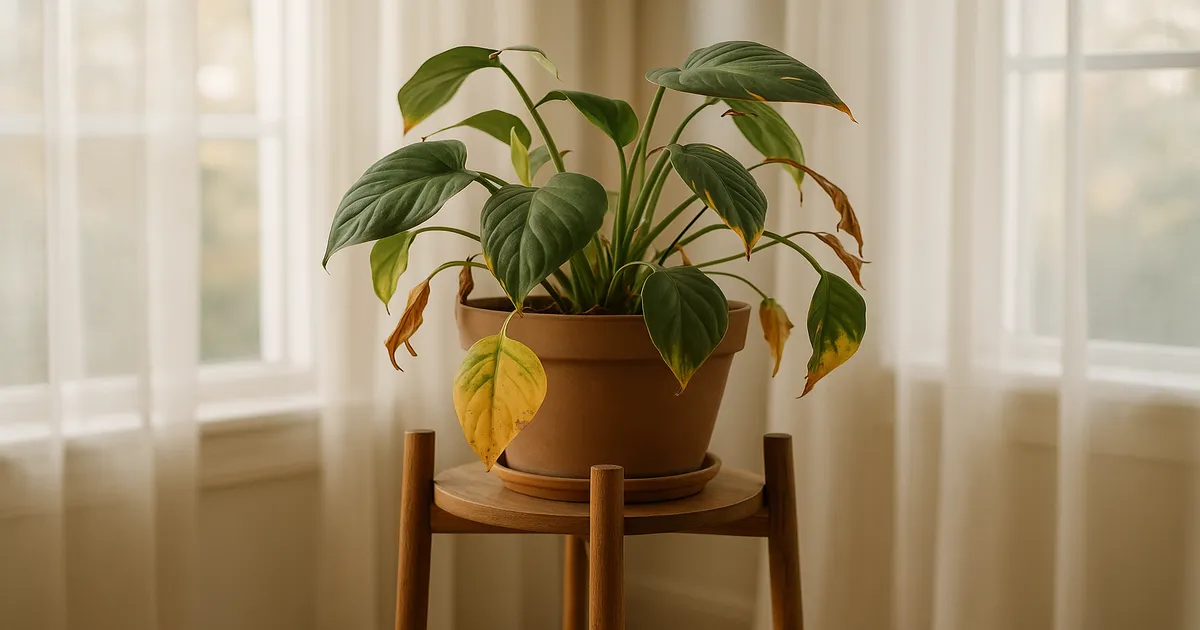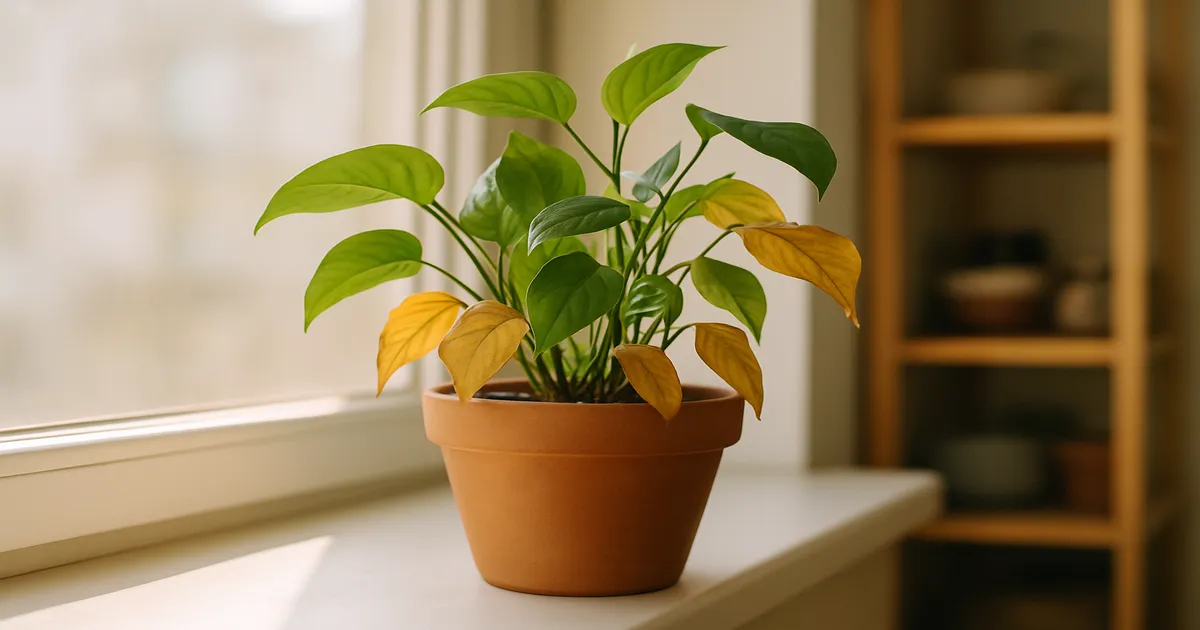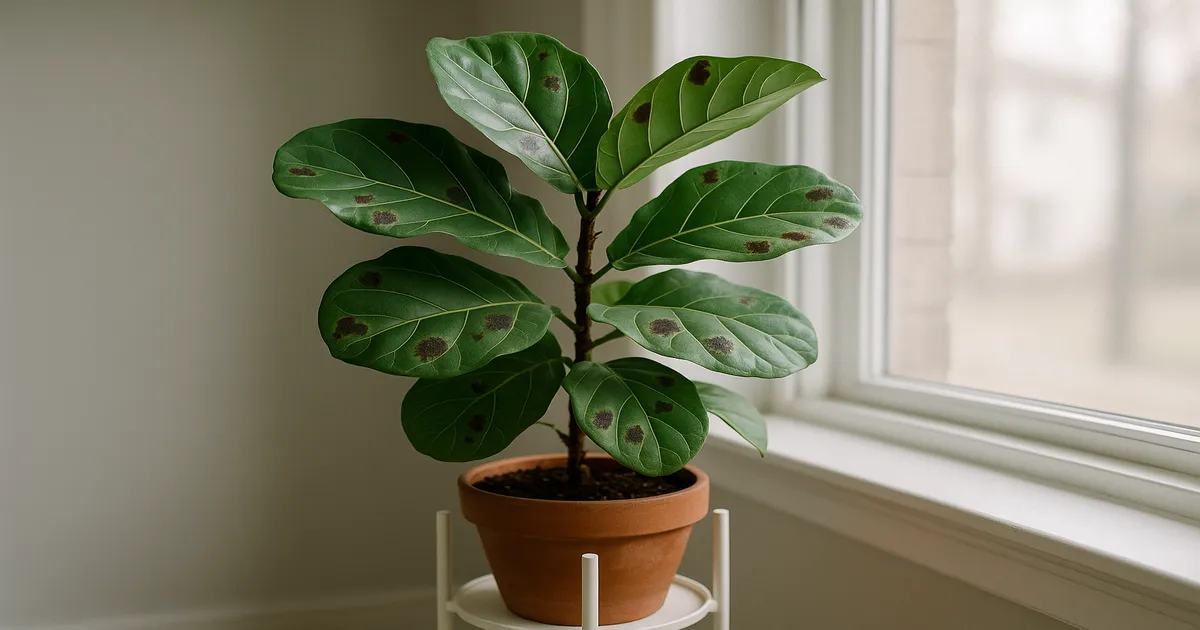
Quick Answer: Dark patches on houseplant leaves are almost always caused by one of nine things: overwatering, fungal infection, bacterial infection, cold damage, sunscald, pests, nutrient problems, water quality issues, or physical stress. The texture of the patch — mushy versus dry and papery — and its location on the leaf are your fastest diagnostic clues. Most cases are fixable once you identify the cause.
Noticing dark patches on your plant’s leaves and wondering what is wrong? You’re not alone. It’s one of the most common houseplant problems, and different causes can look deceptively similar at first glance. A mushy black blotch from overwatering can easily be mistaken for a bacterial infection. Getting the diagnosis right is everything.
This guide walks you through a systematic approach: describe what the patch looks like, figure out why it’s happening, then fix it.
What Causes Dark Patches on Houseplant Leaves?
Dark patches represent one of three things happening inside the leaf: cell death (necrosis), chlorophyll breakdown, or invasion by a pathogen. Because different causes attack different parts of the leaf — the surface epidermis, the inner mesophyll cells, or the vascular bundles — they tend to look distinct once you know what to look for.
The nine main causes are:
- Overwatering and root rot
- Fungal infections
- Bacterial infections
- Cold damage
- Sunscald from too much direct light
- Pest infestations
- Nutrient deficiencies or fertiliser burn
- Water quality problems (chlorine, fluoride, hard water)
- Physical damage and environmental stress
Three clues will get you to the right answer faster than anything else: patch texture (mushy vs. dry and papery), location on the leaf (tip, margin, centre, upper surface), and speed of spread. Start with those.
How to Diagnose Dark Patches on Leaves
Step 1 — Describe the Patch
Pick a representative leaf and look closely. Ask yourself:
- Texture: Mushy and wet, or dry and papery?
- Colour: Black, dark brown, or dark purple?
- Shape: Defined border with a yellow halo, or a spreading blotch with no clear edge?
- Surface detail: Any fuzzy growth, concentric rings, or an oily sheen?
These details narrow your diagnosis quickly. Fuzzy grey growth points to Botrytis fungus. An oily, water-soaked look with no visible texture suggests bacteria. Dry and crispy almost always means a non-infectious cause — sunscald, cold damage, or low humidity.
Step 2 — Note the Location
Location is highly diagnostic:
- Tips and margins → nutrient issues, fluoride or salt toxicity, low humidity, or underwatering
- Centre blotches → fungal or bacterial infection
- Upper surface only → sunscald
- Edges near a window → cold draft damage
- Scattered across the whole plant → overwatering, root rot, or systemic infection
Step 3 — Check Soil, Roots, and Conditions
Lift the pot. A surprisingly heavy pot means the soil is still saturated. Push your finger 2 inches into the soil — if it’s wet and has been for over a week, overwatering is likely. If you can, gently slide the plant out and inspect the roots: healthy roots are white or tan and firm; rotting roots are brown, mushy, and may smell sour.
Also note any recent changes. Did you move the plant? Has the weather turned cold? Did you fertilise heavily?
Step 4 — Inspect for Pests
A 10× loupe or a phone camera in macro mode works well. Check the undersides of leaves first — that’s where most pests hide. Look for:
- Fine webbing (spider mites)
- Tiny brown bumps that don’t brush off (scale)
- Black specks or silver streaking (thrips)
- Sticky residue or a black sooty coating (scale or mealybug honeydew)
Quick-Reference Diagnosis Table
| Patch Appearance | Location | Spreads Quickly? | Most Likely Cause |
|---|---|---|---|
| Mushy, dark brown/black, foul smell | Edges, then inward | Moderate | Overwatering / root rot |
| Dark spots, defined border, yellow halo | Scattered, centre of leaf | Moderate | Fungal infection |
| Water-soaked, oily, no clear border | Anywhere | Fast | Bacterial infection |
| Dark, slightly sunken, dry | Edges near window | No | Cold damage |
| Dry, papery, bleached then dark | Upper surface | No | Sunscald |
| Stippling coalescing to dark bronze | Undersides, then whole leaf | Slow–moderate | Spider mites |
| Dark brown tips/margins only | Tips and margins | Slow | Nutrient / water quality |
The 9 Causes of Dark Patches — and How to Fix Them
1. Overwatering and Root Rot
Waterlogged soil drives oxygen out of the root zone, creating ideal conditions for opportunistic pathogens — primarily Pythium, Phytophthora, and Rhizoctonia species. These fungi colonise stressed roots, block water and nutrient transport, and push toxins up into the leaves. The result is soft, mushy, dark brown to black patches that typically start at leaf edges and move inward. The soil smells sour, the pot feels heavy, and roots are brown and slimy.
Diagnostic clue: Soil has stayed wet for more than 7–10 days; pot is noticeably heavy; roots are brown and mushy.
How to fix it:
- Remove the plant from its pot and trim all brown, mushy roots back to healthy white or tan tissue using sterile scissors.
- Dust cut root ends with powdered cinnamon or sulphur as a natural antifungal.
- Repot into a fresh, well-draining mix: 50% quality potting compost, 30% perlite, 20% orchid bark, targeting a soil pH of 5.5–6.5.
- Use a pot with drainage holes — terracotta is ideal because it allows soil to dry faster.
- Water only when the top 1–2 inches of soil are dry.
- Apply a biological fungicide containing Trichoderma spp. or Bacillus subtilis to the new soil to suppress residual pathogens.
- Remove visibly affected leaves to reduce pathogen load.
2. Fungal Infections
Fungal pathogens including Alternaria, Botrytis cinerea (grey mould), Cercospora, and Colletotrichum (anthracnose) spread via airborne spores that germinate in humid, still conditions and enter through stomata or small wounds. They produce enzymes that break down cell walls, leaving dark brown or black spots with a distinct border — often ringed by a yellow halo. Botrytis adds a characteristic grey fuzzy coating. Anthracnose creates sunken, water-soaked lesions, sometimes with salmon-pink spore masses in humid weather.
Diagnostic clue: Spots have clearly defined edges, may show concentric rings or surface texture, and spread to neighbouring leaves.
How to fix it:
- Isolate the plant immediately to prevent spore spread.
- Remove all affected leaves and bin them — never compost diseased material. Sterilise cutting tools between each cut with 70% isopropyl alcohol.
- Apply a copper-based fungicide or a neem oil solution (2 tsp neem oil + 1 tsp insecticidal soap per quart of water) to all leaf surfaces, including undersides.
- Improve air circulation with a small fan on a low setting.
- Water at the base only — avoid misting. Water in the morning so foliage dries before nightfall.
- Repeat fungicide applications every 7–14 days for 3–4 treatments.
3. Bacterial Infections
Bacteria such as Pseudomonas cichorii, Xanthomonas, and Pectobacterium (formerly Erwinia) enter through stomata or wounds and multiply rapidly in warm, wet conditions. They produce enzymes that dissolve cell walls, causing quick tissue collapse. Patches look water-soaked and translucent at first, then turn dark brown to black with a greasy sheen. Unlike fungal spots, bacterial lesions have no defined border and spread fast. Pectobacterium soft rot produces a distinctly foul odour.
Diagnostic clue: Rapid spread, water-soaked greasy appearance, possible foul odour, often worse after misting.
How to fix it:
- Isolate the plant immediately.
- Remove all affected tissue with sterile tools, cutting at least half an inch into healthy-looking tissue.
- Apply a copper-based bactericide — copper ions disrupt bacterial cell membranes effectively.
- Stop all overhead watering and misting until the plant recovers.
- For surface bacteria, a foliar spray of 3% hydrogen peroxide diluted 1:4 with water can help.
- Important: If the crown or main stem is affected by soft rot, the plant is likely beyond saving. Take cuttings from any remaining healthy tissue and propagate.
4. Cold Damage
Most tropical houseplants begin showing damage below 50°F (10°C); sensitive species such as calatheas and anthuriums react to anything under 55°F (13°C). Cold disrupts cell membranes — either through ice crystal formation in a hard freeze or through chilling injury at lower temperatures. Cells collapse, creating dark, water-soaked patches that dry to brown or black. Damage typically appears on leaf edges, tips, or the side of the plant facing a cold window or air conditioning vent.
Diagnostic clue: Patches appeared suddenly after a cold snap or after the plant was moved near a drafty window or AC vent.
Cold damage is irreversible, so the goal is stabilisation. Move the plant away from drafts and cold glass immediately. Keep temperatures in the 65–80°F (18–27°C) range and use a thermometer near the plant to monitor night-time drops. Hold off fertilising for 4–6 weeks. Leave damaged leaves in place until new growth resumes — they protect the underlying tissue while the plant recovers.
5. Sunscald
Plants adapted to bright indirect light (roughly 1,500–3,000 foot-candles) can’t handle intense direct sun above 5,000–10,000 foot-candles. UV radiation and heat denature chlorophyll and proteins, first bleaching leaf cells pale, then turning them dark brown to black as the tissue dies. Sunscald patches are dry and papery, always on the upper leaf surface, and correspond exactly to where direct light hits. Variegated plants are especially vulnerable — their white sections contain no protective chlorophyll.
Diagnostic clue: Dry, papery patches on the side facing the light source; appeared after moving the plant to a sunnier spot.
Move the plant to bright indirect light or filter direct sun through a sheer curtain. When transitioning any plant to higher light in future, increase exposure gradually — no more than one to two extra hours per week. The scorched tissue won’t recover, but the plant will produce healthy new leaves once conditions improve.
6. Pest Infestations
Pests cause dark patches in two ways: direct feeding damage and secondary sooty mould from honeydew. Key culprits:
- Spider mites: Tiny stippling marks that merge into dark bronzed patches; fine webbing on leaf undersides. Increase humidity above 50% and apply insecticidal soap or neem oil every 5–7 days for three to four rounds.
- Scale insects: Produce sticky honeydew that feeds a superficial black fungal coating (sooty mould). Remove manually with a cotton swab dipped in 70% isopropyl alcohol, then apply a horticultural oil spray weekly.
- Thrips: Silver-streaked feeding damage that darkens over time; black faecal deposits visible. Apply a spinosad-based insecticide or neem oil; use yellow sticky traps to monitor numbers.
- Fungus gnats: Larvae damage roots, indirectly causing dark patches from poor water and nutrient uptake. Allow soil to dry more between waterings and use yellow sticky traps at soil level.
Diagnostic clue: Check leaf undersides with a magnifying glass for webbing, insects, black specks, or sticky residue.
7. Nutrient Deficiencies and Fertiliser Burn
Different nutrients produce different damage patterns:
- Potassium deficiency: Dark brown scorching along leaf margins, progressing inward
- Calcium deficiency: Dark, distorted patches on new growth specifically (calcium is immobile in plants, so new leaves suffer first)
- Magnesium deficiency: Interveinal yellowing that darkens on older leaves
- Fertiliser burn (salt toxicity): Excess fertiliser raises soil salt levels, drawing water out of root cells by osmosis; dark brown tips and margins result, and a white salt crust may appear on the soil surface
Diagnostic clue: Damage pattern — margins vs. between veins vs. tips vs. new vs. old growth — points to specific deficiencies. A soil pH test is essential before correcting.
Test soil pH with a digital pH meter — most houseplants thrive at pH 5.5–6.5. For fertiliser burn, flush the soil thoroughly with water equal to three times the pot volume to leach out excess salts. Withhold fertiliser for 4–6 weeks, then resume at half the recommended dose using a balanced, water-soluble fertiliser.
8. Water Quality Problems
Chlorine and chloramine in tap water cause dark tip burn in sensitive plants. Fluoride, which accumulates in leaf margins over time, is particularly problematic for peace lilies, calatheas, and dracaenas. Hard water gradually raises soil pH, triggering secondary nutrient deficiencies that show up as dark patches. Softened water introduces sodium, which causes its own scorched-margin damage.
Diagnostic clue: Symptoms concentrated at leaf tips; white mineral deposits on soil or pot edges; plants improve when switched to filtered or rainwater.
Let tap water sit uncovered overnight to allow chlorine (though not chloramine) to dissipate. Use filtered water or collected rainwater for sensitive species. Never use water-softener output on plants. Flush pots every two to three months with plain water to prevent mineral salt build-up.
9. Physical Damage and Environmental Stress
Bruising from rough handling, rubbing against a wall, or contact with cleaning chemicals all cause localised dark patches at the contact point. Very low humidity — below 30% — desiccates leaf margins, which darken as tissue dies. Proximity to ripening fruit or gas combustion sources exposes plants to ethylene, which accelerates leaf senescence and dark spotting.
Diagnostic clue: Damage is localised to contact or exposure points, shows no spreading pattern, and has no signs of pests or pathogens.
Which Houseplants Are Most Prone to Dark Patches?
Tropical aroids — Monstera, Philodendron, Pothos: Overwatering is the culprit the vast majority of the time. Their large, thin leaves show damage quickly, and they suffer badly in dense, soggy mixes. Keep them in a chunky, well-draining potting mix and water only when the top 1–2 inches of soil have dried out. Cold damage is a close second concern: keep these plants away from cold windows and air conditioning drafts.
Calatheas and Marantaceae: Exceptionally sensitive to water quality, low humidity, and temperature fluctuations. Brown-edged or dark-spotted leaves on a calathea almost always trace back to fluoride in tap water, humidity below 50%, or cold drafts. Use filtered or rainwater, keep humidity at 50–60%, and avoid placing them near vents or cold glass.
Peace lilies (Spathiphyllum): Fluoride sensitivity causes dark brown leaf tips even at low concentrations. Switch to distilled or rainwater and flush the pot every two months.
Ferns: Low humidity and inconsistent watering are the primary triggers. Most ferns need humidity above 50% and evenly moist (never waterlogged) soil.
Frequently Asked Questions
Can dark patches spread from one plant to another? Yes — but only if the cause is infectious. Fungal spores travel through the air; bacterial pathogens spread through water splash and contaminated tools. Isolate any plant showing rapid or spreading dark patches until you’ve confirmed the cause. Non-infectious causes (cold, sunscald, nutrient issues) cannot spread between plants.
Should I remove leaves with dark patches? It depends on the cause. For fungal or bacterial infections, remove affected leaves promptly to reduce pathogen load — sterilise your tools between cuts. For cold or sunscald damage, leave the leaves in place until new growth resumes, as they protect the plant while it stabilises. For minor nutrient-related tip burn, removal is optional and mostly cosmetic.
My plant has dark patches but the soil is dry — what’s wrong? Dry soil rules out overwatering. Focus on sunscald (check whether patches are on the upper surface facing the light), cold damage (check proximity to windows or vents), water quality (check for tip burn on fluoride-sensitive species), or pests (inspect leaf undersides carefully). Underwatering itself can also cause dark, crispy margins as leaf cells desiccate.
How long does it take for a plant to recover after treatment? Existing dark patches won’t reverse — damaged tissue is permanent. What you’re watching for is the absence of new patches on healthy leaves. With overwatering, expect 2–4 weeks before the plant stabilises after repotting. Fungal and bacterial infections can be arrested within 2–3 weeks of consistent treatment. Nutrient corrections take 4–6 weeks to show improvement in new growth.
What is wrong if only the new leaves have dark patches? New growth affected first points to calcium deficiency (calcium is immobile in plants and can’t be redistributed to new tissue), or to a systemic bacterial infection moving through the vascular system. Check whether older leaves are healthy — if they are, calcium deficiency is the more likely culprit. Confirm with a soil pH test, since calcium becomes unavailable at pH below 5.5.