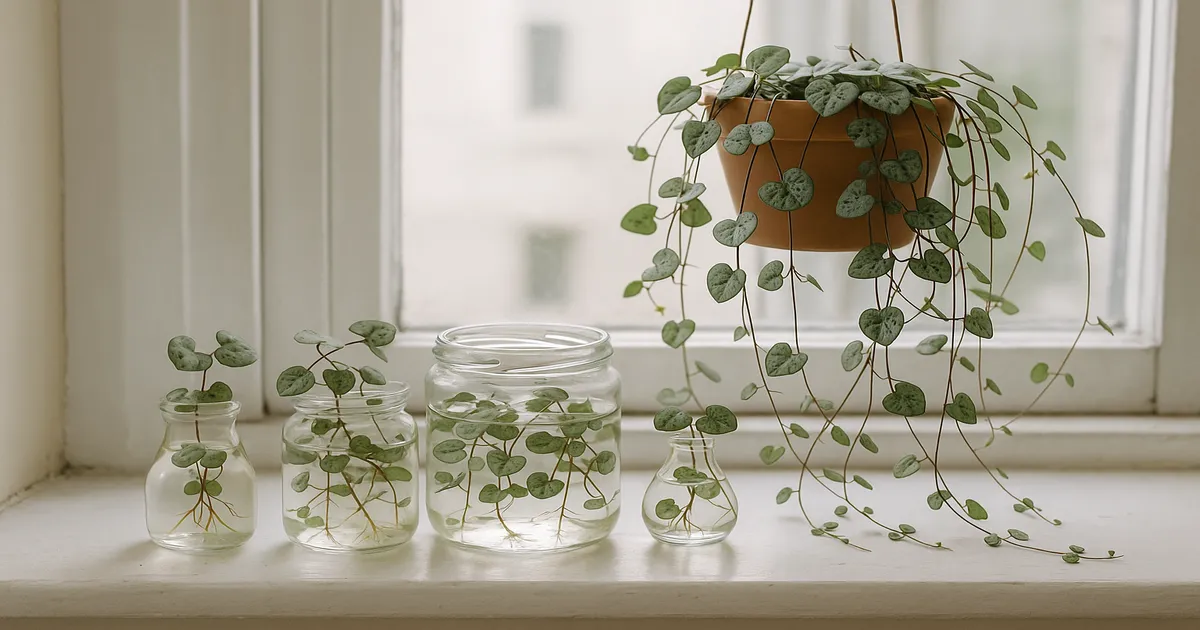
Quick Answer: Yes, you can propagate a string of hearts (Ceropegia woodii), and it’s one of the easiest houseplants to multiply. The plant naturally produces aerial tubers along its vines — a built-in cloning system — and stem cuttings root readily in soil or water. Depending on the method, expect roots in two to six weeks.
Can you propagate a string of hearts? Not only can you — there are five distinct methods, and most require nothing more than a pair of scissors and a small pot of gritty mix. Whether your plant has gone leggy, you want a fuller hanging display, or you’re keen to share it with a friend, this guide covers every method from the simplest to the most advanced.
Five methods at a glance:
| Method | Difficulty | Timeline |
|---|---|---|
| Stem cuttings in soil | Easy | 3–6 weeks |
| Water propagation | Easy | 2–4 weeks to root |
| Aerial tuber (bulbil) | Easiest | 2–4 weeks |
| Butterfly/leaf cutting | Moderate | 4–8 weeks |
| Seed propagation | Advanced | Weeks to germinate; months to mature |
Best for beginners: Aerial tuber (bulbil) propagation or stem cuttings in soil. Both are forgiving, require minimal equipment, and have high success rates.
What Makes String of Hearts So Easy to Propagate
Botanical Background
Ceropegia woodii belongs to the family Apocynaceae and originates from the rocky, well-drained slopes of South Africa, Eswatini (formerly Swaziland), and Zimbabwe. In the wild it grows under dappled tree canopy, which explains why it tolerates lower light than a true succulent but still hates sitting in soggy soil.
It’s a trailing semi-succulent perennial with small, heart-shaped leaves — dark green with silver marbling on top and purple-pink underneath. At its base sits a large underground corm that stores water and energy, acting as the plant’s emergency reserve.
Aerial Tubers: Nature’s Built-In Cloning System
Scattered along the vines, you’ll notice small, round, brownish-tan bumps at the leaf nodes. These are aerial tubers, also called bulbils. They’re not a sign of stress — they’re an evolved asexual reproduction strategy. Each bulbil is genetically identical to the parent plant and already contains pre-formed root tissue and stored carbohydrates. That’s why bulbil propagation is so reliable: the hard work is already done before you even pick up a pair of scissors.
Cultivars and How They Affect Propagation
The three cultivars you’ll most commonly encounter are the standard species, Ceropegia woodii ‘Variegata’ (cream, pink, and green leaves), and ‘Silver Glory’ (enhanced silver patterning with compact internodes). All three propagate using identical methods. The variegated forms contain chimeric tissue — a mix of cells with and without functional chloroplasts — which means they root more slowly, have a slightly higher failure rate, and occasionally revert to all-green growth. Select cuttings with balanced variegation rather than predominantly white sections to improve your odds.
Method 1: Stem Cuttings in Soil (Most Reliable)
How to Take the Perfect Stem Cutting
- Select a healthy vine section 3–5 inches (7–12 cm) long with at least two or three nodes — the small bumps where leaves attach.
- Strip the leaves from the bottom one or two nodes to expose bare stem.
- Let the cut end air-dry for one to two hours. This brief callusing period isn’t as critical as with true succulents, but it does reduce rot risk.
Choosing the Right Rooting Medium
C. woodii roots evolved in rocky, low-organic-matter terrain, so the medium needs to drain fast and stay airy. Reliable formulas include:
- 50% perlite + 50% cactus/succulent potting mix — a bag of Hoffman Organic Cactus and Succulent Soil Mix works well here
- 60% coarse horticultural sand + 40% peat-free potting compost
- Pure perlite or pumice if you’re willing to mist more frequently
Aim for a soil pH of 6.0–6.5. Dense, peat-heavy mixes retain too much moisture and create the anaerobic conditions that rot unrooted cuttings.
Applying a rooting hormone powder or gel containing IBA (indole-3-butyric acid) at 0.1–0.3% concentration before planting is optional, but research suggests it can improve success rates by 20–30%. Bonide Bontone II Rooting Powder is a widely available option.
Environmental Conditions for Successful Rooting
- Light: Bright indirect light (1,500–3,000 foot-candles). Direct sun will desiccate an unrooted cutting before it has a chance to establish.
- Temperature: 65–75°F (18–24°C). Cooler conditions significantly slow root initiation.
- Humidity: 50–60% relative humidity. If your home is dry, tent a clear plastic bag or humidity dome over the cutting for the first few weeks.
- Watering: Mist lightly every two to three days. Do not water heavily until roots are established.
How to Know When Your Cutting Has Rooted
After three to four weeks, give the cutting a very gentle tug. Resistance means roots have formed. New leaf growth is an equally reliable signal — a cutting won’t push new leaves until it has a root system to support them. Full rooting typically takes three to six weeks.
Method 2: Water Propagation
Step-by-Step Guide
- Prepare a cutting as above, removing any leaves that would sit below the waterline.
- Place in a small glass or jar filled with room-temperature water. Only the bottom node should be submerged — about 1–2 cm. Don’t dunk the whole stem.
- Set in bright indirect light. Direct sun promotes algae and overheats the water.
- Change the water every five to seven days to prevent bacterial buildup and maintain oxygen levels.
- Roots typically appear within two to four weeks. Wait until they’re 1–2 cm long before moving to soil.
Honest pros and cons:
- ✅ You can watch root development in real time
- ✅ No medium to prepare
- ❌ Water-grown roots are less lignified and more fragile than soil roots
- ❌ Slightly higher transplant shock risk
Transitioning Water-Rooted Cuttings to Soil
This step trips up a lot of people. Water roots are structurally different from soil roots — adapted to a low-oxygen, high-moisture environment — and can struggle when suddenly thrust into dry compost. Pot into a very loose, gritty mix and water sparingly for the first two weeks, gradually increasing to a normal schedule as the roots adapt. Don’t let the medium dry out completely during this transition.
Method 3: Aerial Tuber (Bulbil) Propagation — Can You Propagate a String of Hearts the Easy Way? Yes, This Is It.
How to Identify Mature Bulbils
Look for bulbils that are firm, round, and at least 4–6 mm in diameter. Soft, shriveled, or very small bulbils don’t have enough stored energy to root reliably. Colour ranges from pale green to brownish-tan — both are fine as long as the texture is firm.
Layering vs. Detaching
Layering (highest success rate): Leave the bulbil attached to the vine. Pin the vine section containing the bulbil onto the surface of moist, well-draining medium in a separate pot using a hairpin or bent paperclip. Keep the medium barely moist — mist lightly every two to three days. Once new growth appears (usually four to six weeks), sever the connecting vine.
Detaching: Carefully remove the bulbil and press it onto the surface of moist perlite or cactus mix. Don’t bury it more than 2–3 mm below the surface. Mist lightly every two to three days. Roots appear in two to four weeks.
Unlike a stem cutting that must generate new root tissue from scratch, a bulbil already contains pre-formed meristematic cells and a carbohydrate reserve. Give it warmth, light, and a little moisture, and it does the rest.
Method 4: Butterfly Cuttings and Method 5: Seed Propagation
Butterfly Cuttings: Why Node Tissue Is Non-Negotiable
A butterfly cutting is a single leaf taken with a short section of stem (1–2 cm) still attached at the node. Lay it flat on moist perlite, pressing the stem section into contact with the medium, and maintain 50–60% humidity and bright indirect light.
The critical caveat: leaf-only propagation in C. woodii has a very low success rate. Unlike Echeveria or Sedum, the leaves don’t reliably produce adventitious roots and new shoots on their own. You need the node tissue. Always include a small section of stem — a detached leaf alone will almost certainly just desiccate.
Seed Propagation: Rare but Possible
C. woodii produces distinctive lantern-shaped flowers that develop into paired horn-shaped seed pods when pollinated. In cultivation, hand pollination is required — the flower’s tubular trap mechanism evolved for specific fly pollinators that don’t exist in most homes. Fresh seed germinates at 70–75°F (21–24°C) with a 60–80% germination rate, but viability drops quickly as seed ages.
Most growers skip this method entirely. It’s slow, requires a pollinated plant, and — critically — seeds will not reliably produce variegated offspring. If you’re propagating a ‘Variegata’, seeds are not the answer.
Troubleshooting: Why Your Cuttings Are Failing
Stem Rot at the Base
Cause: Overwatering during the rooting phase, often combined with a moisture-retentive medium. C. woodii stems have limited lignification and are vulnerable to Pythium and Fusarium fungi in consistently wet conditions.
Fix: Remove the rotted section, re-cut back to healthy tissue, and replant in pure perlite. Reduce watering to a light mist every two to three days until roots establish.
No Roots After Six or More Weeks
Cause: Usually one of three things — temperature is too low, light is too dim, or the node isn’t making contact with the medium.
Fix: Move to a warmer spot (aim for 70–75°F / 21–24°C), increase light, and replant the cutting with the stripped node pressed firmly into the medium.
Leaves Shriveling on the Cutting
Cause: Low humidity or direct sun is pulling moisture out of the cutting faster than it can absorb it.
Fix: Add a humidity dome or clear plastic bag tent, move out of direct sun, and mist more frequently. A little shriveling in the first week is normal; ongoing wilting signals a problem.
Roots Form but the Plant Dies After Potting
Cause: Transplant shock, most commonly when moving water-rooted cuttings into soil.
Fix: Transition gradually using a very loose, gritty mix. Water sparingly for two weeks and don’t let the medium go completely dry during the adjustment period.
Variegated Cuttings Reverting to Green
Cause: Chimeric tissue instability. When the cutting regenerates from cells that lack the variegation pattern, new growth comes in solid green.
Fix: Select cuttings with balanced variegation — not predominantly white or cream sections. Some reversion is normal and unavoidable with chimeric plants.
Best Timing and Conditions for Propagating String of Hearts
Late spring to early summer — April through June in the Northern Hemisphere — is the sweet spot. The plant is entering its most metabolically active phase, meaning auxin production is high, cell division is rapid, and cuttings root quickly. You can propagate through early fall (July–September) with good results. Avoid November through February unless you can provide supplemental grow lighting and maintain temperatures above 65°F (18°C). A full-spectrum LED grow light such as the Barrina T5 Full Spectrum LED Grow Light Strip keeps cuttings moving through winter without a dedicated grow room.
Keeping the Parent Plant Propagation-Ready
A healthy parent plant produces better cutting material. The key factors:
- Light: Bright indirect light (1,500–3,000 foot-candles) keeps internodal spacing tight, giving you compact, well-noded cuttings
- Watering: Soak-and-dry method — water thoroughly, then let the top 50–75% of the soil dry before watering again (every 10–14 days in summer, every three to four weeks in winter)
- Fertilizer: Half-strength balanced fertilizer (10-10-10 or similar) monthly in spring and summer; nothing from October through February
- Temperature: Keep above 50°F (10°C) at all times; optimal range is 65–80°F (18–27°C)
Quick Preparation Checklist
- Clean scissors or pruning shears wiped with 70% isopropyl alcohol
- Pre-moistened rooting medium (damp but not dripping — a squeezed handful should hold shape briefly, then crumble)
- Small pots or propagation trays with drainage holes
- Optional: rooting hormone, humidity dome, plant labels
- Labels and a marker to date your cuttings — tracking timelines helps you spot underperforming batches early
Frequently Asked Questions
How long does it take to propagate a string of hearts?
Stem cuttings in soil typically root in three to six weeks under warm, bright conditions. Water propagation is slightly faster — expect roots in two to four weeks. Bulbil propagation also falls in the two-to-four-week range. Temperature and light are the biggest variables: cuttings kept at 70–75°F in bright indirect light root significantly faster than those in cool, dim spots.
Can you propagate a string of hearts in water?
Yes. Place a stem cutting in a small jar so only the bottom node is submerged (1–2 cm), set it in bright indirect light, and change the water every five to seven days. Roots usually appear within two to four weeks. The main challenge is the transition to soil — water roots are fragile, so pot into a very loose mix and water sparingly for the first two weeks.
What are the little balls on my string of hearts, and can I propagate from them?
Those small, round, brownish bumps along the vines are aerial tubers called bulbils — and yes, they’re one of the most reliable propagation tools the plant offers. Press a firm, mature bulbil (4–6 mm or larger) onto the surface of moist, gritty medium, mist lightly every few days, and roots will emerge from the base within two to four weeks. Leaving the bulbil attached to the vine and pinning it onto a new pot of soil (layering) has an even higher success rate.
Can you propagate a variegated string of hearts?
Yes, using the same methods as the standard species — stem cuttings, bulbils, and butterfly cuttings all work. Variegated forms contain chimeric tissue, so they root more slowly, have a slightly higher failure rate, and may occasionally revert to all-green growth. Select cuttings with balanced pink, cream, and green coloration rather than predominantly white sections, and expect propagation to take a few weeks longer than with the standard species.
Why are my string of hearts cuttings rotting instead of rooting?
Rot almost always comes down to too much moisture, too little drainage, or both. C. woodii stems are semi-succulent and vulnerable to fungal pathogens — particularly Pythium — in consistently wet conditions. Switch to a faster-draining medium (pure perlite works well as a temporary rooting medium), reduce watering to a light mist every two to three days, and make sure your pot has adequate drainage holes.