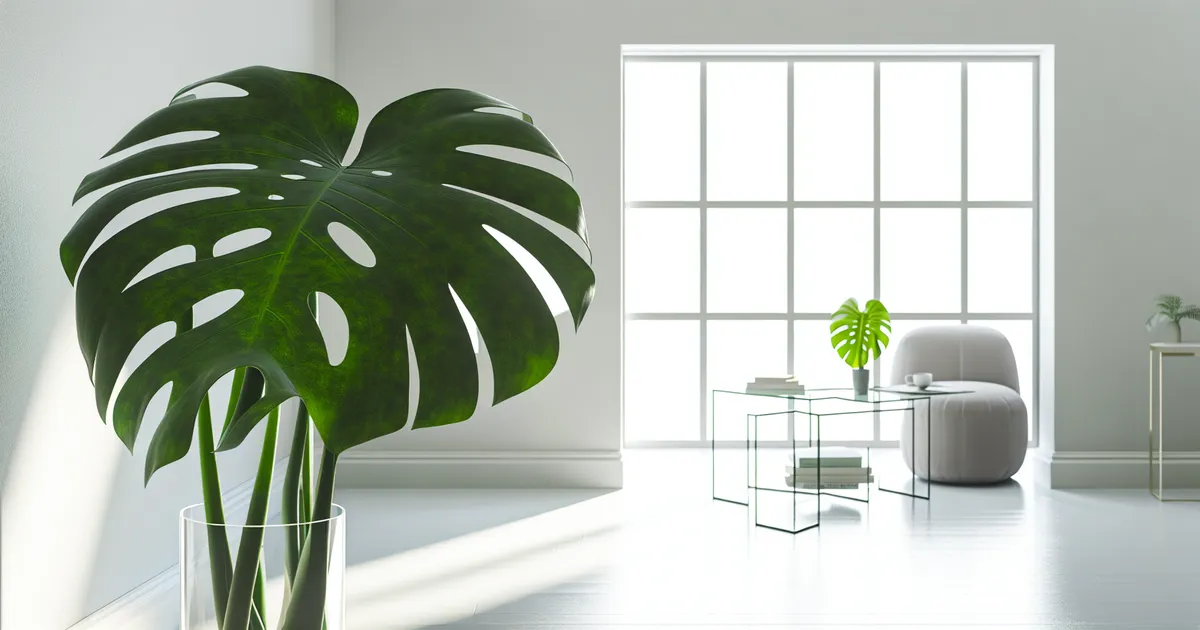
Quick Answer: A Monstera can be worth anywhere from $5 for a common Monstera deliciosa to $5,000 or more for a verified Monstera obliqua. Species identity and variegation type are the two biggest price drivers, but plant health, size, and market timing all matter. If you want to know what your specific plant is worth right now, you need current sold-listing data — not asking prices.
So you’re staring at your plant and asking: how much do you think my Monstera is worth? It’s a fair question, and the honest answer is complicated. “Monstera” covers a genus of roughly 48 species, and price follows rarity more than almost anything else. A standard M. deliciosa from a garden center and a confirmed ‘Mint’ Monstera are both Monsteras — but they inhabit completely different financial universes.
What Is My Monstera Worth? Price Ranges by Species
Monstera Price Ranges at a Glance
| Species / Cultivar | Key Feature | Price Range (USD) |
|---|---|---|
| Monstera deliciosa (standard) | Common; widely available | $5–$80 |
| Monstera adansonii | Swiss cheese vine | $5–$40 |
| Monstera siltepecana | Silver juvenile leaves | $10–$60 |
| Monstera pinnatipartita | Deeply lobed mature leaves | $30–$200 |
| Monstera standleyana ‘Albo’ | White-splashed narrow leaves | $50–$400 |
| Monstera deliciosa ‘Thai Constellation’ | Stable TC variegation | $50–$300 |
| Monstera acacoyaguensis | Rare species; collector demand | $50–$300 |
| Monstera deliciosa ‘Albo Variegata’ | Chimeric white variegation | $100–$1,000+ |
| Monstera deliciosa ‘Mint’ | Rare mint-green variegation | $200–$2,000+ |
| Monstera obliqua | Extremely rare; 90%+ fenestration | $500–$5,000+ |
These ranges shift constantly. Tissue culture labs and social media trends can move prices dramatically within a single year, so treat this table as a starting point, not a fixed reference. ‘Thai Constellation’ in particular has dropped sharply — peak prices of $150–$300 per leaf in 2021 had fallen to under $50 in many markets by 2023–2024 as TC labs scaled production.
The Single Biggest Factor in Monstera Value
Species and cultivar identity. A healthy, well-grown standard M. deliciosa will never command the price of a scraggly ‘Albo’ cutting, because rarity — not beauty or size — is what the collector market pays for. Everything else is secondary.
How Much Is My Monstera Worth? 7 Key Factors
1. Species and Cultivar Rarity
Supply and demand apply directly. Millions of growers propagate standard M. deliciosa, while verified ‘Mint’ Monsteras exist in only a handful of collections. Rarity compounds when a species produces few nodes, making each cutting inherently scarce.
2. Variegation Type: Chimeric vs. Tissue Culture
This distinction is crucial for valuation.
Chimeric variegation (like ‘Albo Variegata’) results from a spontaneous genetic mutation in a single cell layer during development. It cannot be reproduced from seed and can only be passed on through vegetative cuttings — and even then, not every cutting reliably carries the mutation forward. Supply is structurally limited, which keeps prices elevated.
Tissue-culture variegation (like ‘Thai Constellation’) is lab-induced and genetically stable across all cells. TC labs can produce thousands of identical plants, which is exactly why Thai Constellation prices collapsed. The science of mass production caught up with the hype.
Within ‘Albo Variegata’, not all leaves are equal. A clean half-moon leaf — roughly 50% white, 50% green in a distinct split — commands significantly more than a heavily speckled one. The sweet spot for both aesthetics and plant health is 30–50% white to green. Fully white leaves contain no chlorophyll and cannot photosynthesize; the plant cannot sustain them long-term, which makes them a liability rather than an asset.
3. Plant Size, Maturity, and Fenestration
Fenestrations — the iconic holes and splits — only develop on mature M. deliciosa leaves, typically once a plant reaches around 3–4 feet in height under good conditions. A juvenile plant with plain, heart-shaped leaves is worth less than a mature specimen with fully developed splits. Buyers aren’t just paying for the plant; they’re paying for the years of growth it represents.
4. Plant Health and Condition
A stressed or pest-damaged Monstera loses value fast. Buyers assess leaf color (deep, glossy green vs. yellowing or brown), stem integrity, and root health. White, firm roots signal a healthy plant; brown, mushy roots indicate rot. Visible pest damage — stippling from spider mites, silvery streaks from thrips, cottony deposits from mealybugs — will reduce your asking price or kill the sale entirely.
5. Node Count and Propagation Potential
Resellers and collectors both count nodes. Each node is a potential new plant, so a cutting with two or three nodes is worth more than one with a single node. Wet sticks — bare nodes without leaves, kept moist to encourage sprouting — sell at lower prices and represent a high-risk purchase. They’re only worth buying if the cultivar is rare enough that even a bare node justifies the gamble.
6. Market Timing and Geography
The COVID-19 pandemic created an unprecedented houseplant boom. ‘Albo’ cuttings sold for $1,000–$5,000 at peak in 2020–2021. Prices corrected sharply by 2023 as TC labs scaled up and demand normalized. Geography matters too: a plant worth $200 in the US might fetch $20 in Thailand or $400 in Australia, where strict biosecurity laws limit imports.
7. Provenance and Documentation
In the high-end collector market, documentation matters. A cutting from a verified, reputable grower or botanical institution carries a premium over an anonymous listing. The ‘Mint’ Monstera market is particularly flooded with misidentified plants — verified specimens with photographic lineage history sell for multiples of unverified ones.
How to Find Out What Your Monstera Is Actually Worth Right Now
Where to Research Current Market Prices
- eBay completed listings — the most reliable source of actual sale prices (see below)
- Etsy — search your specific cultivar and filter by “most recent” for current asking prices
- Facebook Marketplace plant groups — useful for regional pricing and local comps
- Whatnot — live plant auctions with real-time price discovery
How to Use eBay Sold Listings Correctly
This is the most important valuation tool available, and most people use it wrong. Active listings are not sale prices. Anyone can list a plant for $2,000; that tells you nothing about what someone actually paid.
- Search your plant’s name on eBay
- In the left sidebar, check “Sold Items”
- Filter by the last 30–90 days for the most relevant data
- Look only at the prices that actually sold — ignore unsold listings
This gives you real market data, not wishful thinking.
Getting a Community Appraisal
Reddit’s r/RareHouseplants and dedicated Facebook groups are genuinely useful. Post clear photos of every leaf, both sides of the stem, and the root system if possible. Experienced collectors will often give you an honest range — and flag misidentifications, which are extremely common with rare cultivars.
How to Maximise Your Monstera’s Value Before Selling
Treat Any Pests First
Identify the pest before treating — use a 10x loupe and check both leaf surfaces and stem joints.
- Spider mites: Treat with insecticidal soap or a 2% neem oil solution; raise humidity above 60%, as mites thrive below 40% RH
- Thrips: Apply imidacloprid-based systemic granules to the soil, combined with yellow sticky traps; repeat every 5–7 days for three cycles to break the full lifecycle
- Mealybugs: Dab individual insects with 70% isopropyl alcohol on a cotton swab, then follow with insecticidal soap spray
- Scale: Remove manually with a soft toothbrush and soapy water, then apply horticultural oil
- Fungus gnats: Let soil dry more between waterings; top-dress with coarse perlite; apply beneficial nematodes (Steinernema feltiae) to the soil
Fix Root Rot Before It Tanks Your Price
- Remove the plant from its pot and shake off all old soil
- Trim every brown, mushy root with sterile scissors (sterilize with 70% isopropyl between cuts)
- Let roots air-dry for 30–60 minutes
- Dust cut surfaces with powdered sulfur as an antifungal (cinnamon has minimal evidence of efficacy and is not recommended as a primary treatment)
- Repot into fresh mix: 40% quality potting mix + 30% perlite + 20% orchid bark + 10% horticultural charcoal, targeting a soil pH of 6.0–6.5
- Hold off fertilizing for 4–6 weeks to avoid stressing recovering roots
Encourage Better Variegation in Chimeric Plants
If your ‘Albo’ has pushed a run of all-green or all-white leaves, prune back to the last node that showed good variegation in the stem tissue itself. New growth from that node is most likely to express the chimeric pattern again. Increase light to bright indirect (1,500–3,000 foot-candles) — low light causes the plant to favor green tissue for survival. No fertilizer or supplement creates variegation; any product claiming otherwise is a scam.
Speed Up Fenestration Development
Install a moss pole or coco coir totem. As a hemiepiphyte, Monstera responds to a climbing structure by maturing its leaf morphology faster — climbing plants develop fenestrations measurably earlier than trailing ones. Pair that with bright indirect light and a balanced liquid fertilizer at half strength every two to four weeks during the growing season.
Photograph and Present Your Plant Well
- Wipe every leaf with a damp microfiber cloth the day before shooting
- Photograph in natural, indirect daylight — flash flattens texture and distorts color
- Shoot every leaf individually (both sides), the full plant, the stem, and roots if bare-rooting for shipping
- Write an honest, specific description: leaf count, node count, variegation percentage, pot size, and any pest history
Are Monsteras a Good Investment?
The honest answer: rarely, and only for specific cultivars. Thai Constellation is the cautionary tale — a plant that went from $300 per leaf to under $50 in three years, not because the plant changed, but because scarcity did. This pattern will likely repeat with any cultivar that can be reliably produced through tissue culture.
Cultivars more insulated from price collapse are those that are structurally difficult to mass-produce:
- True chimeric ‘Albo Variegata’ — the chimeric mutation cannot be replicated by TC; supply remains inherently limited
- Verified ‘Mint’ Monstera — extremely rare, frequently misidentified, and not yet successfully TC’d at scale
- Confirmed Monstera obliqua — so rare in cultivation that TC production is not a near-term threat
Three things can destroy a Monstera’s value quickly: chimeric reversion (an ‘Albo’ can push all-green growth indefinitely, effectively becoming a standard M. deliciosa in value terms), permanent pest or disease scarring, and TC labs commoditizing a previously scarce cultivar. If you’re holding a rare plant as an investment, those are the risks to manage.
Frequently Asked Questions
How do I know if my Monstera is actually a rare variety? Start with a species identification — post clear photos to r/RareHouseplants or a dedicated Facebook group. For high-value cultivars like ‘Mint’ or ‘Albo’, ask for provenance documentation from whoever sold it to you. Misidentification is extremely common, especially with M. obliqua (most are actually M. adansonii) and ‘Mint’ Monstera.
Does a bigger Monstera always mean a higher price? Size helps, but it’s not the primary driver. A large, mature standard M. deliciosa is still worth less than a small, healthy ‘Albo’ cutting. For common species, size and fenestration development do add meaningful value. For rare cultivars, rarity and variegation quality matter far more than size.
Can I sell a Monstera with root rot? You can, but you must disclose it — and price it accordingly. Treat the rot first (see the root rot section above), allow the plant to recover for several weeks, and photograph the healthy new roots before listing. Selling a plant with undisclosed root rot is both unethical and likely to result in disputes.
Why did my Monstera’s value drop so much in the last two years? Almost certainly because tissue culture labs scaled up production of your cultivar, or because pandemic-era demand normalized. Thai Constellation is the clearest example. If your plant is a chimeric cultivar like ‘Albo’, some price correction has occurred but structural scarcity still supports higher prices than TC varieties.
Is a Monstera with no fenestrations worth less? For M. deliciosa, yes — fenestrations signal maturity and years of good growing conditions, which buyers pay for. A juvenile plant without splits is worth less than a mature specimen. That said, some species like M. adansonii and M. siltepecana are valued for other features and are not expected to fenestrate in the same way.