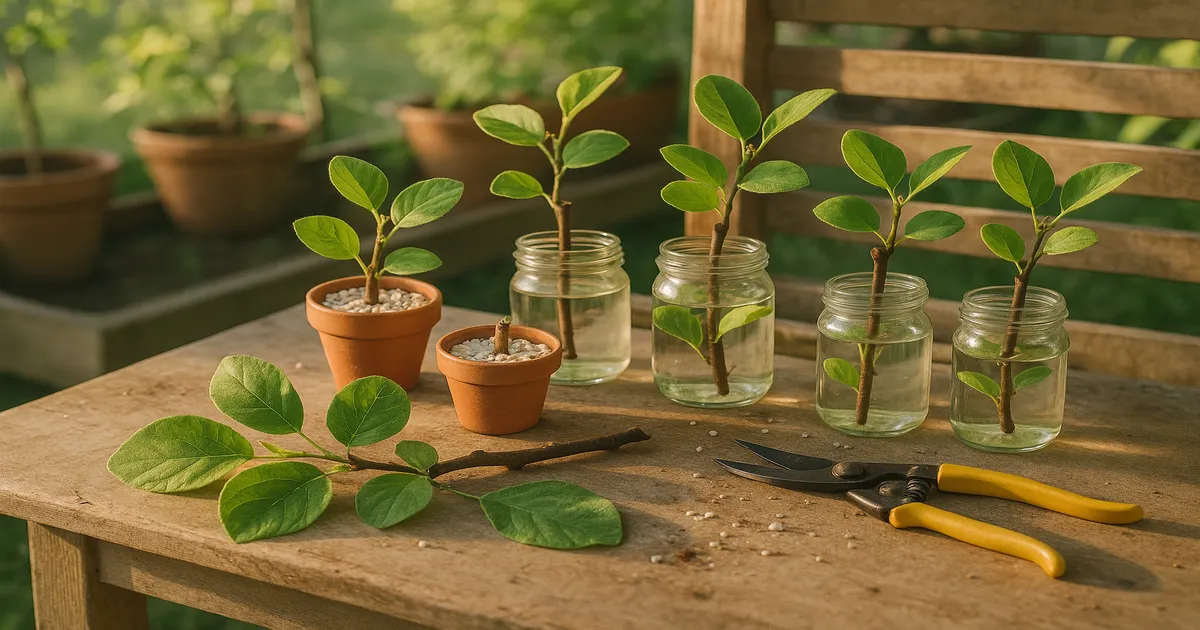
Quick Answer: You can grow quince from cuttings using three methods — hardwood (November–February), semi-hardwood (July–August), or softwood (May–June). Hardwood cuttings are the best starting point for beginners: they require minimal equipment, tolerate humidity fluctuations, and root reliably when treated with IBA rooting hormone at 8,000–10,000 ppm. Expect 60–80% success with good technique. Ornamental quince (Chaenomeles spp.) generally roots more readily than fruiting quince (Cydonia oblonga).
Learning how to grow quince from cuttings is one of the most satisfying skills a home grower can develop. One snip of wood, a little patience, and within a couple of seasons you have a fruit-bearing tree — a genetic clone of the parent you already know and trust. Both fruiting quince (Cydonia oblonga) and ornamental quince (Chaenomeles spp.) respond well to cutting propagation, though technique varies by species, cutting type, and time of year.
Quince Species and Cultivars Best Suited to Cutting Propagation
Fruiting Quince: Cydonia oblonga
Cydonia oblonga is the only true fruiting quince — a deciduous shrub or small tree reaching 3–6 metres. It’s moderately difficult to root, so technique matters more here than with easier species. The most reliable cultivars to propagate are:
- ‘Vranja’ (Leskovac): Vigorous Serbian variety with large fruit; semi-hardwood cuttings root consistently
- ‘Champion’: Cold-hardy American heirloom; responds well to hardwood cuttings
- ‘Smyrna’: High-sugar Turkish variety; rooting success comparable to ‘Vranja’
- ‘Pineapple’: Distinctive flavour; moderate success from semi-hardwood
- ‘Portugal’ (Lusitanica): Traditional large-fruited European variety; hardwood cuttings preferred
Ornamental Quince: Chaenomeles Species
Chaenomeles speciosa, C. japonica, and the hybrid C. × superba are botanically distinct from Cydonia but share the same Rosaceae rooting characteristics. They root more readily across all cutting types, making them an excellent confidence-builder if you’re new to propagation. Reliable cultivars include ‘Crimson and Gold’, ‘Jet Trail’, and ‘Cameo’.
How to Grow Quince from Cuttings: Choosing the Right Cutting Type
Hardwood Cuttings: Best for Beginners (November–February)
Take hardwood cuttings during full dormancy, after leaf drop. The wood is fully lignified and stable, which makes it forgiving of the humidity fluctuations that kill softer material. Rooting is slow — 8–14 weeks — but steady. Cut sections 20–30 cm long from pencil-thick, current-season wood.
Semi-Hardwood Cuttings: Best Overall Success Rate (July–August)
By midsummer, new growth has partially lignified: firm enough to handle, yet physiologically active enough to root quickly. This is the sweet spot for Cydonia oblonga, with success rates of 60–80% under good conditions. Prepare cuttings 15–20 cm long.
Softwood Cuttings: Advanced Method (May–June)
Softwood tips taken in May or early June carry the highest endogenous auxin levels and greatest meristematic activity. In theory, ideal for rooting. In practice, they wilt and collapse without a misting system or very attentive humidity management. Keep them to 8–12 cm and don’t attempt this method without a proper propagation chamber. Failure rates for beginners are high.
The Snap Test: Identifying the Right Wood Maturity
Bend a shoot sharply between your fingers. If it bends without snapping, it’s softwood. If it snaps cleanly with a crisp break, it’s semi-hardwood — exactly what you want for a July cutting. If it flexes without snapping at all, it has crossed into fully hardwood territory.
Step-by-Step: How to Take and Prepare Quince Cuttings
Tools and Sterilization
Use a sharp grafting knife or bypass pruners — a quality pair such as Felco F-2 Classic Bypass Pruners makes clean cuts that heal quickly. Never use anvil pruners; they crush vascular tissue, creating a damaged cut surface that invites pathogens and roots poorly. Sterilize blades between cuts with 70% isopropyl alcohol or a 10% bleach solution.
Cut Angles, Node Placement, and Length
- Make a 45° cut just below a node at the base — the angled cut maximises surface area for hormone uptake and prevents water pooling
- Make a straight cut just above a node at the top — this also helps you identify which end is which when planting hardwood cuttings
- Target lengths: 20–30 cm for hardwood, 15–20 cm for semi-hardwood, 8–12 cm for softwood
Leaf Removal and Wounding
Strip all leaves from the lower two-thirds of the cutting. For semi-hardwood, retain 2–4 leaves at the tip to maintain photosynthesis — but if the leaves are large, cut them in half horizontally to reduce transpiration. Then wound the basal 3–4 cm: scrape away the outer bark on one or two sides with a clean knife to expose the green cambium beneath. This increases the surface area available for IBA uptake and significantly improves rooting rates.
Applying Rooting Hormone
IBA (indole-3-butyric acid) is the key to reliable quince propagation. Use the correct concentration for your cutting type:
- Softwood: 1,000–3,000 ppm
- Semi-hardwood: 3,000–8,000 ppm
- Hardwood: 8,000–10,000 ppm
Powder formulations are the simplest to use — moisten the cut base, dip it in powder, and tap off the excess. Gel formulations such as Clonex Rooting Hormone Gel add a physical barrier against pathogens, which is particularly useful for semi-hardwood cuttings. Apply hormone only to the bottom 2–3 cm of the stem, and do it within 30 seconds of wounding. Over-application causes auxin toxicity and suppresses rooting — more is not better.
Rooting Environment: Medium, Containers, and Temperature
Best Rooting Medium for Quince Cuttings
Standard potting compost is the wrong choice. It’s too nitrogen-rich (which pushes shoot growth over root development), too moisture-retentive, and creates ideal conditions for Phytophthora and Pythium. Use one of these mixes instead:
- 50% coarse perlite + 50% horticultural grit — maximum aeration and drainage
- 60% perlite + 40% coir — slightly better moisture retention for drier climates or heated propagators
A good horticultural perlite such as Espoma Organic Perlite is widely available and essentially sterile out of the bag. Target a medium pH of 5.5–6.5 and always use fresh, commercially bagged materials.
Container Choice
Deep cells or root trainers with a minimum depth of 15 cm are ideal — they accommodate the developing root system without forcing it to circle, and the open-base design air-prunes roots naturally. Whatever container you use, drainage holes are non-negotiable.
Bottom Heat
Root initiation in quince is an enzymatic process. The optimal rooting medium temperature is 18–24°C (65–75°F). Below 15°C the process slows to a crawl; above 27°C, microbial activity accelerates and cuttings deteriorate. A propagation heat mat placed under the tray — such as the Vivosun Seedling Heat Mat — provides consistent bottom heat without warming the air above. That differential (warm roots, cooler tops) encourages root formation while slowing premature bud break.
Managing Humidity Without Encouraging Mould
For leafy cuttings, target 80–95% relative humidity using a clear humidity dome or a plastic bag tent. The catch: Botrytis cinerea (grey mould) thrives in exactly these conditions. Ventilate for 10–15 minutes once or twice daily — open the vents, let the air exchange, then close up again. It’s a small habit that makes a significant difference.
Common Reasons Quince Cuttings Fail
Wrong cutting type for the season. Softwood taken in October will rot. Hardwood taken in June lacks the carbohydrate reserves to root. Match cutting type to the calendar: hardwood in dormancy (November–February), semi-hardwood in midsummer (July–August), softwood only in late spring with full humidity control.
Skipping or misapplying rooting hormone. Without IBA, semi-hardwood rooting rates can fall below 20–30%. With correct application, they reach 60–80%. The two most common mistakes are using the wrong concentration and applying too much. Tap off excess powder and never coat more than the bottom 2–3 cm.
Waterlogged rooting medium. This is the single most common cause of rotting cuttings. If your medium holds water like a sponge, oxygen can’t reach the developing root primordia, and Phytophthora and Pythium move in fast. Stick to perlite-based mixes and confirm that drainage holes are actually draining.
Taking cuttings at the wrong point in the growth cycle. Carbohydrate reserves are lowest immediately after the spring flush, when the plant has invested heavily in new growth. Gibberellin levels are also elevated at this point, actively suppressing adventitious rooting. Wait for reserves to rebuild. Water the parent plant thoroughly 24–48 hours before taking cuttings, and collect them early in the morning when stem turgor is highest.
Fungal and bacterial pathogens. Botrytis, Phytophthora, Pythium, and Pseudomonas syringae are the main culprits. Prevention beats treatment: sterilize tools and containers, use fresh sterile rooting medium, ventilate humidity domes daily, and remove any rotting cuttings immediately before they infect their neighbours.
Aftercare: From Rooted Cutting to Established Plant
How to Tell When Cuttings Have Rooted
The most reliable indicator is resistance when you gently tug the cutting — a rooted cutting holds firm. You may also see root tips emerging from drainage holes or new leaf growth at the tip. New leaves are encouraging but not conclusive; a cutting can push a bud from stored energy before any roots have formed.
Weaning Off High Humidity
Don’t remove the dome all at once. Reduce humidity gradually over 1–2 weeks by opening vents a little more each day. Sudden exposure causes rapid transpiration that the young root system can’t keep up with, and the cutting wilts or dies.
Potting On and First-Year Care
Move rooted cuttings into a nutrient-lean compost mix — a 50/50 blend of multipurpose compost and perlite works well at this stage. Hold off on high-nitrogen fertiliser until the root system is well established, water consistently without overwatering, and keep plants frost-free through their first winter.
Transplanting to the Garden
Most quince cuttings are ready for their permanent position in the second growing season. Choose a site in full sun with well-drained soil at pH 6.0–6.5. Quince tolerates a range of soil types but hates waterlogged roots — if drainage is questionable, plant on a slight mound or improve the bed with grit. Space fruiting quince 4–5 metres apart; ornamental types can be planted closer depending on the cultivar.
Frequently Asked Questions
What is the best time of year to take quince cuttings?
For beginners, the best time is during full dormancy — November through February — when hardwood cuttings are easiest to manage. If you’re comfortable with humidity control, mid-July to August for semi-hardwood offers the highest overall success rate. Avoid early spring, when carbohydrate reserves are depleted and elevated gibberellin levels suppress rooting.
How long do quince cuttings take to root?
Semi-hardwood cuttings typically root in 6–10 weeks with bottom heat. Hardwood cuttings are slower — expect 8–14 weeks, sometimes longer in cool conditions. Softwood cuttings can root in as little as 4–6 weeks but require consistent high humidity throughout.
Can you grow quince from hardwood cuttings without rooting hormone?
Technically yes, but success rates drop significantly — often below 20–30% for Cydonia oblonga. Ornamental quince (Chaenomeles spp.) is more forgiving and may root acceptably without hormone. For fruiting quince, IBA at 8,000–10,000 ppm is strongly recommended. It’s an inexpensive product that makes a measurable difference.
Why are my quince cuttings rotting instead of rooting?
Rotting almost always points to one of three causes: waterlogged rooting medium, cutting material taken at the wrong stage of maturity, or pathogen pressure from Phytophthora, Pythium, or Botrytis. Your medium should feel moist but never soggy. Switch to a perlite-heavy mix, sterilize containers, ventilate your humidity dome daily, and confirm you’re using current-season wood at the correct stage.
What is the difference between propagating fruiting quince and ornamental quince?
The technique is essentially the same, but ornamental quince (Chaenomeles spp.) roots more readily and tolerates less-than-perfect conditions better. Fruiting quince (Cydonia oblonga) benefits more from correct IBA concentration, cambium wounding, and bottom heat. Both can be propagated from hardwood or semi-hardwood cuttings within the same timing windows.