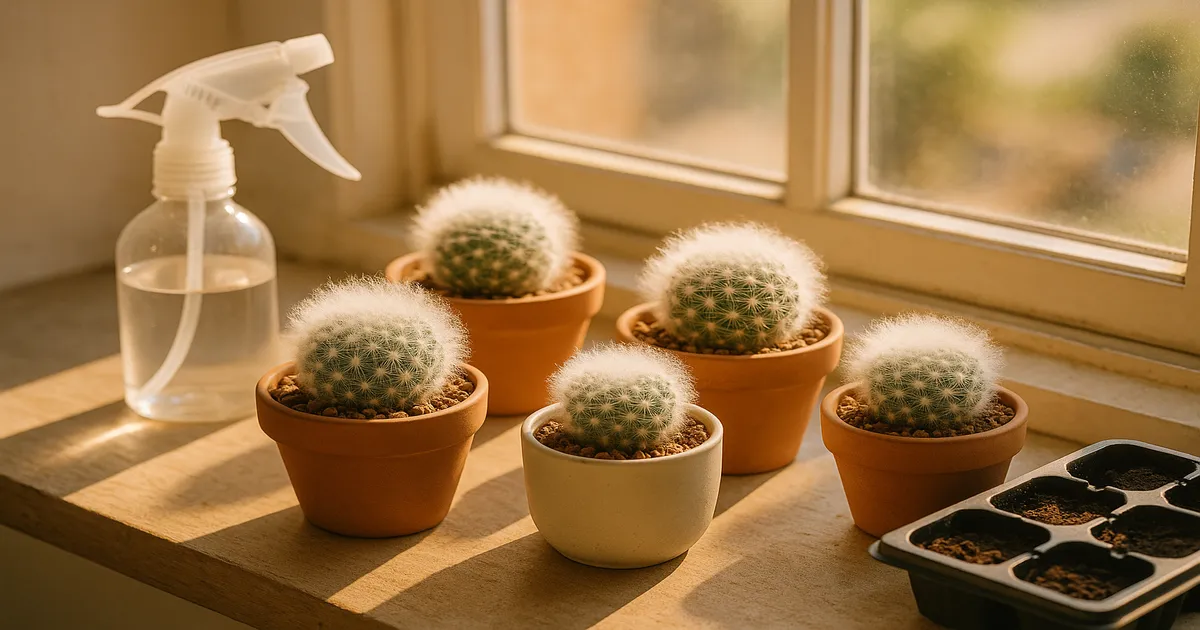
Quick Answer: Yes, you can propagate a baby booby cactus — and it’s one of the easiest cacti to multiply. Mammillaria bocasana naturally produces clusters of offsets (pups) that can be separated, callused, and rooted in as little as three to eight weeks. Offset division is the fastest and most reliable method for most growers.
Can You Propagate a Baby Booby Cactus?
Yes — and you’ll likely have more propagation material than you know what to do with. Mammillaria bocasana is a prolific offsetter, which makes it one of the most beginner-friendly cacti to multiply. Three methods work: offset division, stem cuttings, and seed propagation. Offset division is the clear winner for speed and success rate, so that’s where we’ll spend most of our time.
What Is a Baby Booby Cactus?
The baby booby cactus is Mammillaria bocasana, a small, clustering cactus native to the rocky highlands of central Mexico. Its nickname comes from the rounded, nipple-like tubercles (called mammillae) that cover its surface — the same feature that gives the entire Mammillaria genus its name.
You may also see it sold as “nipple cactus,” “powder puff cactus,” or simply Mammillaria. Close relatives like M. bombycina and M. hahniana share the same nickname and are propagated using identical methods, so everything in this guide applies across the genus.
How Baby Booby Cacti Propagate Naturally
Why Mammillaria Produces So Many Offsets
Each tubercle on a Mammillaria stem contains an axillary meristem — a cluster of undifferentiated cells capable of generating new growth. Under the right conditions, these meristems produce pups as a clonal survival strategy. The more stems in a cluster, the better the plant’s chances of surviving drought or physical damage. A healthy, well-lit mother plant can produce dozens of offsets over its lifetime, giving you a steady supply of propagation material without any intervention.
The tubercles aren’t just decorative — they’re the engine of the plant’s reproductive biology. Flowers and offsets both emerge from the axils between tubercles, which is why rough handling during offset removal can damage future flowering and pup-producing capacity. Clean, careful separation protects this tissue.
Three Propagation Methods at a Glance
| Method | Difficulty | Time to Established Plant | Best For |
|---|---|---|---|
| Offset division | Easy | 3–8 weeks to root | Most growers |
| Stem cuttings | Moderate | 4–10 weeks to root | Plants with few offsets |
| Seed | Advanced | 3–5 years to flowering size | Collectors, breeders |
Offset division is the go-to method because the pup already has stored energy and often has root primordia developing before you even separate it. Seeds are a fascinating long-term project, but they’re not the right choice if you want a mature plant anytime soon.
How to Propagate a Baby Booby Cactus: Offset Division Step by Step
When Is an Offset Ready to Separate?
Patience pays off here. An offset that’s too young simply doesn’t have the vascular tissue or carbohydrate reserves to survive on its own. Look for these signs before cutting:
- Diameter of at least 2–4 cm — roughly one-third the size of the mother stem
- A visible constriction point where the pup meets the mother plant
- A slight wiggle when you gently probe the base — it should feel like a loose tooth, not a fused joint
- Small white root nubs already forming at the base (a bonus, not a requirement)
Tools and Sterilization
You need one sharp, thin-bladed tool — a sterilized knife, scalpel, or offset spatula all work. Wipe the blade with 70% isopropyl alcohol and let it air-dry before making any cut. This single step prevents you from transferring fungal spores or bacteria between plants.
Removing the Pup
- Put on thick leather gloves or grip the offset with several layers of folded newspaper.
- Identify the natural constriction point at the base of the pup.
- Make a clean, single cut at that point — don’t saw back and forth.
- If the pup already has root nubs, gently tease the roots apart rather than cutting through them.
- Set the offset on a clean, dry surface — cut-side up or on its side.
- Dust the mother plant’s wound with powdered sulfur or cinnamon as a natural antifungal barrier.
- Keep the mother plant completely dry for 5–7 days and withhold fertilizer for 4–6 weeks.
For a safe grip, folded newspaper wrapped around the stem works well. Silicone-coated kitchen tongs also give precise control without crushing the plant. Avoid bare hands on a spiny Mammillaria.
The Callusing Step: Why It Makes or Breaks Propagation
What Callusing Does
When you cut a cactus, the open wound invites rot pathogens like Fusarium and Pythium. The plant’s defense is suberization — the formation of a dry, corky layer that seals off the vascular tissue. Skipping this step is the single most common reason propagation fails. A freshly cut offset planted directly into moist soil will almost certainly rot.
Ideal Callusing Conditions
Place your offset somewhere with:
- Bright indirect light (1,500–3,000 foot-candles)
- Good airflow — a gentle fan or open window helps
- Temperature of 20–25°C (68–77°F)
- Relative humidity below 50%
Optionally, dust the cut surface with powdered sulfur or activated charcoal for extra antifungal protection. Neither is strictly necessary if conditions are right, but both provide useful insurance.
How Long to Callus
- Small offsets (under 2 cm): 3–7 days
- Larger offsets or thicker cuts: up to 14 days
The callus is ready when the cut surface looks dry and slightly papery or corky — no longer wet or translucent. When in doubt, give it another day or two.
Planting and Rooting Your Offset
The Right Soil Mix
Standard potting soil holds far too much moisture for an unrooted cactus. Use this DIY mix instead:
- 50% coarse inorganic material — perlite, pumice, or horticultural grit (2–4 mm particle size)
- 30% cactus-specific potting mix — low organic content, such as Bonsai Jack Gritty Mix
- 20% coarse horticultural sand — not beach sand, which contains salt and fine particles
Target a soil pH of 6.0–7.0.
Pot Choice and Watering
Terracotta pots wick excess moisture through their walls and improve aeration — exactly what an unrooted offset needs. Choose a pot only slightly larger than the offset; excess soil volume holds unnecessary moisture.
After planting, wait 7–14 days before watering. This feels counterintuitive, but a brief dry period encourages the offset to initiate roots in search of moisture. Once you begin watering, moisten the bottom third of the soil and let the pot dry out completely before watering again. The lift test works well: a pot that feels noticeably light is ready for water.
Light During the Rooting Phase
Keep your offset in bright indirect light (1,500–3,000 foot-candles) — near a bright window but out of direct midday sun. An unrooted offset can’t replace water lost through transpiration, so intense direct light causes stress before the plant can handle it. Once roots are confirmed, acclimate the plant to more direct sun over 2–4 weeks.
Confirming Roots Have Formed
Rooting typically takes 3–8 weeks under good conditions. Give the offset a very gentle tug — clear resistance means roots have anchored into the soil. New growth from the top of the offset is another reliable signal, since the plant won’t push new tissue until it has a functioning root system.
Common Reasons Baby Booby Cactus Propagation Fails
Removing offsets too early. An offset smaller than 2 cm, or one with no visible constriction point, lacks the stored energy to survive on its own. A few more weeks on the mother plant makes a significant difference.
Skipping the callusing step. This is the number one killer. Planting a freshly cut offset — even in well-draining soil — creates perfect conditions for rot pathogens to enter the open wound.
Overwatering before roots form. Before roots exist, there’s no mechanism to regulate water uptake. A soggy substrate creates anaerobic conditions and dramatically increases Pythium and Phytophthora risk. Err on the side of too dry during the first few weeks.
Wrong temperature. Root initiation requires metabolic activity, which stalls below 15°C (59°F). Cold conditions don’t just slow rooting — they raise rot risk because wounds heal slowly and soil stays moist longer. Stick to spring and early summer if possible, or use a seedling heat mat set to 21–24°C (70–75°F) if propagating in cooler months.
Pest problems on new propagules. Mealybugs and root mealybugs (Rhizoecus spp.) are common in Mammillaria collections, and freshly separated offsets are especially vulnerable. Before planting, inspect the offset for white cottony egg sacs. A preventive dip in diluted neem oil solution (2–3 ml per liter of water), allowed to dry fully before planting, provides solid protection.
Best Time of Year to Propagate a Baby Booby Cactus
Spring (April–June, Northern Hemisphere) is the optimal window. Rising temperatures and lengthening days trigger active growth, root initiation is fastest, and moderate humidity makes callusing straightforward.
Summer works well too, but watch for heat above 35°C (95°F), which can stress unrooted offsets, and note that mealybug pressure peaks in warm months. Provide afternoon shade if temperatures spike.
Fall and winter are not recommended unless you’re using a heat mat in a climate-controlled space. Cooler temperatures slow wound healing and root initiation, and rot risk climbs as evaporation slows. Expect rooting to take 6–12 weeks rather than 3–8 if you propagate outside the growing season.
Keeping the Mother Plant Healthy for Future Offsets
A well-fed mother plant produces more vigorous pups. During the growing season, fertilize monthly with a low-nitrogen, high-phosphorus cactus fertilizer — look for an NPK ratio around 2-7-7 — at half the recommended strength. High nitrogen pushes soft, weak growth; phosphorus supports root and offset development.
For established mother plants, aim for full sun to bright direct light (3,000–6,000+ foot-candles) for at least four to six hours daily. Keep ambient humidity in the 30–50% range and ensure good airflow — the most effective preventive measure against fungal disease. Never mist a Mammillaria; moisture trapped in the spine clusters promotes rot at the areoles.
Seasonal watering schedule:
- Spring and summer: every 7–14 days when the top 2–3 cm of soil is dry
- Fall: taper to every 3–4 weeks
- Winter: once every 3–6 weeks, or suspend watering entirely if temperatures drop below 10°C (50°F)
Always use pots with drainage holes. Always use fresh, sterile rooting medium for new propagules — never reuse soil from a plant that’s had disease or pests. Sterilize tools between plants with 70% isopropyl alcohol, and quarantine new acquisitions for 2–4 weeks before placing them near your collection.
Frequently Asked Questions
Do I need rooting hormone to propagate a baby booby cactus offset?
No. Cacti naturally produce their own auxins to stimulate root initiation, and a healthy, well-callused offset will root reliably without additives. A light dusting of rooting powder can marginally speed things up, but it won’t rescue a poorly callused offset or compensate for overwatering.
Why is my cactus offset turning yellow or mushy after separation?
Yellowing or mushy tissue almost always points to rot, caused by overwatering, insufficient callusing, or poorly draining soil. If the base is mushy, cut back to firm tissue, let it re-callus for another 7–10 days, and replant in a drier, grittier mix. If rot has reached the core, the offset is unlikely to recover.
Can I propagate a baby booby cactus that has no offsets yet?
Yes, though it requires a different approach. Young or recently repotted plants sometimes take a year or two before producing their first pups. In the meantime, you can propagate via seed (slow but rewarding) or take a stem cutting from a columnar form. Improving light levels and fertilizing during the growing season often triggers pup production within a single season.
Is it normal for a cactus pup to shrivel slightly after being removed?
Yes — mild shriveling is completely normal. The offset is drawing on its stored water reserves while it calluses and begins to root. As long as the shriveling is slight rather than a severe collapse or mushy texture, the plant is fine. Once roots establish and you begin watering, the offset will plump back up within a week or two.
How long does it take a baby booby cactus offset to root?
Under good conditions — warm temperatures (18–27°C), bright indirect light, and a well-draining mix — most offsets root within 3–8 weeks. Fall and winter propagation can stretch this to 6–12 weeks. Confirm rooting with a gentle tug: resistance means roots have formed.