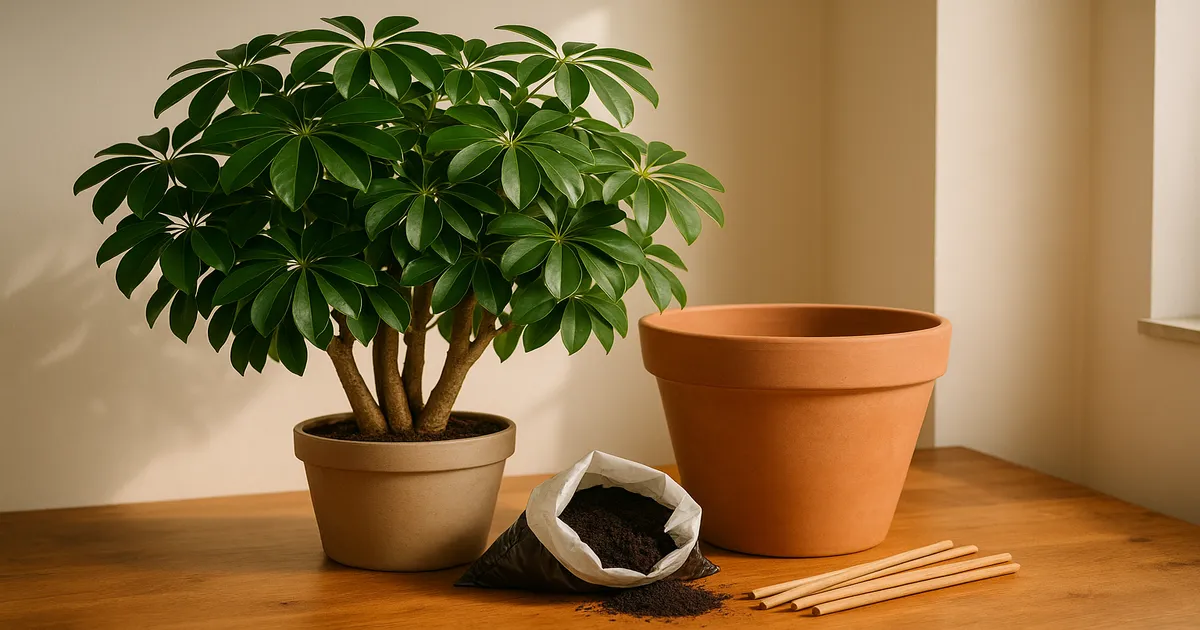
Quick Answer: A huge top-heavy Schefflera tips because its canopy has outgrown its pot’s footprint, the root ball has lost its anchoring ability, or the pot is too light to act as ballast. Fix it by moving up 2–4 inches in pot diameter, choosing a heavy terracotta or ceramic pot, pruning circling roots, using a well-draining soil mix, and staking the trunk securely. Spring is the best time to tackle repotting a huge top-heavy Schefflera.
Key steps at a glance:
- Repot in spring, after watering the plant 24–48 hours beforehand
- Move up 2–4 inches in pot diameter; choose a wide, squat, heavy pot
- Prune circling and rotten roots; remove up to one-third of root mass
- Use a well-draining mix (60% coir/peat, 20% perlite, 20% coarse sand or pumice)
- Stake the trunk deep into the root ball at two or three tie points
- Rotate the plant quarterly to prevent future directional lean
Why a Huge Schefflera Gets So Top-Heavy Indoors
Canopy Weight Stacks Higher With Every Growth Flush
Schefflera grows in a sympodial pattern — each growing tip produces a whorl of leaflets, then the stem continues from a lateral bud. The result is a progressively taller plant with canopy weight stacking higher with every growth flush. S. actinophylla can push 12–24 inches of new growth per year indoors, so the problem escalates faster than most owners expect.
The palmate compound leaves don’t help. A single leaf on a mature S. actinophylla can span 12–24 inches across, creating significant gravitational load and a wind-sail effect that amplifies any instability.
Indoor Stems Stay Soft Without Air Movement
Outdoors, constant air movement triggers thigmomorphogenesis — mechanical stress causes stems to deposit more lignin and build thicker cell walls, producing a rigid, self-supporting trunk. Indoors, with still air, stems stay semi-herbaceous and flexible long after they should have hardened off.
Lower light compounds the problem. Less photosynthesis means less raw material for building structural tissue, so an indoor Schefflera is simultaneously growing faster toward the light and building weaker stems to support that growth.
A Single Trunk Concentrates All the Load
In the wild, Schefflera often develops a multi-stemmed, spreading habit that distributes canopy weight across several anchor points. In a pot, it typically grows as a single dominant trunk — concentrating all that canopy mass on one structural column rooted in a relatively small volume of soil.
Signs It’s Time to Repot Your Top-Heavy Schefflera
Root-Bound Conditions Destroy Structural Anchoring
When roots fill a pot and start circling the container wall, they lose their ability to anchor the plant. The root mass becomes a compressed plug the plant sits on top of rather than being held by. Girdling roots can also strangle the root collar over time, weakening the structural connection between stem and root system.
Signs to check: roots emerging from drainage holes, soil drying out within 1–2 days of watering, plant rocking when you nudge the canopy.
Canopy Has Outgrown the Pot’s Footprint
As the center of mass rises with each growth flush, the pot’s base needs to widen and weigh more to compensate. A pot that was adequate two years ago may now be completely mismatched to the canopy it’s trying to anchor.
Signs to check: plant tips when nudged, pot lifts on one side when the canopy is pushed.
Degraded Potting Mix No Longer Grips Roots
Organic potting mix breaks down over time, compressing from a light, porous structure into a dense, compacted mass. Fresh mix has a bulk density of around 0.3–0.5 g/cm³; degraded mix can exceed 0.8 g/cm³. Paradoxically, denser soil grips roots less effectively, and the anaerobic conditions it creates invite root rot.
Signs to check: water pools before absorbing, soil pulls away from pot edges, musty smell.
Phototropic Leaning Shifts the Center of Mass
Schefflera has strong phototropism — stems and petioles grow toward the light source via auxin redistribution. Over months, a plant sitting near a single window develops a structurally committed lean that shifts its center of mass laterally, dramatically increasing tipping risk.
Signs to check: all new growth pointing toward one window, visible lean of 15–30+ degrees, one side of the canopy noticeably denser.
The Pot Material or Shape Is Wrong
A lightweight plastic nursery pot weighing half a pound simply cannot counterbalance a multi-pound canopy. Terracotta or ceramic pots of equivalent volume can weigh 5–15 lbs — that extra weight at the base dramatically lowers the effective center of gravity of the whole plant-pot system. Tall, narrow pots compound the problem by raising the center of gravity further.
Signs to check: pot feels very light when lifted, slides or shifts when the plant sways.
What You Need Before You Start Repotting
Best Time to Repot a Large Schefflera
Spring through early summer is ideal. The plant is entering active growth and recovers quickly from root disturbance. Avoid repotting in winter — slower metabolism means slower healing and prolonged stress.
Water the plant 24–48 hours before repotting. Moist soil holds the root ball together during extraction; dry soil crumbles and takes healthy roots with it.
Tools and Materials Checklist
- New pot (2–4 inches larger in diameter than the current one)
- Well-draining potting mix components (see soil recipe below)
- Heavy-duty bamboo or metal rebar stake
- Soft plant ties or stretchy tree ties
- Sharp, sterilized pruning shears
- 70% isopropyl alcohol or 10% bleach solution (for tool sterilization)
- Gloves — non-negotiable (see safety note below)
- Tarp or drop cloth
- A second person for very large specimens
Safety Warning: Schefflera Sap Is a Skin Irritant
Schefflera sap contains calcium oxalate crystals and irritating resins that cause contact dermatitis and can trigger allergic reactions in sensitive individuals. Wear nitrile or rubber gloves for the entire repotting process and wash your hands and forearms thoroughly afterward. Keep children and pets away from the work area until everything is cleaned up.
Step-by-Step: Repotting a Huge Top-Heavy Schefflera
Step 1: Extract the Root Ball Safely
Tip the pot onto its side — you’ll almost certainly need a second person for a large specimen. Grip the base of the trunk (gloves on) and gently work the root ball free. If it’s stuck, run a long knife around the inside edge of the pot or tap the sides firmly with a rubber mallet. Never yank from the trunk.
Step 2: Inspect and Prune the Roots
Lay the root ball on your tarp and assess. Healthy roots are white to tan and firm; brown, black, or mushy roots are dead or rotting and need to go.
Using sterilized shears, remove:
- All dead, rotted, or mushy roots (cut back to healthy white tissue)
- Circling and girdling roots — cut through them rather than trying to unwind them
- The bottom 1–2 inches of a severely compacted root ball to encourage new downward growth
You can safely remove up to one-third of total root mass from a healthy plant. If you remove more, balance it with equivalent canopy pruning to reduce transpiration demand. Afterward, use your fingers or a chopstick to tease apart the outer root mass and shake out as much old, degraded soil as possible.
Step 3: Choose and Prepare the Right New Pot
Go up 2–4 inches in diameter — not more. An oversized pot holds excess moisture that roots can’t use, setting the stage for root rot. For a severely neglected plant, 4–6 inches is acceptable.
Choose a wide, squat “azalea-style” pot over a tall, narrow one. The lower center of gravity makes a real difference in stability.
Pot material:
- Terracotta — ideal for most large indoor Schefflera; breathable, heavy, affordable
- Ceramic or glazed — very heavy, excellent stability; ensure large drainage holes
- Concrete or stone — maximum ballast for very large specimens
- Avoid lightweight plastic nursery pots for any Schefflera over 3 feet tall
Confirm your new pot has adequate drainage holes before adding a single scoop of soil.
Step 4: Mix the Right Soil
Don’t use straight bagged potting mix — it compacts too quickly in a large pot. Build your own blend:
- 60% high-quality peat-based or coco coir potting mix
- 20% perlite
- 20% coarse horticultural sand or pumice
For very large, heavy plants, bump the inorganic components to 40% total (split between perlite and pumice or coarse sand) to slow compaction over time. Optional upgrades: 10–15% aged orchid bark for long-term aeration, and 5–10% worm castings for slow-release nutrition.
Target a soil pH of 6.0–6.5. This range keeps nitrogen, phosphorus, potassium, and micronutrients all available to the roots.
One thing to skip: the gravel drainage layer. Placing rocks at the bottom of a pot raises the perched water table inside the pot, keeping the root zone wetter — the opposite of what you want.
Step 5: Plant, Stake, and Secure the Trunk
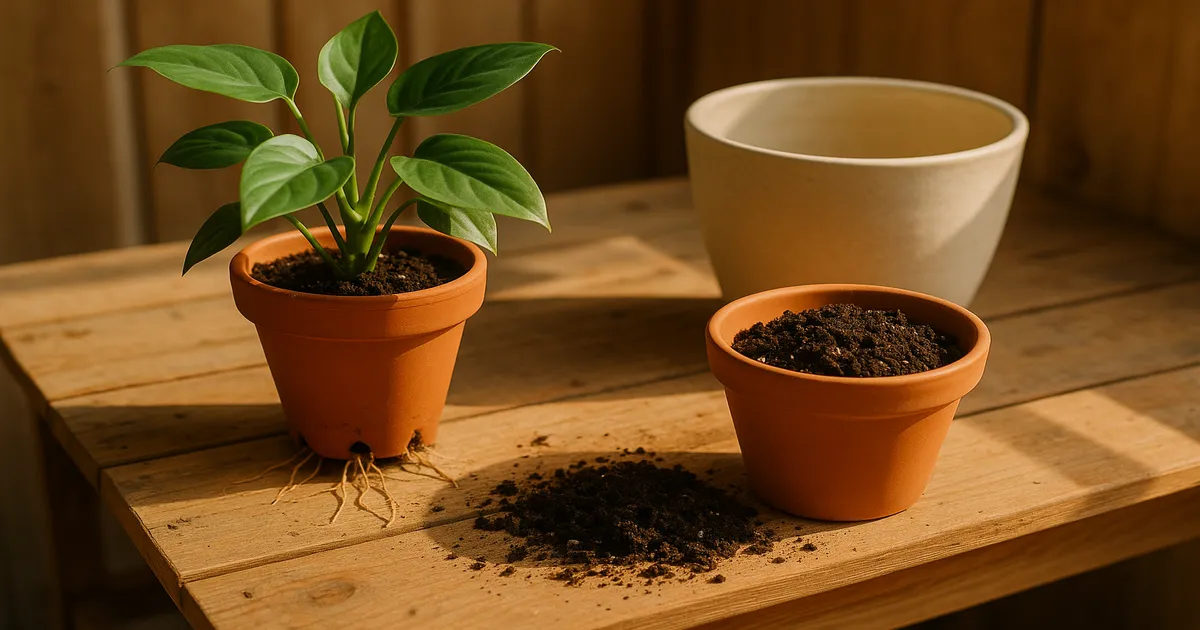
Add a few inches of soil mix to the bottom of the new pot. Before placing the root ball, insert your stake first — push it all the way to the bottom of the pot. Trying to add a stake after planting risks spearing roots.
Set the root ball so the root collar sits at the same depth as before (or very slightly higher). Fill in around the root ball, firming gently as you go to eliminate air pockets.
Tie the trunk to the stake at two or three points using soft plant ties. Tie firmly enough to provide support, but leave a small amount of flex — some stem movement is what triggers the lignification you want.
Step 6: Correct a Phototropic Lean
If your Schefflera has a persistent lean toward the window, repotting is your chance to correct it. When setting the root ball in the new pot, angle it slightly counter to the existing lean — if the plant leans left, tilt the root ball so the stem angles slightly right. The plant will gradually straighten as it responds to corrected light exposure over the coming weeks.
After repotting, rotate the plant 90–180 degrees relative to its light source to reduce phototropic pull going forward.
Keeping Your Repotted Schefflera Stable Long-Term
Staking Methods for Very Large Specimens
For Schefflera under 5 feet, a heavy-duty bamboo stake works well. For taller or heavier specimens, switch to a metal rebar stake — bamboo can flex or snap under significant canopy load. Drive the stake as deep into the root ball as possible for maximum leverage, and tie at multiple points along the trunk using soft, stretchy ties. The goal is to hold the plant vertical while it re-establishes, not to immobilize it completely. A little sway builds stem strength over time.
Use Canopy Pruning to Lower the Center of Mass
Removing 20–30% of the canopy immediately reduces the gravitational load the stem and root system must support and shifts the center of mass downward. As a bonus, cutting just above a leaf node encourages bushier regrowth — a fuller, more compact canopy that’s naturally more stable.
Run a Fan to Build Stem Strength
Place an oscillating fan near your Schefflera on a low setting for a few hours daily. The gentle movement triggers thigmomorphogenesis, causing the stem to deposit more lignin and build thicker cell walls. Within a few weeks you’ll notice the stem becoming firmer and more self-supporting. It’s one of the simplest things you can do for a chronically floppy indoor plant. (Honeywell HT-900 TurboForce Fan)
Optimize Light and Rotate Quarterly
Aim for bright indirect light — 1,500–3,000 foot-candles, near a large east- or west-facing window, or set back from a south-facing one. More light means more photosynthesis and more material for building structural tissue. Every three months, rotate the plant 90–180 degrees relative to its light source to prevent auxin from accumulating consistently on one side, keeping growth upright and the canopy balanced.
Repotting Frequency
- Juvenile plants (under 4 feet): every 2–3 years
- Mature specimens (4+ feet): every 3–5 years
Don’t wait for a crisis. Early warning signs are soil drying out within 1–2 days of watering, roots emerging from drainage holes, or noticeably slower growth despite good light and feeding.
Frequently Asked Questions
How do I know if my Schefflera needs repotting?
The clearest signs are roots growing out of drainage holes, soil that dries out within a day or two of watering, and a plant that rocks or tips when you nudge the canopy. Slower growth, yellowing lower leaves, and water that pools on the surface before absorbing are also reliable indicators that the root ball has outgrown the pot or the soil has broken down past the point of usefulness.
What size pot should I use for a large top-heavy Schefflera?
Move up 2–4 inches in diameter from the current pot — for example, from a 10-inch to a 12–14-inch pot. For a severely neglected plant, 4–6 inches is acceptable. Don’t jump to a much larger pot: excess soil volume stays wet too long and creates root rot conditions. Choose a wide, squat pot shape over a tall, narrow one to keep the center of gravity as low as possible.
Can I cut the roots when repotting a Schefflera?
Yes, and for a top-heavy plant you should. Circling and girdling roots should be cut through rather than left to continue wrapping around the root ball. Remove all dead, rotted, or mushy roots, cutting back to healthy white tissue. You can safely remove up to one-third of the total root mass from a healthy plant. If you remove more, balance it with equivalent canopy pruning to reduce the plant’s water demand while it recovers.
Why does my Schefflera keep falling over even after repotting?
The most common culprit is a pot that’s still too light or too narrow relative to the canopy. Switching from a plastic pot to a heavy terracotta or ceramic one makes a significant difference. Insufficient staking is the second most common issue — make sure you’re tying the trunk at two or three points and that the stake reaches the bottom of the pot. If the plant still leans, check whether a phototropic lean was left uncorrected during repotting and whether the canopy needs a 20–30% reduction to bring the center of mass down.
Is it safe to repot a Schefflera in winter?
It’s best avoided. Schefflera’s metabolism slows considerably in winter, which means root wounds heal more slowly and the plant is more vulnerable to prolonged stress. If the plant is in genuine crisis — actively falling over or showing signs of severe root rot — repot carefully and keep it warm (above 60°F / 16°C) with reduced watering until spring. Otherwise, wait for spring when the plant can recover quickly.