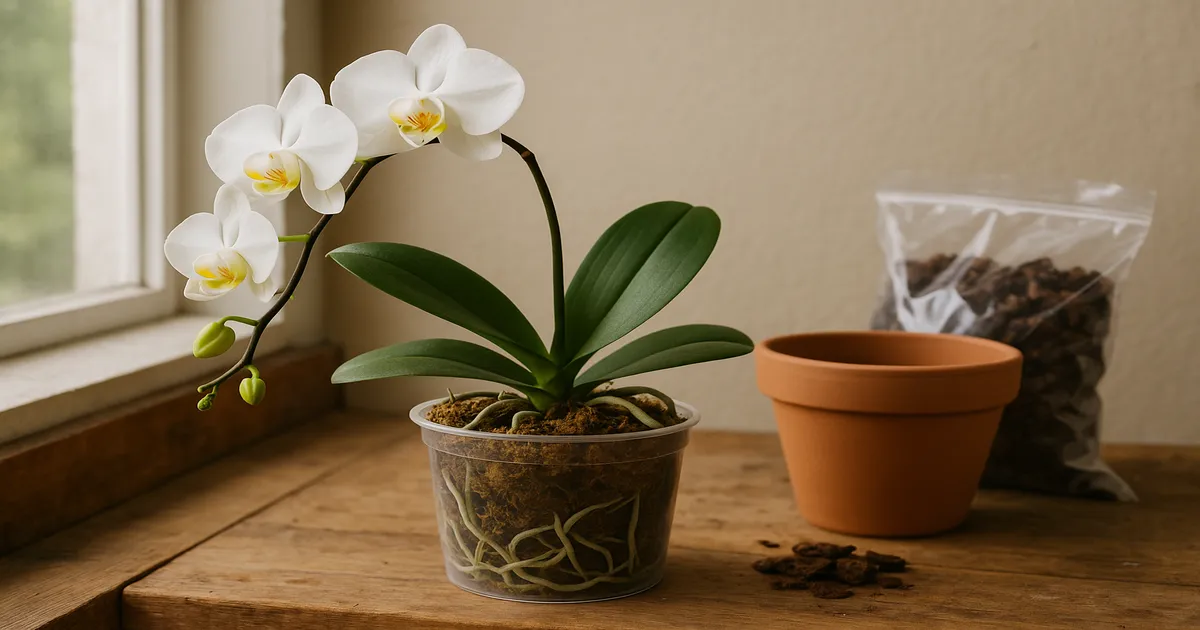
Quick Answer: Should you repot your orchid? Check three things first: Is the bark medium older than 18–24 months? Are any roots brown, mushy, or hollow? Does the medium stay soggy for more than a week after watering? If you answered yes to any of these, it’s time to repot. Aerial roots dangling over the pot edge are completely normal — not a repotting trigger. Start with the medium, and everything else follows.
So you’re staring at your orchid, wondering whether that tangle of roots and that slightly tired-looking pot means it’s time to act. “Should I repot my orchid?” is one of the most common — and most misunderstood — questions in houseplant care. The good news: once you know what to actually look for, the answer becomes clear pretty quickly.
Should You Repot Your Orchid? Start With These 3 Checks
Run through this quick checklist before you do anything else:
- How old is the potting medium? If it’s been more than 18–24 months since the last repot — or you genuinely don’t know — the bark is probably breaking down.
- What do the roots look like? Healthy roots are firm, plump, and turn bright green when wet. Brown, hollow, or mushy roots signal a problem.
- How long does the medium stay wet? If it’s still soggy 5–7 days after watering, aeration has been compromised.
If one or more of these raises a red flag, keep reading. If all three check out, your orchid is almost certainly fine — even if the pot looks crowded.
Why Orchid Repotting Is Different From Other Houseplants
Most houseplants get repotted because their roots run out of space. Orchids are different. The vast majority of popular houseplant orchids are epiphytes — in nature, they grow anchored to tree bark with their roots exposed to open air and periodic rain, not buried in soil. That’s why they’re repotted primarily because their growing medium breaks down, not because roots need more room.
Aerial roots spilling over the pot edge? Normal and healthy — leave them alone. A pot that looks packed with roots? Often perfectly fine. The medium is almost always the real story.
7 Clear Signs Your Orchid Needs Repotting
Sign 1: The Potting Medium Is Decomposed or Waterlogged
This is the number-one reason to repot. Bark and other organic media break down over 18–24 months due to microbial activity, repeated watering, and humidity. As the particles get smaller, the air gaps that orchid roots depend on disappear — and what’s left is dense, waterlogged, and essentially suffocating.
Do the 5–7 day test: if the medium is still wet a week after watering, it’s no longer draining properly. A sour or musty smell is another dead giveaway.
Sign 2: Roots Are Brown, Mushy, or Hollow
Gently squeeze a few roots. Healthy roots feel firm and plump; dead ones feel hollow, papery, or collapse under light pressure. The usual culprits are the pathogens Fusarium, Pythium, and Rhizoctonia — they colonize roots that have been oxygen-deprived by waterlogged media. If more than 30–40% of your root mass is dead, repotting is urgent rather than optional.
Sign 3: Sympodial Orchids Have Run Out of Room
This sign applies specifically to orchids like Cattleya, Oncidium, and Dendrobium, which grow horizontally via rhizomes and produce pseudobulbs. When the newest pseudobulb (the “lead”) is within an inch or two of the pot rim, there’s no room for the next growth cycle.
Phalaenopsis (moth orchid) grows vertically from a single stem and rarely runs out of horizontal space — don’t confuse a full-looking pot with genuine overcrowding.
Sign 4: Roots Are Trapped in or Cracking the Pot
Roots growing through drainage holes can get stuck, and forcing the plant out will damage them. Plastic pots visibly cracking under root pressure have also reached the end of their usefulness. That said, roots simply visible at the drainage holes — without being trapped — aren’t automatically a problem. Check the medium condition first.
Sign 5: White Crusty Deposits on the Pot or Roots
White or yellowish crust on the pot rim, the medium surface, or the roots themselves signals fertilizer salt accumulation. These salts cause osmotic stress, pulling moisture out of root cells rather than letting them absorb it. You’ll often see brown, desiccated root tips alongside this buildup.
Try flushing first — run water through the pot three or four times in succession. If the medium is also degraded, go ahead and repot.
Sign 6: Persistent Pests in the Root Zone
Fungus gnats, mealybugs, and scale insects all love to shelter in moist, decomposing media. Fungus gnat larvae are especially damaging — they chew through roots and thrive in high-moisture conditions. If you’re seeing persistent pest pressure despite surface treatments, the root zone itself needs to be inspected and cleaned.
Sign 7: You Just Brought It Home From a Store
Grocery-store and big-box orchids are almost always packed in pure sphagnum moss — great for keeping roots hydrated during shipping and display, but problematic for long-term health. Moss holds moisture far longer than bark and is often already partially decomposed by the time you buy it. Inspect the roots within two to four weeks of purchase. If the moss smells musty or the roots look stressed, repot sooner rather than later.
When Is the Best Time to Repot an Orchid?
Spring is ideal. Rising temperatures and increasing light naturally stimulate new root and leaf growth, so the plant is primed to recover quickly. Look for bright green new root tips with white velamen — that’s your clearest signal the orchid is ready to handle the stress of a move.
Phalaenopsis often finishes blooming in late winter or early spring. Repot immediately after the last flower drops and before the plant redirects energy into new growth.
Can you repot while it’s blooming? Generally, no. Repotting stress often causes flower drop, and nobody wants to lose a spike they’ve waited months for. The exception is an emergency: active root rot or a severe pest infestation can’t wait. In those cases, the plant’s long-term health matters more than the current bloom.
Emergency repotting can happen any time of year. Root rot, pest infestation, or a cracked pot all justify immediate action regardless of season. Summer’s higher humidity actually supports faster root recovery. Autumn repotting is workable but gives the plant less recovery time before slower winter growth.
How to Repot an Orchid: Step-by-Step
What You’ll Need
- Sharp scissors or pruning snips, sterilized with 70% isopropyl alcohol
- A new clear plastic nursery pot (for Phalaenopsis) or unglazed terracotta pot, sized 1–2 inches larger than the current root mass
- Fresh orchid-specific potting medium
- Powdered cinnamon or horticultural charcoal (natural antifungal for cut surfaces)
- 3% hydrogen peroxide for root sanitation
Choosing the Right Pot
Go only 1–2 inches larger than the current root mass. A pot that’s too big holds excess moisture in unused medium — exactly what you’re trying to avoid. Clear plastic pots are highly recommended for Phalaenopsis: seeing root color and moisture level through the walls makes ongoing care much easier.
Terracotta dries out faster, which helps prevent rot, but roots cling to it and removal is harder next time. Use decorative ceramic pots as cachepots only — never as the primary container.
Step-by-Step Instructions
- Water 24 hours before repotting to make roots pliable and less prone to snapping.
- Remove the plant from its pot gently. If roots are stuck, cut the pot away rather than forcing the plant out.
- Shake off all old medium and discard it — never reuse it.
- Rinse roots with room-temperature water and inspect carefully.
- Trim dead roots with sterilized tools, cutting back to healthy white or green tissue. Dust every cut surface with powdered cinnamon.
- Soak healthy roots in plain water or a dilute hydrogen peroxide solution (1 part 3% H₂O₂ to 3 parts water) for 10–15 minutes.
- Position the plant with the oldest growth toward the back (sympodial genera) or centered (Phalaenopsis).
- Fill with fresh medium, working it gently between roots without forcing or packing.
- Do not water for 3–5 days after repotting. This encourages roots to reach for moisture and reduces rot risk on freshly cut surfaces.
- Hold fertilizer for 4–6 weeks until new root growth is visible.
The First 4–6 Weeks After Repotting
Keep the plant in bright indirect light (1,500–3,000 foot-candles) and maintain humidity around 50–70%. A gentle fan on low helps reduce fungal pressure. Resist the urge to fertilize early — new roots are too tender to handle fertilizer salts, and fresh medium provides adequate nutrients in the short term.
Choosing the Best Potting Mix for Orchids
Never use standard potting soil. Epiphytic orchid roots need oxygen as much as they need water. Regular potting soil retains far too much moisture and collapses the macro-pore space roots depend on for gas exchange, leading to suffocation and rot within weeks.
Best Media by Orchid Type
- Phalaenopsis: Medium-grade fir bark (10–15 mm particle size) or a 60:20:20 blend of bark, perlite, and horticultural charcoal
- Cattleya: Coarse fir bark or coconut husk chunks for maximum airflow
- Cymbidium: Fine bark with added perlite and coarse sand — this genus leans more terrestrial and tolerates a slightly denser mix
- Paphiopedilum: Fine bark or a perlite/peat blend; tolerates slightly more moisture than most epiphytic genera
All orchid media should maintain a pH of 5.5–6.5 — slightly acidic, matching the bark environments these plants evolved in.
Sphagnum moss is useful for orchids recovering from root loss, but it’s a poor long-term medium. It compacts, goes anaerobic, and is difficult to gauge for moisture by touch. Use it strategically, not as a permanent home.
Treating Root Rot and Rescuing a Struggling Orchid
Identifying Healthy vs. Dead Roots
Healthy roots are firm, plump, and turn bright green when wet (the velamen — the spongy outer layer — absorbs water and changes color). Dead roots stay brown or tan even when wet, feel hollow or papery, and may collapse when gently squeezed. A mushy texture means active rot is present.
Removing Dead Roots
Remove every dead, mushy, or hollow root — be thorough, not conservative. Leaving dead tissue gives Fusarium, Pythium, and Rhizoctonia a foothold to spread into healthy roots. Dust every cut with powdered cinnamon, then soak the remaining healthy roots in a copper- or sulfur-based fungicide solution labeled for ornamentals for 15–20 minutes. Let roots air-dry for 1–2 hours before potting.
When to Mount Instead of Repot
If fewer than 3–5 healthy roots remain after cleanup, skip the pot entirely. Mount the orchid on a piece of cork bark with a small pad of sphagnum moss at the attachment point. Without a medium to stay wet, the rot cycle breaks — and the plant can recover while you mist the roots daily. It’s a surprisingly effective rescue strategy.
How to Prevent Needing to Repot Too Soon
Water correctly. Water only when the medium is nearly dry — for bark mixes, that’s typically every 5–10 days depending on your home’s humidity and temperature. When you do water, run water through the pot for 30–60 seconds to fully hydrate the bark and flush accumulated salts. Never let the pot sit in standing water; empty the saucer within 30 minutes.
Fertilize lightly. The “weakly, weekly” method works well: apply a balanced orchid fertilizer at ¼ strength every 7–10 days during active growth. Every fourth watering, use plain water only to flush accumulated salts. Stop fertilizing during winter dormancy and for the first 4–6 weeks after repotting.
Set a monitoring schedule.
- Every 3 months: Probe the medium with a chopstick. If it comes out clean and dry, aeration is intact. Dark and muddy means degradation is underway.
- Every 6 months: Check root color and density through the drainage holes or clear pot walls.
- At 18 months: Set a calendar reminder for a formal inspection, even if the plant looks healthy. Don’t wait for obvious symptoms.
Repotting Needs by Orchid Species
Phalaenopsis (Moth Orchid): Repot every 1–2 years, ideally right after the last flower drops. Aerial roots growing outside the pot are completely normal — don’t cut them, and don’t let them push you into an unnecessary repot. Focus on medium condition above all else.
Cattleya, Dendrobium, and Oncidium: These sympodial orchids grow via rhizomes and produce pseudobulbs. Repot Cattleya and Dendrobium every 2–3 years; fast-growing Oncidium every 1–2 years. The trigger is the lead pseudobulb reaching within an inch or two of the pot rim. Dendrobium tolerates crowding well — disturb its roots as little as possible.
Cymbidium and Paphiopedilum: Cymbidium needs larger pots than most orchids; repot every 2–3 years into a mix that includes perlite and coarse sand alongside fine bark. Paphiopedilum (slipper orchid) is semi-terrestrial and tolerates slightly more moisture; repot every 1–2 years and don’t let it dry out as aggressively as you would a Phalaenopsis.
Frequently Asked Questions: Should I Repot My Orchid?
How do I know if my orchid needs repotting?
Check three things: the age of the medium (repot if it’s older than 18–24 months), the condition of the roots (brown, mushy, or hollow roots need attention), and how long the medium stays wet after watering (more than 5–7 days signals poor aeration). If all three look fine, your orchid is almost certainly okay — even if the pot looks crowded.
Do orchids like to be root-bound?
Yes, most do. Orchids evolved with their roots in open air, not expansive soil, so they actually prefer a snug pot over a large one. An oversized pot holds excess moisture in unused medium, which leads to rot. Aerial roots growing outside the pot are healthy and normal, not a sign the plant needs more space.
How long after repotting should I water my orchid?
Wait 3–5 days before watering. This pause lets freshly cut root ends callous over, reducing rot risk, and prompts new root tips to actively seek moisture — which helps the plant establish faster in its new medium.
Can I repot an orchid while it is blooming?
It’s best to wait until after the last flower drops, since repotting stress often causes a plant to abort its blooms. The exception is a genuine emergency — active root rot or a severe pest infestation threatening the plant’s survival. In those cases, save the plant first and accept the flower loss.
What is the best potting mix for orchids?
For most Phalaenopsis, a medium-grade fir bark blend — roughly 60% bark, 20% perlite, 20% horticultural charcoal — provides the drainage and aeration epiphytic roots need. Coarser mixes suit Cattleya; finer, slightly moisture-retentive blends work better for Paphiopedilum. Avoid standard potting soil entirely — it retains far too much moisture and will cause root rot within weeks.