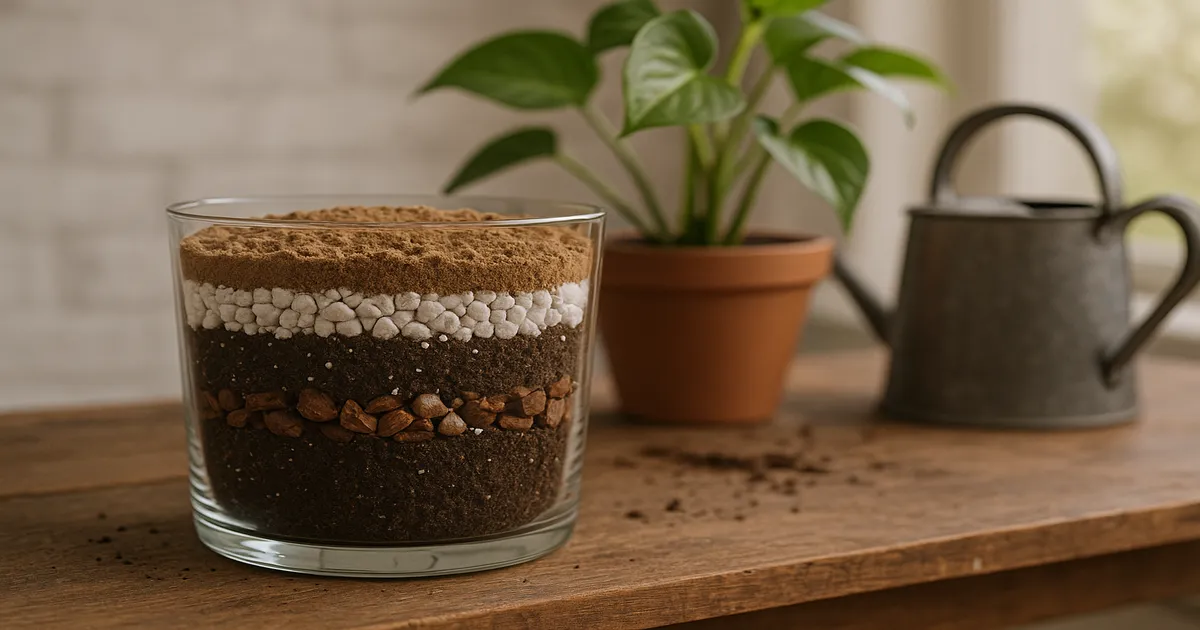
Quick Answer: Your houseplant “soil” is actually a soilless growing medium made from a blend of organic and mineral ingredients — peat or coco coir, perlite, bark, and often slow-release fertilizer pellets. It also hosts a living ecosystem of bacteria, fungi, and tiny invertebrates, most of which are harmless or actively helpful. The tricky part is knowing which inhabitants to welcome and which to evict.
If you’ve ever peered into a pot and wondered what is in my soil, you’re not alone. Those little white balls, fuzzy patches, jumping specks, and mysterious orange pellets all have explanations — and most of them are far less alarming than they look. This guide breaks down every ingredient, organism, and chemical problem you’re likely to encounter in your potting mix, plus exactly what to do about the ones that actually matter.
What Is Actually in Your Soil? Potting Mix vs. Garden Soil
True garden soil is a complex mineral matrix built up over centuries. It’s great outdoors but terrible in a pot — it compacts, drains poorly, and introduces pathogens that thrive in the confined, moist environment of a container. What most of us call “soil” for houseplants is technically a soilless growing medium engineered specifically for pots: lighter, more porous, and far more forgiving.
Every decent potting mix — whether you buy it or blend it yourself — is built around four things:
- Mineral particles or substitutes (perlite, pumice, sand, vermiculite) for structure and drainage
- Organic matter (peat, coco coir, bark, compost) for moisture retention and nutrients
- Water held in the pore spaces between particles
- Air in the larger pores, which roots need just as much as water
And then there’s the biology. A teaspoon of healthy growing medium can contain roughly 1 billion bacteria, yards of fungal hyphae, thousands of protozoa, and dozens of nematodes. Your pot is not just a vessel — it’s a micro-ecosystem.
Common Potting Mix Ingredients Explained
Peat Moss and Coco Coir: The Water-Retaining Base
These two are the backbone of most commercial mixes. Peat moss is brown, fibrous, and spongy. It holds water well and creates a slightly acidic environment — pH around 4.0–5.0 before liming agents are added — which suits most tropical houseplants. Coco coir looks similar but has a more uniform texture and a near-neutral pH of 5.8–6.8, making it easier to work with and more sustainable to source, since it’s a byproduct of coconut processing rather than a mined resource.
Both have high cation exchange capacity (CEC), meaning they hold onto nutrients like calcium, magnesium, and potassium and release them gradually to roots.
Perlite, Vermiculite, and Bark: Aeration and Drainage Agents
- Perlite — those white, lightweight, glassy beads — is volcanic glass superheated until it pops. It creates air pockets in the mix and has almost no CEC, so it doesn’t hold nutrients. It’s purely structural.
- Vermiculite looks like gold or silver accordion-like flakes. Unlike perlite, it retains moisture and some nutrients, making it better for seed-starting mixes than for drainage-focused blends.
- Bark (pine or orchid bark) adds chunky aeration, drains freely, and decomposes slowly. It’s the main ingredient in orchid mixes and a great addition to any tropical plant blend.
Worm Castings, Compost, and Biochar: Nutrient and Microbial Boosters
Worm castings are the dark, fine-textured, earthy-smelling amendment that quietly does the most work. They deliver slow-release nutrients, introduce beneficial microbes, and improve soil structure all at once. Compost does something similar but with more variable texture and a broader microbial profile.
Biochar — black, porous, lightweight chunks — buffers pH swings, creates habitat for beneficial microbes, and persists in the soil for years without breaking down.
Those Coloured Pellets Are Fertilizer, Not Pest Eggs
This deserves its own section because the panic is real. Small, round, yellow, green, or orange spheres in your potting mix are almost certainly polymer-coated slow-release fertilizer pellets. A product like Osmocote Smart-Release Plant Food is a common example . They release nutrients gradually over 3–9 months based on soil temperature and moisture. They are not eggs. They are not harmful. Leave them alone.
You might also spot dolomitic lime granules — small white or off-white pellets used to raise pH and add calcium and magnesium. Some premium mixes include mycorrhizal inoculants as a white powdery coating or as granules, which help plants form symbiotic fungal networks that improve nutrient uptake.
Beneficial Organisms Living in Your Soil
Springtails: The Tiny Jumpers That Help Your Soil
Springtails (Collembola) are tiny — 0.5–2 mm — white, gray, or silver hexapods that leap dramatically when disturbed. That jump comes from a forked appendage called a furcula that snaps against the ground like a spring. They feed on algae, mold, and decaying organic matter, making them excellent decomposers and a sign of a biologically active mix. They only become a nuisance in massive numbers, which usually signals chronically overwatered soil rather than a springtail problem per se.
Soil Mites: Mostly Your Friends
Most soil mites are so small (0.2–1.0 mm) you’ll barely see them without a hand lens. Oribatid mites are slow-moving, round, dark brown decomposers — completely harmless. Predatory mites like Stratiolaelaps scimitus are tan, fast-moving, and genuinely useful: they hunt fungus gnat larvae and other small soil pests. Fast-moving specks in your soil are more likely working for you than against you.
Beneficial Nematodes and the Soil Food Web
Nematodes are microscopic roundworms that live in the water films between soil particles. Beneficial species like Steinernema feltiae parasitize fungus gnat larvae, thrips pupae, and root weevils — they’re sold as a biocontrol product. Their presence, along with bacteria, fungi, and mites, forms the soil food web: an interconnected system where each organism feeds on another, cycling nutrients back to your plant’s roots.
Saprophytic Fungi and Beneficial Mycelium
White, fluffy, cobweb-like growth on the soil surface after repotting is almost always saprophytic mycelium — fungi breaking down organic matter in fresh potting mix. It’s harmless and usually disappears as the mix stabilises. Don’t confuse it with gray, powdery Botrytis mold, which has a dustier texture and appears under high-humidity, stagnant-air conditions.
Pest Organisms Found in Houseplant Soil
Fungus Gnat Larvae
Adult fungus gnats (Bradysia spp.) are tiny black flies that hover around your plants. The real damage comes from their larvae — white, thread-like worms up to 5 mm long with distinctive black heads, living in the top 2–3 inches of moist soil. Females lay 100–200 eggs per cycle in wet, organically rich topsoil, and the larvae feed on root hairs, which can seriously set back seedlings.
Root Mealybugs
Root mealybugs (Rhizoecus spp.) are sneaky because their symptoms — wilting, yellowing, stunted growth — look exactly like overwatering. You won’t find them without removing the plant from its pot. Look for white, waxy, cottony clusters clinging to roots and at the soil-root interface. They’re typically introduced through contaminated nursery stock.
Bulb Mites and Plant-Parasitic Nematodes
Bulb mites (Rhizoglyphus spp.) are white, pear-shaped, and visible under magnification. Unlike beneficial oribatid mites, these feed on bulb tissue and roots, introducing secondary fungal infections as they go. Root-knot nematodes (Meloidogyne spp.) invade root tissue and cause characteristic galls — rounded, knotty swellings — that disrupt water and nutrient uptake. Both are most likely to appear when outdoor or garden soil has been used in a container.
Algae Crusts on the Soil Surface
A green or blue-green crust on your soil surface is algae — either standard green algae or cyanobacteria, which can produce toxins in high concentrations. Both thrive where moisture, light, and nutrients combine at the surface. A thick algae crust also becomes hydrophobic, repelling water and reducing gas exchange between soil and air.
What Is in My Soil? Diagnosing Chemistry Problems
White Crusty Deposits: Salt Buildup
That white crust on your soil surface, pot rim, or the sides of a terracotta pot is mineral salt accumulation — synthetic fertilizer residue and calcium carbonate deposited by hard tap water (typically above 150 ppm hardness). As salts build up, they raise soil EC above safe levels. Most houseplants prefer an EC of 1.5–3.5 mS/cm; above that, salts cause osmotic stress, drawing water out of root cells. Your plant looks thirsty even when the soil is wet.
Rotten Egg Smell: Anaerobic Conditions and Root Rot
That unmistakable sulfur smell means your soil has gone anaerobic. Waterlogged soil depletes oxygen below the 10% threshold roots need, and anaerobic bacteria move in, producing hydrogen sulfide and organic acids that are toxic to root tissue. Roots turn brown and mushy. By the time the smell is noticeable, damage is already significant.
pH and Nutrient Lockout
Most houseplants want a slightly acidic to neutral range of 5.5–7.0. When salt buildup or overliming pushes pH above 7.5, micronutrients like iron, manganese, and zinc become chemically insoluble — the plant can’t access them even if they’re present. You’ll see this as interveinal yellowing (chlorosis) on new leaves first.
How to Fix the Most Common Soil Problems
Eliminating Fungus Gnats
Combine multiple strategies for best results:
- Dry down: Let the top 2 inches of soil dry completely before watering. Larvae can’t survive in dry conditions.
- Bti drench: Soak a mosquito dunk in water overnight and apply as a soil drench. Summit Mosquito Dunks are a reliable option . Bacillus thuringiensis var. israelensis kills dipteran larvae without harming plants, pets, or beneficial insects.
- Yellow sticky traps: Place horizontally at soil level to catch and monitor adults.
- Nematode drench: Apply Steinernema feltiae as a soil drench when soil temperature is above 50°F (10°C). NaturesGoodGuys sells a reliable formulation .
- Hydrogen peroxide drench: Mix 1 part 3% hydrogen peroxide with 4 parts water and apply once. It kills larvae on contact but also kills beneficial microbes, so use it as a reset rather than a routine.
Treating Root Rot
Act fast. Remove the plant from its pot, shake off old soil, and inspect the roots. Trim every brown, mushy root back to healthy white tissue using sterilised scissors. Dust the cuts with cinnamon powder or powdered sulfur to discourage re-infection, then repot into fresh mix containing 30–40% perlite to prevent future waterlogging. Espoma Organic Perlite is a widely available choice .
Getting Rid of Root Mealybugs
- Confirm first: Remove the plant and look for waxy white clusters on roots.
- Neem oil drench: Mix 2 tsp neem oil + 1 tsp liquid dish soap per quart of water; drench thoroughly.
- Insecticidal soap drench: Apply at label dilution every 7–10 days for 3–4 cycles.
- Severe infestations: Imidacloprid granules applied to the soil can be effective, but avoid using them on flowering plants where pollinators may be at risk.
Flushing Salt Buildup
Run water slowly through the pot for 3–5 minutes, let it drain completely, then repeat two or three more times. This leaches accumulated salts effectively. Going forward, switch to rainwater, filtered water, or distilled water if your tap water is hard. Reduce fertilizer to half the recommended dose during the growing season and skip it entirely in fall and winter.
Suppressing Surface Mold and Algae
- Dust the soil surface lightly with cinnamon powder — its active compound, cinnamaldehyde, has documented antifungal properties.
- Top-dress with neem cake (neem meal) to suppress both fungi and soil-dwelling insects.
- Apply a Bacillus subtilis inoculant as a soil drench to establish beneficial bacteria that outcompete pathogenic fungi. Serenade Garden is a readily available product .
- For algae specifically, reduce surface moisture and block excess light from reaching the soil.
Building a Healthier Potting Mix
Match Your Mix to Your Plant
Aim for 30–40% perlite or pumice in any mix designed for tropical foliage. For succulents and cacti, push that to 50%. Add 10–20% worm castings for an immediate biological and nutritional boost, and sprinkle mycorrhizal inoculant directly on root zones at repotting time.
| Plant Type | Target pH | Suggested Mix Ratio |
|---|---|---|
| Tropical foliage (Monsteras, Pothos) | 5.5–6.5 | 50% coco coir, 30% perlite, 20% worm castings |
| Succulents & cacti | 6.0–7.0 | 50% coarse perlite/pumice, 30% coco coir, 20% coarse sand |
| Acid-lovers (Gardenias, Blueberries) | 4.5–5.5 | 60% peat moss, 25% perlite, 15% bark |
Preventing Soil Problems Before They Start
Water correctly. Always check moisture 2 inches deep before watering — not just the surface. Water thoroughly until it drains from the bottom, then let the mix partially dry before the next session. This wet-dry cycle keeps oxygen levels healthy and gives pest larvae nowhere to thrive.
Quarantine new plants. New arrivals are the single most common source of soil pests. Keep every new plant isolated for 2–4 weeks before placing it near your collection, and inspect roots at repotting time.
Repot on a schedule. Repot most houseplants every 1–2 years, even if they haven’t outgrown their pot. Fresh mix resets salt accumulation, restores structure that has compacted over time, and gives you a chance to inspect roots. Spring is ideal — plants are entering active growth and recover quickly.
Monitor with meters. An inexpensive pH and EC meter combo is one of the most useful tools a serious plant owner can have. Target an EC of 1.5–3.5 mS/cm and a pH of 5.5–7.0, adjusting with pH-down solution or dolomitic lime as needed.
Frequently Asked Questions
What are the white balls in my potting soil? Almost certainly perlite — volcanic glass beads added to improve drainage and aeration. If they’re round, coloured (yellow, orange, or green), and slightly waxy, they’re slow-release fertilizer pellets. Neither is harmful.
What are the tiny white bugs jumping in my soil? Springtails. They’re harmless decomposers that feed on mold and decaying matter. Their presence in small numbers is actually a sign of a healthy, biologically active mix. Large populations usually mean the soil is staying too wet.
What causes a rotten egg smell from my plant pot? Anaerobic conditions caused by waterlogged soil. Oxygen-deprived bacteria produce hydrogen sulfide as a byproduct. Unpot the plant, check for root rot, trim any damaged roots, and repot into fresh, well-draining mix.
Is the white fuzzy stuff on my soil dangerous? Usually not. White, cobweb-like growth is typically saprophytic mycelium — fungi breaking down organic matter in the potting mix. It’s harmless and fades on its own. Gray, powdery growth with a dusty texture is more likely Botrytis mold and signals poor air circulation and excess humidity.
How often should I replace my houseplant soil? Every 1–2 years for most houseplants, regardless of pot size. Over time, potting mix compacts, salts accumulate, and the organic matter breaks down, reducing aeration and drainage. A fresh mix at repotting time resets all of these issues at once.