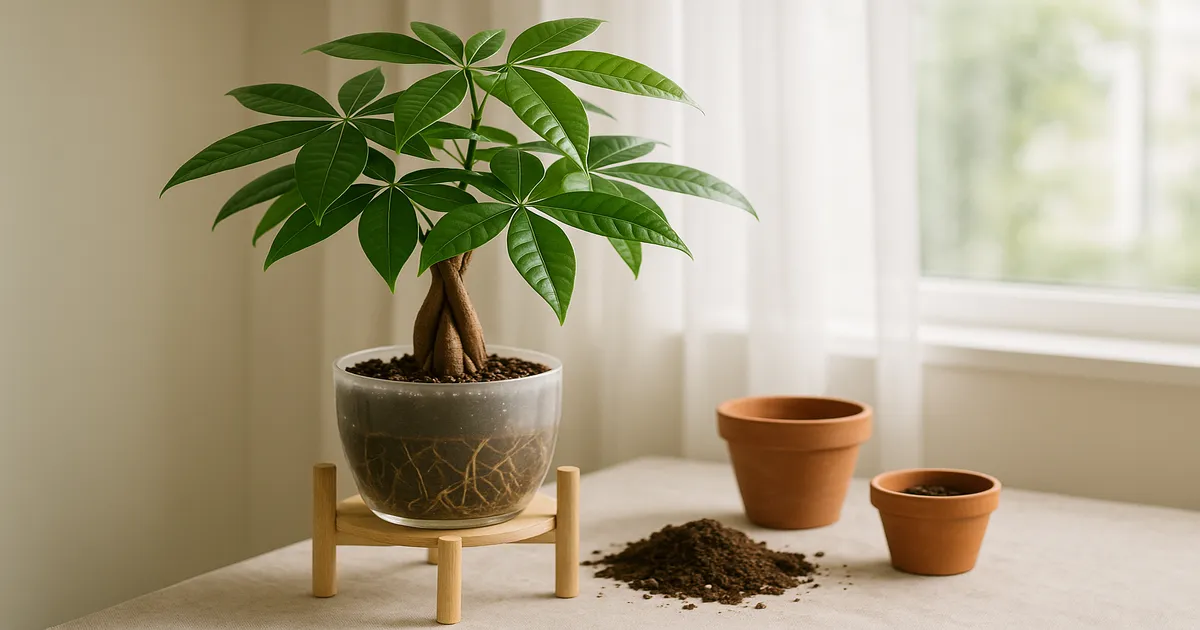
Quick Answer: Repot your money tree every 1–2 years, ideally between late February and April when the plant is entering its active growing season. Watch for roots escaping drainage holes, soil drying out within a day or two, or stunted growth as your cues to act sooner. Root rot or severe pest problems are emergencies — repot immediately, regardless of the time of year.
Money trees (Pachira aquatica) are vigorous growers, and knowing when to repot a money tree can mean the difference between a thriving statement plant and a slow, struggling one. The good news: the plant gives you plenty of signals before things go wrong. This guide covers timing, warning signs, and the exact steps for repotting — including tricky situations like root rot and braided trunks.
How Fast Does a Money Tree Outgrow Its Pot?
Pachira aquatica is a moderate-to-fast grower. Under good conditions — bright indirect light, consistent watering, and regular feeding — it can add 30–60 cm (12–24 inches) of height in a single growing season. For most owners keeping their money tree in a well-lit room with decent humidity, repotting every 1–2 years is a realistic expectation.
The root system is fibrous and spreads laterally before heading downward, filling pot volume quickly. Money tree roots are also thicker and fleshier than those of many tropical houseplants — they store water, a trait carried over from the plant’s native wetland habitat in Central and South America.
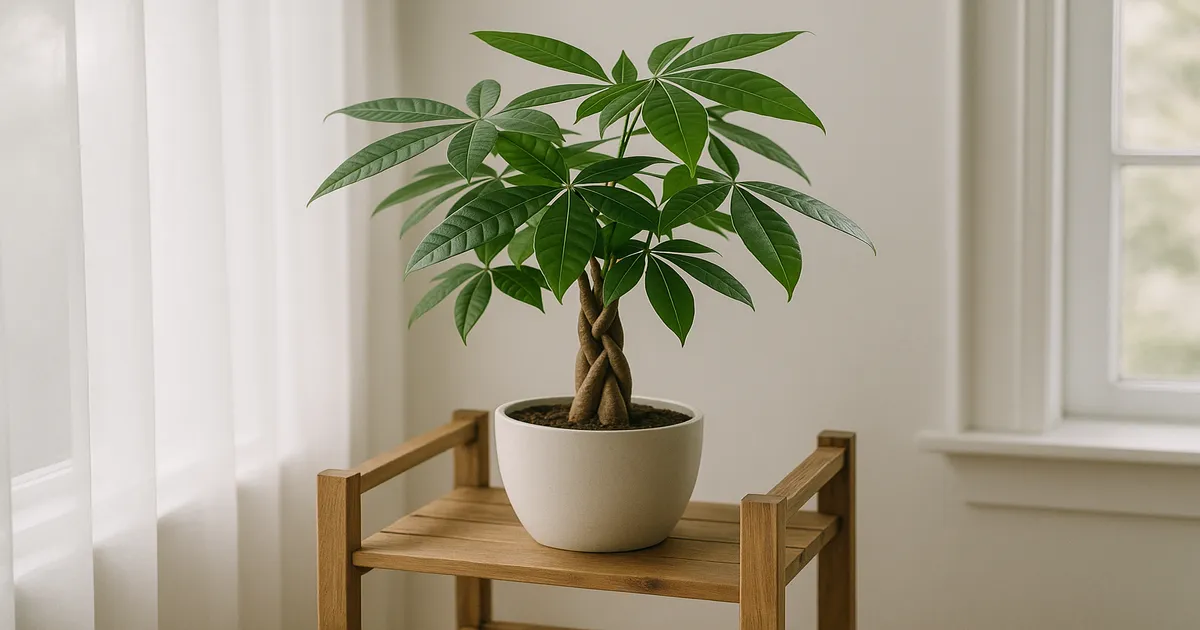
One thing worth knowing: the braided trunk you see in nurseries isn’t a single plant. It’s typically 3–7 individual seedlings twisted together while young. Multiple root systems sharing one pot means the soil fills up faster than you might expect. If your specimen is densely braided, plan for the shorter end of that 1–2 year window.
7 Signs Your Money Tree Needs Repotting Now
1. Roots Growing Out of Drainage Holes or Over the Soil Surface
This is the most obvious sign. Roots circling the soil surface or poking out of drainage holes mean the root ball has completely colonized the pot. Don’t wait until they’re visibly cracking the nursery container.
2. Soil Drying Out Unusually Fast
If the pot feels bone-dry within a day or two of watering, you’re likely dealing with channeling — water rushing straight through the root mass without hydrating the soil. The roots have displaced so much growing medium that almost nothing is left to retain moisture.
3. Stunted Growth Despite Good Light and Fertilizing
A money tree that has stalled — no new leaves, no fresh growth — when conditions seem right is often root-bound. Without room to expand, the root system can’t support new canopy growth, regardless of how much fertilizer you add.
4. Yellowing Lower Leaves
When the plant runs out of available nutrients in compacted soil, it pulls resources from older leaves first. Yellowing that progresses from the bottom up, without an obvious watering problem, points to a root-bound plant or depleted soil.
5. Water Pooling on the Surface or Draining Too Slowly
This is a soil degradation issue rather than a root-bound one — and it’s worth telling them apart. Organic potting mix breaks down over 18–24 months, losing the large air pockets that allow water to move freely. When puddles sit on the surface before slowly absorbing, the mix has essentially composted itself into a dense, poorly aerated slab.
6. White Crusty Deposits and Soil Odor
White crust on the soil surface or pot rim is mineral salt buildup from tap water and fertilizer. A musty or sour smell signals anaerobic zones where rot-causing pathogens like Pythium and Phytophthora thrive. Both signs mean the soil is exhausted and needs replacing.
7. Wilting Despite Moist Soil
This one is urgent. If your money tree is drooping but the soil is wet, the roots may have rotted to the point where they can no longer absorb water. Unpot the plant immediately and check: healthy roots are white to tan and firm; rotted roots are brown or black, mushy, and fall apart when touched. This requires emergency repotting regardless of the season.
When to Repot a Money Tree: Timing by Season
Why Late Winter to Early Spring Is Ideal
The best window for repotting is late February through April in the Northern Hemisphere (August–October in the Southern Hemisphere). As day length increases, Pachira aquatica exits its relative dormancy and root meristem activity picks up — the cells responsible for new root growth become more active in response to longer days. Repotting just as this surge begins gives roots immediate access to fresh nutrients and open pore space, setting the plant up for a strong growing season.
Can You Repot in Summer, Autumn, or Winter?
Summer repotting is possible but carries higher transplant stress risk. Heat accelerates moisture loss from both soil and leaves, and a plant managing root disturbance alongside heat stress has two problems at once. If you repot in summer, move the plant out of direct sun and keep humidity up for a few weeks.
Autumn and winter repotting should be avoided unless you’re dealing with an emergency. Root meristems are less active in low-light months, recovery is slower, and the risk of overwatering a freshly repotted plant in cool conditions rises sharply. If you spot root rot or a severe pest infestation in December, repot immediately — but for routine refreshes, hold off until spring.
Choosing the Right Pot and Soil Mix
What Size Pot Does a Money Tree Need?
Stick to the one-size-up rule: choose a pot 5–7 cm (2–3 inches) larger in diameter than the current one. A pot that’s too large holds excess moisture around the roots long after watering, creating the anaerobic conditions that cause rot. If you’re repotting after root rot and removed significant root mass, downsize the pot to match the remaining root volume.
Pot Material: Terracotta vs. Ceramic vs. Plastic
- Terracotta: Wicks moisture through its walls, lowering rot risk. Best for owners who tend to overwater or live in humid climates.
- Glazed ceramic or plastic: Retains moisture longer — useful if your home runs dry or you tend to forget waterings, but requires more careful watering discipline.
- Non-negotiable: At least one drainage hole.
Best Soil Mix for Pachira Aquatica
Pre-mixed “tropical” potting soils are rarely ideal for money trees long-term. A DIY blend gives you far better control:
- 40% peat-based or coco coir potting mix
- 25% perlite
- 20% coarse horticultural sand or pumice
- 15% orchid bark or wood chips
Target a soil pH of 6.0–7.0. To test drainage, pour water through the dry mix: it should pass through in 30–60 seconds. If it pools or takes longer, add more perlite.
How to Repot a Money Tree: Step-by-Step
What You’ll Need
- New pot (correct size, with drainage)
- Fresh potting mix (see recipe above)
- Sterile pruning shears or scissors
- 70% isopropyl alcohol (for sterilizing tools)
- Gloves
- Watering can
Step-by-Step Instructions
- Water 24–48 hours before repotting. Moist roots are flexible; dry roots snap easily.
- Tip the pot sideways and ease the root ball out gently. If it’s stuck, run a butter knife around the inner edge.
- Inspect the roots. White to tan and firm = healthy. Brown, mushy, or foul-smelling = root rot (see below).
- Loosen the outer root mass with your fingers or a sterile chopstick. This encourages roots to grow outward into the new soil rather than continuing to circle.
- Prune dead or excessively long roots — anything dark, hollow, or extending more than a third of the root ball’s length.
- Add fresh mix to the bottom of the new pot so the root ball sits with the soil line about 2–3 cm below the pot rim.
- Center the plant, backfill with fresh mix, and firm gently — settled, not compacted.
- Water thoroughly until it drains freely from the bottom. This eliminates air pockets and gives roots their first contact with fresh medium.
- Move to bright indirect light (1,500–3,000 foot-candles) and keep it out of direct sun for 2–4 weeks while it recovers.
- Hold off on fertilizer for 4–6 weeks. Fresh mix already contains nutrients; feeding stressed roots risks chemical burn.
Special Note for Braided Money Trees
Never grab a braided trunk to pull the plant from its pot. The braid is held together by interlocked growth from multiple stems, and yanking can loosen or damage it permanently. Instead, tip the pot and support the entire root ball from below as you ease it out.
Repotting for Specific Problems
Root Rot
Act fast. Remove the plant, shake off all old soil, and rinse the roots under room-temperature water so you can see clearly what you’re working with. Cut every rotted root back to firm, healthy tissue, sterilizing your shears between cuts with 70% isopropyl alcohol.
Once pruned, soak the remaining roots in a dilute hydrogen peroxide solution (1 part 3% H₂O₂ to 3 parts water) for 5–10 minutes. This kills residual pathogens without harming healthy tissue. Repot into completely fresh, sterile medium — never reuse soil from an infected plant — and choose a pot sized to the remaining root volume. Water sparingly for the first 2–3 weeks.
Fungus Gnats or Root Mealybugs
For fungus gnats, discard all old soil and wash the roots clean. Repot in fresh sterile medium and add a 2–3 cm top dressing of coarse sand or perlite to deter egg-laying. Yellow sticky traps help monitor adult populations; a Bacillus thuringiensis israelensis (Bti) biological larvicide applied as a soil drench targets the larvae.
For root mealybugs, wash roots thoroughly and soak them in a 2% neem oil solution or insecticidal soap for 10–15 minutes before repotting in sterile mix. Severe infestations may warrant a systemic imidacloprid drench after repotting.
Exhausted or Salt-Damaged Soil
Test the old soil’s pH with a digital meter before you start. A reading below 6.0 calls for adding agricultural lime (5–10 grams per liter of new mix); above 7.5, use elemental sulfur or an acidifying fertilizer. Remove as much old medium as possible, rinse the roots, and repot into fresh, pre-moistened mix. Switching to filtered or rainwater going forward will slow future salt buildup considerably.
Keeping Your Money Tree Healthy Between Repottings
Simple Monitoring Routine
- Monthly: Lift the pot — if it feels surprisingly light right after watering, roots may be displacing most of the soil. Check drainage holes for emerging roots.
- Every 6 months: Probe the soil surface with a chopstick to feel for compaction; look for fungus gnat larvae (small white worms) near the surface.
- Annually: Run through the 7 signs listed above. If the plant hasn’t been repotted in 2 years, schedule it for the next spring window.
Watering and Fertilizing Habits That Extend Soil Life
Allow the top 2–4 cm of soil to dry between waterings — use the lift test to gauge moisture rather than a fixed schedule. Over-fertilizing is one of the fastest ways to shorten the interval between repottings: excess salts accumulate, raising the soil’s electrical conductivity (EC) to levels that damage roots. Fertilize at half the recommended dose during active growth, and skip it entirely in autumn and winter. A balanced liquid fertilizer applied monthly from spring through summer is plenty.
Root Pruning to Control Size
If you love your money tree at its current size but it’s outgrowing its pot, root pruning is the answer. Remove 20–30% of the outer root mass with sterile shears, then repot back into the same clean pot with fresh medium. This bonsai-inspired technique resets the clock without requiring a larger container — ideal for anyone working with limited space.
Frequently Asked Questions About Repotting Money Trees
How often should you repot a money tree?
Every 1–2 years under normal growing conditions. Fast-growing specimens in good light may need it annually; slower-growing plants in lower light can sometimes go the full 2 years. Watch for the signs rather than counting years — the plant’s behavior is a more reliable guide than any fixed schedule.
What happens if you don’t repot a money tree?
A severely root-bound money tree will stall out — stunted growth, yellowing leaves, and soil that dries out almost immediately after watering. Over time, degraded soil creates anaerobic conditions that invite root rot. The plant won’t die overnight, but chronic neglect of repotting steadily weakens it.
Should I water my money tree immediately after repotting?
Yes. Water thoroughly right after repotting until water drains freely from the bottom. This settles the soil, eliminates air pockets, and gives roots their first contact with fresh medium. After that initial soak, scale back slightly for the first 2–3 weeks while the plant adjusts — especially if roots were pruned.
Can repotting a money tree kill it?
Done correctly, repotting is very low risk. The danger comes from repotting at the wrong time (deep winter), choosing a pot that’s too large, or damaging roots carelessly. A plant with severe root rot is already stressed, so even careful repotting carries some risk — but leaving it in rotted soil guarantees decline. When in doubt, repot.
How do I know if my money tree is root bound?
The clearest signs are roots growing out of drainage holes or circling the soil surface, soil that dries out within a day or two of watering, and growth that has stalled despite good light and regular feeding. If you’re still unsure, gently tip the plant out of its pot — a root-bound plant will hold the shape of the container, with roots visibly wrapping the outside of the root ball.