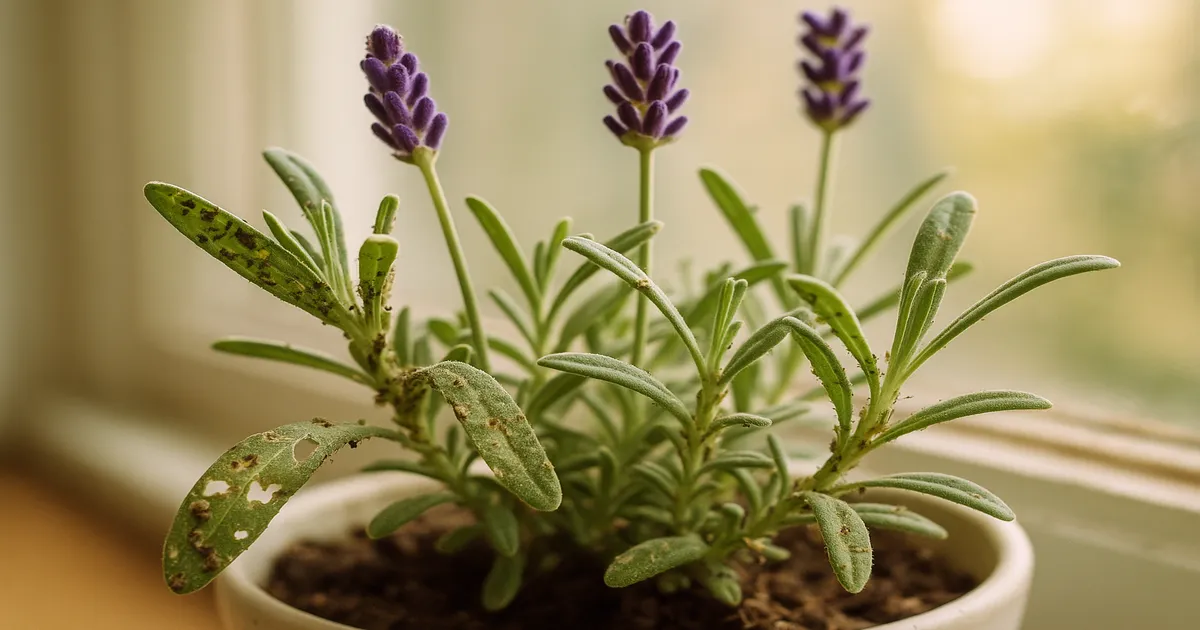
Quick Answer: The most common bugs on lavender are aphids, spittlebugs, whiteflies, spider mites, leafhoppers, thrips, scale insects, and caterpillars. Not every insect you spot is a pest — bees, hoverflies, and lacewings are all beneficial and should never be treated. Lavender’s aromatic oils offer some natural resistance, but stressed or indoor plants are still vulnerable. Correct identification before any treatment is essential.
What Are Those Bugs on My Lavender?
If you’ve noticed something crawling, clustering, or leaving sticky residue on your lavender, you’re likely dealing with one of a handful of common culprits: aphids, spittlebugs, whiteflies, spider mites, leafhoppers, thrips, scale insects, or caterpillars. Each one leaves a different calling card, and telling them apart matters before you do anything else.
Lavender is also one of the best pollinator plants you can grow, so it naturally attracts a lot of good insects too. Bees are obvious, but hoverflies and lacewings are just as important — and are often mistaken for pests. Before you reach for any spray, it’s worth knowing exactly what you’re looking at.
Lavender’s essential oils deter some pests, but that protection has real limits, especially for plants grown indoors, in containers, or under stress. This guide walks you through every common bug, how to tell them apart, and what to do about the ones that actually need treating.
Why Some Lavender Plants Get More Bugs Than Others
Lavender produces linalool and linalyl acetate — volatile compounds that repel many insects. This is why it’s often recommended as a companion plant. But “deterrent” is not the same as “immune.” Over-fertilised plants, waterlogged roots, and lavender grown in low light all become significantly more attractive to pests. A stressed plant produces less of the protective oils and more of the soft, sugary growth that pests crave.
Species and variety matter too. Lavandula angustifolia (English lavender) is the most resilient — compact, cold-hardy, and high in aromatic oils. Lavandula dentata (fringed lavender) and Lavandula stoechas (French lavender) are more susceptible, partly because their broader leaves retain more moisture and partly because they’re more often grown in unsuitable conditions. Lavandin hybrids like ‘Grosso’ sit somewhere in between.
Growing lavender indoors or in pots raises the pest risk further. Reduced airflow, lower light, and higher humidity are the exact opposite of the Mediterranean conditions lavender evolved in. Ideal conditions — full sun, well-draining soil at pH 6.5–7.5, and humidity around 40–50% — produce a tough, aromatic plant. Deprive it of those, and pests find it much easier to exploit.
How to Identify the Bugs on Your Lavender
Getting the identification right before you treat is genuinely important. Lavender’s volatile oils can interact with certain chemical pesticides to cause leaf burn (phytotoxicity), and some damage patterns — like stippling — look similar across several pests that require completely different responses.
Aphids: Sticky Residue and Clustered Soft-Bodied Insects
Aphids are small (1–3 mm), pear-shaped, and soft-bodied, appearing in shades of green, black, grey, or waxy white depending on species. They cluster densely on new growth and flower stems, tapping into the plant’s phloem with needle-like mouthparts. The most reliable signs are sticky honeydew residue, black sooty mould growing on top of it, and curled or distorted new shoots. Populations can explode from a handful to thousands within days, especially in spring.
Spittlebugs: White Foam Blobs on Stems
These are hard to miss — small blobs of white frothy foam clinging to stems at the leaf joints. Inside each blob is a froghopper nymph, which creates the foam to regulate its own temperature and humidity while feeding on xylem fluid. Adults (5–7 mm, brown, jumping) are less conspicuous. Damage to healthy established plants is usually mild, but heavy infestations on young plants can cause stunting.
Whiteflies: Clouds of Tiny White Insects
Whiteflies are tiny (1–2 mm), white, and moth-like — disturb the plant and they erupt in a cloud. Check leaf undersides for scale-like nymphs and eggs. They cause yellowing, honeydew, sooty mould, and general decline. Whiteflies are primarily a problem on indoor or greenhouse lavender, especially L. dentata in humid, still-air rooms. Bemisia tabaci can also transmit plant viruses, making early control important.
Spider Mites: Fine Webbing and Stippled, Bronzed Foliage
Spider mites (0.3–0.5 mm) are barely visible to the naked eye, but their damage is unmistakable: fine silk webbing on stems and leaf undersides, combined with stippled, bronze, or silvery discolouration across the foliage. They’re arachnids rather than insects and thrive in hot, dry conditions above 80°F (27°C) — ironically, the kind of conditions that arise when lavender sits near a heating vent indoors. Populations can double every three to five days.
Leafhoppers: Pale Stippling and Shed Skins
Leafhoppers (3–4 mm, pale yellow-green, wedge-shaped) jump when disturbed. Their feeding creates a distinctive pale stippled “ghosting” pattern on the upper leaf surface, different from the more uniform bronzing caused by spider mites. White shed skins (exuviae) on leaf undersides are a telltale sign. Eupteryx melissae specifically targets aromatic herbs including lavender and produces multiple generations per year in warm climates.
Thrips: Silver Streaking and Black Frass on Flowers
Thrips (1–2 mm, slender, fringed wings) are difficult to spot without a hand lens. The easiest method is tapping flower spikes over a sheet of white paper. Look for silver-grey streaking or scarring on leaves and petals, distorted or discoloured flowers, and tiny black fecal specks (frass). They’re drawn specifically to lavender flowers, feeding inside buds and on pollen. Frankliniella occidentalis can also transmit Tomato Spotted Wilt Virus.
Scale Insects: Brown Waxy Bumps on Woody Stems
Scale insects look more like part of the plant than a pest — small (1–5 mm), brown or tan, waxy bumps attached firmly to woody stems. They’re easy to overlook for months. Yellowing stems, wilting growth, and honeydew (from soft scales) or direct stem dieback (from armoured scales) are the main signs. They’re most common on stressed, woody, or pot-bound lavender that hasn’t been pruned regularly.
Caterpillars and Cutworms: Chewed Leaves and Severed Stems
Ragged chewed edges on leaves suggest caterpillars. Stems severed cleanly at the base overnight are the signature of cutworms, which hide in the soil by day. Cutworms are fat, grey-brown, and curl up when disturbed. Dense, unpruned lavender provides ideal shelter for larvae, and young transplants are most at risk.
Beneficial Insects on Lavender: What Not to Treat
Bees on lavender flowers are never pests. Any treatment that harms bees should be a genuine last resort, with strict timing to avoid flowering periods.
Hoverfly adults look like small wasps or bees and feed on nectar — harmless to your plant. Their larvae, however, are voracious aphid predators. Lacewings (delicate, green-winged) have larvae nicknamed “aphid lions” for good reason. Parasitic wasps are tiny and dark; if you spot swollen, tan, mummified aphids on your plant, that’s evidence they’re already at work. Leave them alone.
The key questions when you spot an unfamiliar insect: Is there visible plant damage nearby? Is the insect on the flowers (likely a pollinator or predator) or clustered on stems and new growth (likely a pest)? Beneficials tend to move purposefully; pest colonies stay put. When in doubt, wait and watch before treating — broad-spectrum pesticides eliminate natural allies along with pests, often making infestations worse long-term.
How to Get Rid of Bugs on Lavender
Aphids
Start with the simplest fix: a strong blast of water dislodges 80–90% of aphids immediately. Repeat every two to three days. If colonies persist, apply insecticidal soap (2–3% potassium-based solution) directly onto colonies, covering stems and leaf undersides thoroughly, and reapply every 5–7 days for two to three cycles . Neem oil (0.5–1% cold-pressed solution with an emulsifier) applied in early morning or evening disrupts aphid feeding and reproduction without the phytotoxicity risk of midday application . Also switch to a low-nitrogen fertiliser (5-10-10 or 4-8-12 NPK) to reduce the soft new growth that attracts aphids in the first place.
Spittlebugs
Wipe or wash off the foam masses with a gloved hand or a water spray. Without its protective foam, the nymph cannot survive. For healthy established plants, that’s usually all you need. Heavy infestations on young plants can be treated with insecticidal soap or pyrethrin, but the spray must make direct contact with the nymph inside the foam.
Whiteflies
Place yellow sticky traps near the plant to catch adults and monitor population levels . Apply insecticidal soap or neem oil to leaf undersides every 5–7 days for three to four cycles — you need to break the full egg-to-adult life cycle, which takes around three to four weeks at room temperature. Rotate with spinosad spray to prevent resistance, applying in the evening to protect pollinators . Also bring humidity down to 40–50%, add a small fan for airflow, and move the plant to the brightest available spot.
Spider Mites
Raising humidity to 45–55% alone can suppress mite populations significantly — try relocating the plant away from heating vents. Blast leaf undersides with water every two to three days to physically remove mites and eggs. For persistent infestations, neem oil or insecticidal soap with thorough coverage of leaf undersides is effective; neem also kills eggs. Predatory mites such as Phytoseiulus persimilis are highly effective for indoor plants and greenhouses and won’t harm lavender or beneficial insects .
Leafhoppers
For outdoor plants, fine insect mesh (mesh size ≤0.8 mm) provides a physical barrier. Kaolin clay sprayed onto plant surfaces creates a mineral film that deters feeding and egg-laying; reapply after rain. For direct treatment, insecticidal soap or pyrethrin applied in early morning — when leafhoppers are less active — gives the best contact results.
Thrips
Blue sticky traps are more effective for thrips than yellow ones. Remove and bag heavily infested flower spikes — don’t compost them, as thrips will simply spread. Spinosad spray applied in the evening is the most effective organic treatment. For ongoing indoor control, introduce Amblyseius cucumeris predatory mites.
Scale Insects
For light infestations, a cotton swab dipped in 70% isopropyl alcohol scrubbed directly onto scale bumps is surprisingly effective. For larger infestations, horticultural oil smothers insects by blocking their breathing pores; apply thoroughly to all woody stems . Repot pot-bound plants and prune out the most heavily affected woody sections before treating.
Caterpillars and Cutworms
Hand-pick caterpillars in the evening when they’re most active. For cutworms, place a physical collar — a cut toilet-paper tube works well — around the base of young transplants to prevent stem-severing. Bacillus thuringiensis (Bt) applied to foliage is a safe, targeted biological control that kills caterpillar larvae without affecting beneficial insects.
Prevention: How to Stop Bugs Coming Back
A healthy, well-sited lavender is the single best pest deterrent. Outdoors, that means full sun, lean and fast-draining soil at pH 6.5–7.5, and good airflow. Indoors, it means bright direct light (3,000–5,000 foot-candles minimum), humidity held at 40–50%, and temperatures between 60–85°F (15–29°C).
Prune lavender back by one-third after flowering every year. This opens up the canopy, improves airflow, removes the dense woody shelter that pests hide in, and stimulates fresh aromatic growth. Neglected, overgrown lavender is dramatically more pest-prone than a regularly pruned plant.
For container lavender, use a fast-draining mix with 30–40% perlite by volume and avoid high-nitrogen fertilisers — they produce the soft, succulent growth that aphids, thrips, and whiteflies find irresistible. Any new plant should be isolated for two to three weeks before placing it near existing plants, especially indoors where whiteflies and spider mites spread rapidly between pots.
Finally, planting lavender alongside other aromatic herbs (rosemary, thyme, sage) and nectar-rich flowers (yarrow, fennel, sweet alyssum) creates a garden ecosystem that attracts and sustains beneficial insects year-round. A quick look at stems and leaf undersides every week or two means you catch problems when they’re a handful of aphids, not a colony of thousands.
Frequently Asked Questions About Bugs on Lavender
What are those bugs on my lavender, and are they harmful?
It depends entirely on which insects you’re seeing. Bees, hoverflies, and lacewings are beneficial and should never be treated. Aphids, spider mites, whiteflies, thrips, scale insects, leafhoppers, spittlebugs, and caterpillars are the common pests. Check for visible plant damage — sticky residue, stippling, webbing, or chewed leaves — to confirm you’re dealing with a pest before treating.
Why does my lavender keep getting aphids?
Aphids are drawn to soft, nitrogen-rich new growth. The most common cause is over-fertilising with a high-nitrogen feed. Switch to a low-nitrogen fertiliser (5-10-10 NPK), ensure the plant gets full sun, and prune regularly to reduce the dense new growth that aphid colonies exploit. Natural predators like lacewings and parasitic wasps will also help keep populations in check if you avoid broad-spectrum pesticides.
Can I use neem oil on lavender without damaging it?
Yes, but timing matters. Apply neem oil (0.5–1% solution with an emulsifier) in early morning or evening — never in direct midday sun or temperatures above 90°F (32°C). Lavender’s volatile oils can interact with oil-based sprays to cause leaf burn if applied in heat. Always test on a small area first and allow 48 hours before treating the whole plant.
Are spittlebugs on lavender serious?
Rarely. Spittlebugs are more alarming-looking than they are damaging. On healthy, established lavender, simply washing off the foam masses is enough — without its protective foam, the nymph dies quickly. Only heavy infestations on young or newly transplanted lavender warrant insecticidal soap treatment.
Why is my indoor lavender getting so many pests?
Indoor lavender faces compounding challenges: lower light reduces the plant’s protective oil production, poor airflow creates stagnant conditions where whiteflies and spider mites thrive, and indoor humidity is often either too high or too low. Place the plant in the brightest available window, run a small fan nearby, keep humidity at 40–50%, and inspect stems and leaf undersides every one to two weeks. Lavandula angustifolia and compact lavandin hybrids are the best choices for indoor growing — they’re more resilient and more aromatic than L. dentata or L. stoechas.